From Switchboard to Hybrid: How the Business Phone System Got Here
The hybrid phone system is usually described as a modern compromise — a bit of cloud, a bit of on-premises, a sensible middle path invented sometime around the pandemic. That is not quite how it happened. Hybrid is one of the oldest ideas in business telephony, and it has been reinvented at least three times, each time for a different reason.
Knowing which reinvention you are being sold matters, because the version most vendors were selling in 2005 was designed to protect their revenue, and the version available now is designed to protect your uptime. Same word, very different product.
The Original PBX Was a Person
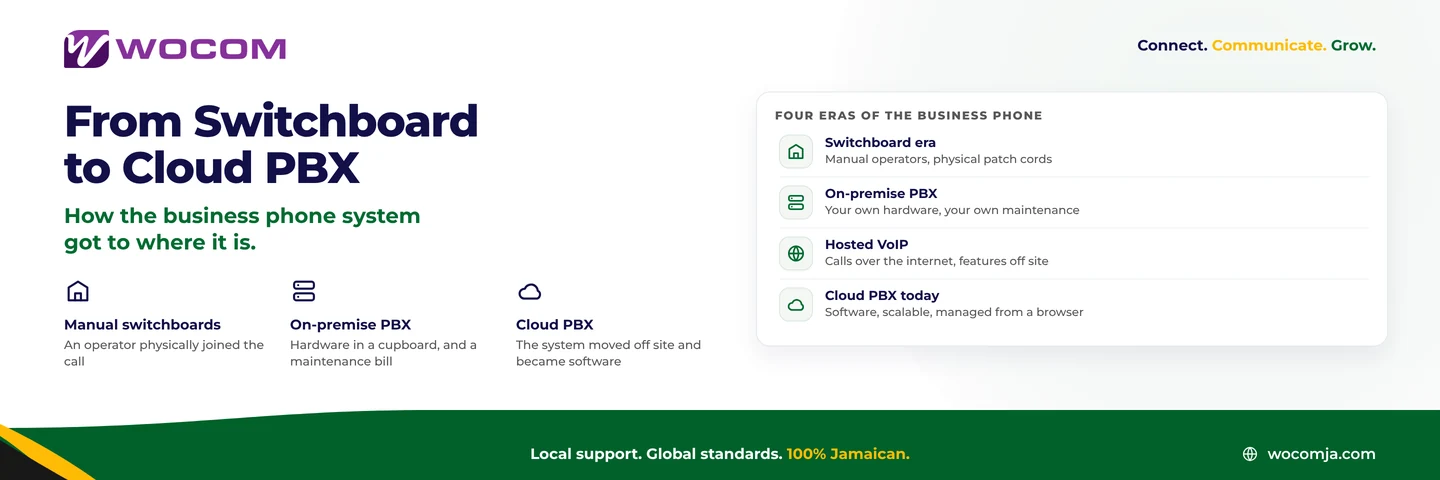
The letters stand for Private Branch Exchange, and for the first several decades of its existence the exchange really was a branch of the public network sitting inside your building — with a human operating it. A switchboard operator sat at a cord board, took an incoming call, and physically patched it into the jack for the extension the caller wanted. Internal calls between two extensions never touched the public network, which is the fundamental idea that has survived every technology change since.
The economics were simple and brutal: external lines were scarce and expensive, so a business bought a handful of them and shared them across many internal phones. That ratio — many extensions, few outside lines — is still the arithmetic behind every trunk and channel decision made today.
By the middle of the twentieth century the operator was being automated away. The private automatic branch exchange let a caller dial an extension directly, and by the 1960s and 1970s the key system had put a row of illuminated line buttons on every desk. The switchboard operator did not disappear so much as get distributed across the whole office.
Jamaica's Version of That History Was Shorter on Lines
The technology arrived in Jamaica on roughly the international schedule. The supply did not.
For a business in Kingston in the decades after Independence, the constraint was never which PBX to buy — it was whether you could get lines at all. Telephone service ran through a single monopoly provider, capacity was limited to where copper had been laid, and a new business line was something you applied for and waited on. Where the network did not reach, no amount of money produced service. A PBX in that environment was not a convenience feature; it was how you made four precious external lines serve thirty desks.
That scarcity shaped a generation of Jamaican business habits that persist today: treating the phone system as capital infrastructure to be maintained for fifteen years rather than a service to be switched, and a strong institutional attachment to a working number, because getting one had been so difficult.
The Digital PBX and the Capital Model
From the mid-1970s the PBX became a computer. Stored-program control meant the call routing was software running on a proprietary processor in a cabinet, and features that had required an operator's judgement — hunt groups, call forwarding, pickup groups, night service — became configuration.
This is the era that set the commercial pattern the industry is still unwinding. A digital PBX was a large capital purchase, tied to one manufacturer, installed and maintained by a certified dealer, with proprietary handsets that only worked with that system. You did not buy telephony; you bought a platform and then bought everything else from the same place. Systems were specified to last a decade or more because they cost like they should.
Trunks evolved alongside it. Analog lines gave way to digital circuits, and by the 1990s a serious business connection meant a T1 carrying twenty-three simultaneous calls into the building on a single delivery. It was better, but it was still a fixed pipe of a fixed size, ordered months ahead and priced accordingly.
Then the Call Became Data
The technical shift arrived in the mid-1990s and took roughly fifteen years to finish arriving.
Software that carried a voice conversation over an internet connection appeared commercially in 1995. The ITU published H.323 in 1996 as the first serious attempt at a standard for it. But the protocol that actually won was SIP — the Session Initiation Protocol — first published by the IETF in 1999 and revised into its lasting form as RFC 3261 in 2002. SIP's advantage was that it was simple, text-based and did not care what was at either end, which meant anyone could implement it.
In 1999 an open-source telephone system called Asterisk demonstrated the consequence: the PBX was now just software, and it would run on ordinary computer hardware. The proprietary cabinet had been the product. Once the product could be downloaded, the business model underneath the whole industry was on notice.
Jamaica's regulatory environment changed on almost exactly the same timeline. The Telecommunications Act of 2000 ended the exclusive monopoly, established the Office of Utilities Regulation as the sector regulator, and created a licensing framework that separated carriers who own and operate infrastructure from service providers who resell it. Competition arrived over the following three years, and for the first time a Jamaican business could choose who carried its calls.
Hybrid, Version One: A Defensive Move
Here is where the word first appears in earnest, and it is worth being blunt about why.
By the early 2000s every major PBX manufacturer had a large installed base of expensive digital systems and a new technology that made those systems look obsolete. Telling customers to throw away a six-figure investment was not a winning sales conversation. So the vendors built IP cards for the existing cabinets. Your TDM PBX could now speak IP alongside its traditional circuits, and the industry called this a hybrid PBX.
It genuinely worked, and it genuinely helped customers stage the transition. But it is important to be clear about what that first hybrid generation was for: it existed to protect an installed base. The cloud did not feature, because there was no cloud. Hybrid meant one box that spoke two languages.
Hybrid, Version Two: The Lines Changed, the Box Stayed
The second reinvention came from the trunk side, through the second half of the 2000s and into the 2010s.
SIP trunking let a business keep its existing on-site PBX exactly as it was and replace only the expensive fixed circuits feeding it. The saving was immediate and required no change on any desk. Capacity became elastic — channels could be added for a season and removed afterwards, which mattered enormously in a tourism economy where call volume in February bears no relationship to call volume in September.
This version of hybrid was not defensive. It was the first one that was straightforwardly good for the buyer, and it remains the single most common entry point into hybrid today: leave the system alone, change the lines, take the saving.
Hybrid, Version Three: The System Moves Out, the Wiring Stays
Through the 2010s the PBX itself moved off the premises. Hosted and cloud phone systems turned the platform into a subscription, and unified communications folded voice, video, messaging and presence into one service. Capital expenditure became operating expenditure, and the ten-year replacement cycle became a monthly bill.
For a while the industry framed this as an endgame: everything would go to the cloud, on-site equipment would disappear, and hybrid would be a transitional artefact that faded out. That is not what happened, for two reasons that turned out to be durable.
The first is physical. Some things are wired, and wiring does not virtualise. Overhead paging in a warehouse, an intercom at a gate, in-room handsets in a hotel, an emergency line in a lift, a door entry panel — all of these terminate on copper somewhere in a building, and the app on your phone cannot replace the amplifier in the ceiling.
The second is connectivity. A fully cloud-hosted system makes every call, including the one from reception to the back office, dependent on the building's internet link. In a market where a single fixed broadband service per site is still the norm, that concentrates a lot of operational risk on one cable.
So the third hybrid generation inverted the original logic. The cloud is the primary system, holding the features, the reporting, the multi-site dial plan and the automated answering. The on-site equipment is kept deliberately, for exactly two jobs: terminating what is physically wired, and keeping the building talking to itself when the outside link fails. It is no longer a compromise between old and new. It is an architectural choice about where risk should sit.
The Pattern Underneath All of It
Read the whole arc and the same movement repeats. The intelligence keeps moving further from the building — from the operator's cord board to the cabinet in the closet, from the cabinet to a server, from the server to the cloud — while the physical layer stubbornly stays put. Every generation, someone predicts the wire is finished. Every generation, the wire outlives the prediction, because a gate phone is a gate phone.
Hybrid is simply the name for admitting both halves of that at once. And the reason it keeps being reinvented is that each generation has had to rediscover, at its own expense, that the last mile inside your own building is a real place with real constraints.
What has changed is who is on the hook for making the two halves work together. In version one it was your PBX dealer. In version two it was split between your dealer and whoever sold you trunks. In version three it can be one licensed provider that owns the network, the trunk and the cloud platform — which is how WOCOM builds a hybrid phone service today.
FAQ
When did hybrid phone systems first appear?
In the early 2000s, when PBX manufacturers added IP capability to their existing digital systems so customers could adopt voice over IP without replacing hardware. That first generation was about protecting an installed base. The modern meaning — an on-site system deliberately kept alongside a cloud platform — developed much later, once hosted phone systems became mainstream in the 2010s.
What does PBX actually stand for?
Private Branch Exchange. It describes a private telephone exchange operating inside an organisation, connected to the public network by a limited number of shared outside lines. Originally the exchange was operated by a human switchboard operator patching calls by hand; automation replaced the operator, and software eventually replaced the switch.
Why did SIP become the standard for voice over IP?
SIP was published by the IETF in 1999 and revised as RFC 3261 in 2002. It won over earlier standards largely because it was simple, text-based and independent of what sat at either end, which made it easy to implement and easy to interconnect. That openness is why a phone, a PBX and a carrier network from three different vendors can hold a call together today.
How did telecommunications liberalisation change business phones in Jamaica?
The Telecommunications Act of 2000 ended the exclusive monopoly and established the Office of Utilities Regulation as the sector regulator, with a licensing framework distinguishing carriers that own and operate infrastructure from service providers that resell it. Competition phased in over the following years, which is what made it possible for a Jamaican business to choose its provider — and later, with number portability, to change providers while keeping its number.
Is hybrid a transitional technology that will eventually disappear?
It was predicted to be, and it has not been. Two things keep it alive: physical devices such as paging, intercoms, lift lines and in-room handsets that terminate on wiring inside a building, and the risk of making every internal call depend on a single internet connection. For businesses with either of those characteristics, hybrid is a permanent architecture rather than a waypoint.
Where Your System Sits on That Line
Most Jamaican businesses are somewhere in the middle of this history — a digital PBX from the capital era, trunks that were modernised at some point, and a growing list of things the cloud does that the box in the closet cannot.
WOCOM is a licensed Jamaican carrier operating its own voice network, and we will tell you plainly where your system sits and what the next sensible step is. Call 876-906-7240 or visit wocomja.com/contact.
Continue exploring
Ready to upgrade your communications?
Talk to our team about the right solution for your business.
Book a Demo Contact SalesMichelle Goss is a data and AI analyst at WOCOM, where she studies how Jamaican businesses use voice, messaging and AI to win and keep customers. With a BSc in Data Science & Analytics, she turns call data, customer trends and AI receptionist performance into practical guidance owners can act on. Michelle writes WOCOM's coverage of AI call handling, call analytics, customer growth and industry trends.