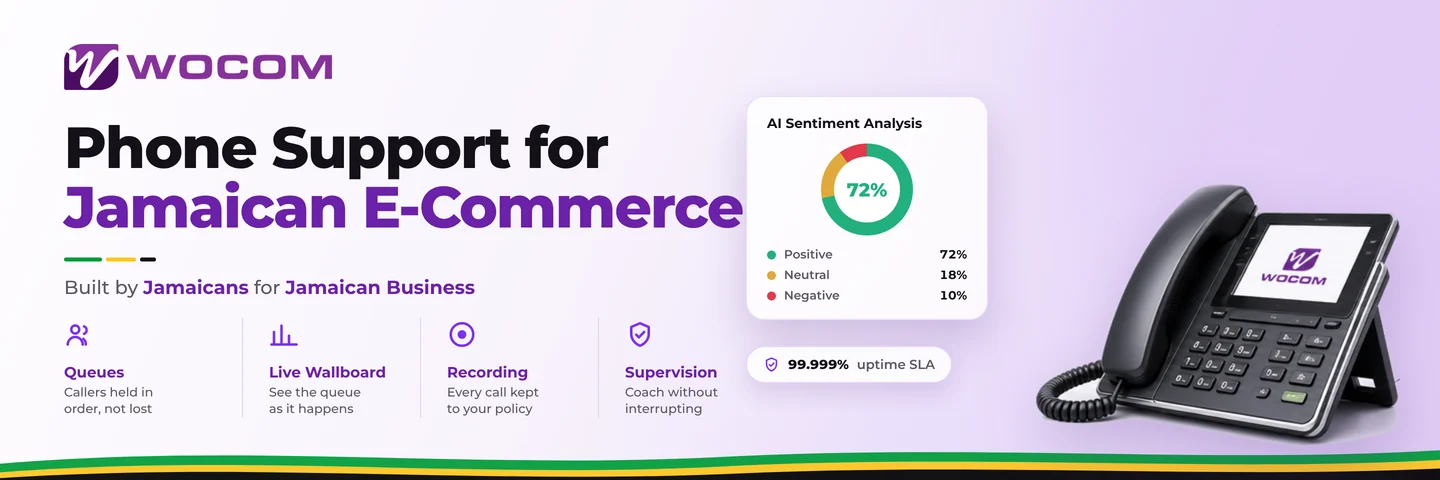
Phone Support for Jamaican E-Commerce: Put Calls in the Same Inbox as Chat and Email
Ask a Jamaican online seller where customer questions arrive and the answer is rarely one place. WhatsApp, Instagram DMs, Facebook comments, email, and the phone number on the website — five channels, often handled by two or three people, with no shared view of any of it.
The result is familiar. A customer messages on Instagram, gets no reply within the hour, then calls. The person answering the phone has no idea about the message, asks for the order number again, and the customer repeats themselves. It is not poor service exactly; it is service without memory.
What a Helpdesk Integration Changes
Helpdesk platforms like Gorgias exist to merge those channels into a single ticket per customer. Most sellers connect the messaging channels and stop there, leaving the phone outside the system — which is odd, because the phone carries the highest-intent contacts. A customer who takes the trouble to ring is usually closer to buying, or closer to complaining, than one who sends a DM.
Connecting the phone line into the helpdesk means:
- Calls appear as tickets, in the same queue and the same customer timeline as their chat and email history.
- The agent sees the order before answering — what was bought, when it shipped, whether there is an open refund.
- Missed calls become tickets too, so an unanswered call is a piece of work rather than a line in a call log nobody reads.
- One customer, one thread, no matter how many ways they reached out.
Why This Matters More for Jamaican Sellers
Two local realities make the phone unusually important here.
Delivery is a conversation. In a market where a courier may call to confirm a landmark rather than an address, and where “is it in stock” is answered honestly only by a person, phone contact is not a legacy channel. It is often the deciding one.
Trust is verified by voice. Plenty of Jamaican shoppers will not send money to an online store without speaking to a human first. If that call goes unanswered, the sale does not happen and no analytics dashboard ever records why. This is the same dynamic covered in why WhatsApp alone is not enough.
The Setup, Honestly Described
There are two workable arrangements, and the right one depends on volume.
Small team, moderate volume: a WOCOM business number on a Cloud PBX, with the AI receptionist answering first, capturing the caller’s name, order number and reason, and delivering that as a structured message. It reaches the helpdesk as a ticket without anyone having to be at a desk. For a two-person operation this is usually enough, and it is the setup described in the AI receptionist setup guide.
Larger team, real call volume: a Contact Center queue with agents logged in, integrated so that call events and recordings attach to helpdesk tickets. Agents work from one screen rather than alt-tabbing between a softphone and a browser.
Where a direct connector is not available for your particular helpdesk, Programmable SIP can post call events into it via API — which covers most platforms, including ones built in-house. The Gorgias setup guide has the specifics for that platform.
What to Measure Once It Is Connected
The point of unifying channels is not tidiness; it is that certain numbers become visible for the first time.
- How many calls go unanswered during business hours. Most sellers guess low. The real figure is usually a surprise — see how missed calls get classified.
- How often the same customer uses more than one channel for the same issue. High numbers mean the first channel is too slow.
- Which questions repeat. The top three phone questions almost always belong on the website or in the AI receptionist’s knowledge base instead.
- Time to first response by channel. Phone is instant or it is nothing; there is no queue a customer will wait in the way they will wait for an email reply.
The Thing Most Sellers Get Wrong
Putting a mobile number on the website and calling it customer support. It works while volume is low, then quietly fails: calls arrive while the owner is driving, packing orders, or asleep, and there is no record that they happened at all. Nothing on the site tells the seller how much business that costs, which is precisely why it goes unaddressed for so long.
A business number with proper answering, logged into the same system as everything else, is the fix — and it is a small monthly cost against the value of the orders it recovers.
To connect phone support into your helpdesk, call WOCOM on 876-326-1212, message us on WhatsApp, or start from the Contact Center page.
Continue exploring
Ready to upgrade your communications?
Talk to our team about the right solution for your business.
Book a Demo Contact SalesEverett Kildare is WOCOM's voice and infrastructure specialist, with more than 25 years of experience designing and running carrier-grade voice, SIP and virtualization infrastructure. Holding a BSc in Information Technology, he has built, secured and migrated phone systems for businesses of every size. Everett writes WOCOM's technical coverage of SIP trunking, cloud PBX, contact centres, business continuity and migration.