First Call Resolution Jamaica: Why Your Contact Centre's Most Important Metric Isn't Being Tracked
The Metric Most Jamaica Contact Centres Get Wrong
If you manage a contact centre in Jamaica, you probably track how quickly calls are answered, how long agents spend on each call, and how many calls are abandoned before someone picks up. These numbers matter. But there is one metric that outranks all of them for predicting customer loyalty — and most local operations either measure it incorrectly or ignore it entirely.
First Call Resolution (FCR) is the percentage of customer contacts where the issue is fully resolved during the first interaction, with no callback, no escalation, and no follow-up required. Research across industries consistently shows that FCR is the single strongest predictor of customer satisfaction scores and churn rates — from Kingston's BPO parks to utility companies in Montego Bay to financial services call centres across the island.
A 1% improvement in FCR typically produces a 1% improvement in customer satisfaction. A 1% drop in FCR tends to increase overall call volume by roughly 5%, because every unresolved issue generates at least one follow-up contact. If your contact centre handles 500 calls a day, a 10% unresolved rate means 50 customers calling back — often frustrated and less patient the second time around.
Why Your FCR Rate Is Probably Lower Than You Think
Many Jamaica businesses estimate their FCR by asking agents at wrap-up whether the issue was resolved. That is self-reported FCR, and it consistently overstates the real number by 15–25%. Agents tend to mark calls resolved to keep their personal metrics clean. The customer who calls back two days later to escalate the same issue often lands on a different agent — and that callback never gets linked to the original contact.
True FCR requires matching repeat contacts. The process looks like this:
- Tag every incoming call with a customer identifier — phone number, account number, or national ID
- Flag any contact from the same identifier within a defined window, typically 5 to 7 business days, as a repeat contact
- Exclude planned callbacks, outbound follow-ups the agent explicitly promised, and contacts about unrelated issues
- Divide first-time-resolved contacts by total contacts to calculate your actual FCR rate
Without call tagging and repeat-contact tracking built into your platform, you are flying blind. Most cloud contact centre systems — including WOCOM's — give supervisors the data required to run this calculation. If you cannot pull a repeat-contact report from your current system right now, that is the first gap to close.
Five Reasons FCR Drops (and What to Do About Each One)
Before you can improve FCR, you need to know why calls are failing to resolve in the first place. These are the five most common causes seen in Jamaican contact centre environments:
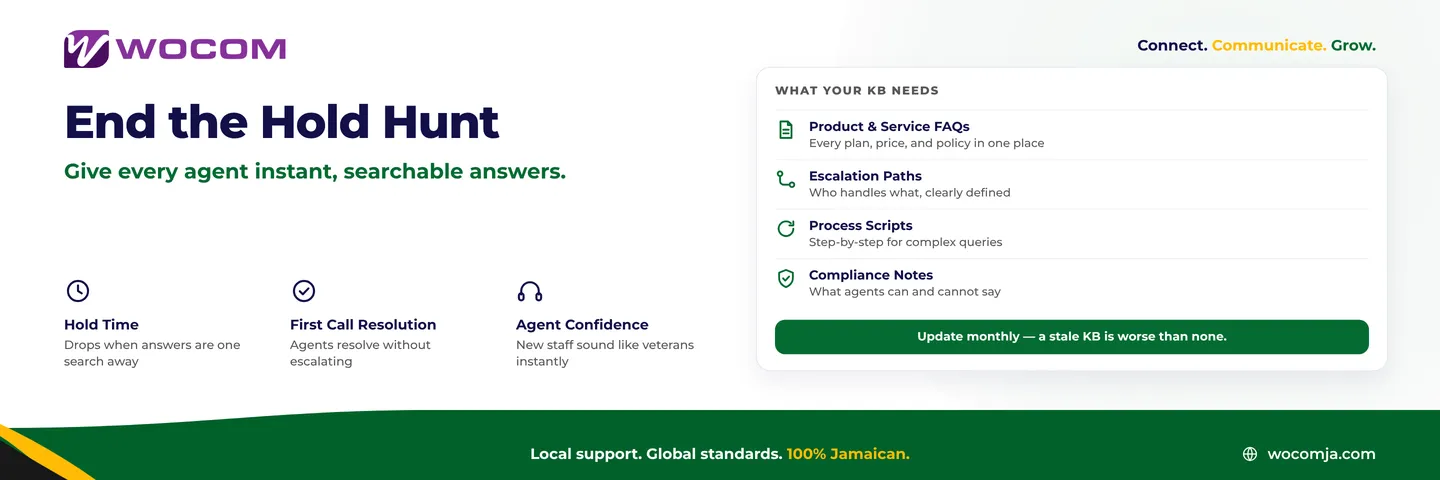
1. Agents lack access to the right information. When a customer asks a question the agent cannot answer without escalating, the call ends unresolved. The fix is a searchable internal knowledge base — a shared resource where agents can look up procedures, pricing, and policies mid-call without putting the customer on hold for several minutes.
2. The issue genuinely requires another department. Transfers are not always avoidable, but they break FCR when the receiving agent is unprepared. Warm transfers — where the first agent briefs the second before handing off — dramatically improve resolution rates compared to cold transfers where the customer must explain their situation all over again.
3. The IVR is routing calls to the wrong team. If customers calling about billing are reaching technical support, every misrouted call starts with a transfer — and many end unresolved. Review your IVR menu options quarterly against actual call volume by reason. If 40% of calls are billing queries but billing only receives 25% of IVR traffic, the routing is misaligned and your FCR is suffering for it.
4. Agents are not empowered to resolve. Policies that require supervisor approval for common situations — refunds under a certain amount, payment extensions, simple account changes — force escalations that shatter FCR. Identify your ten most common escalation triggers and ask honestly whether agents could handle them with clearer guidelines and appropriate authority levels.
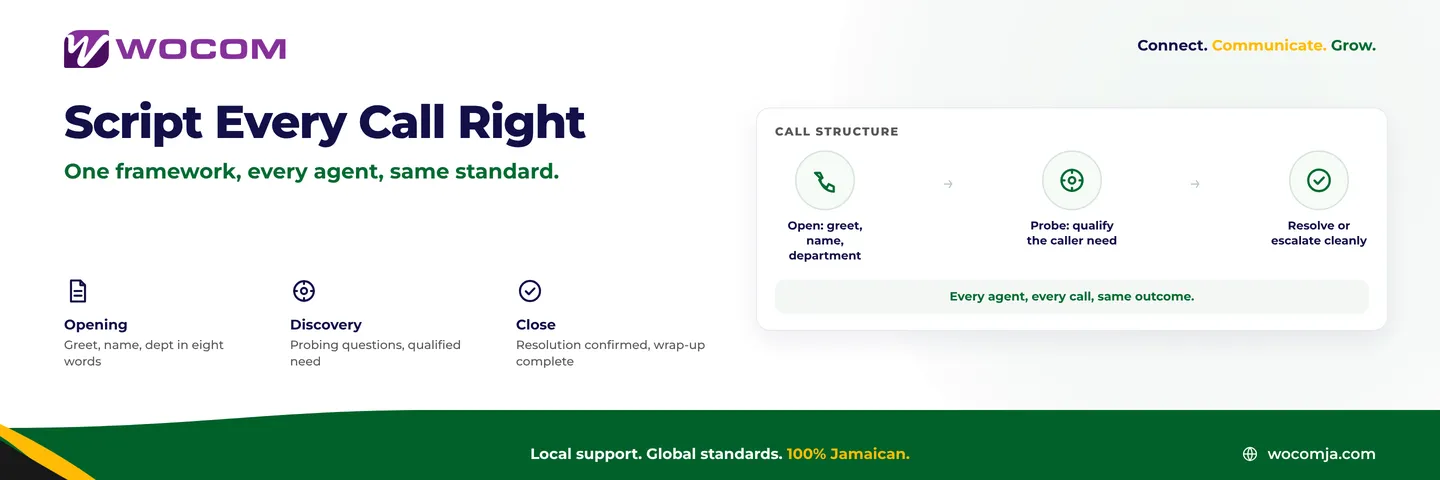
5. The call closes before the customer is satisfied. Sometimes agents complete the transaction but do not confirm the customer's concern is fully addressed. A brief closing question — "Does that fully resolve your concern, or is there something else I can help with today?" — catches residual issues that would otherwise generate a callback within 48 hours.
How Call Recording and Analytics Fuel FCR Coaching
You cannot coach what you cannot hear. Call recording gives supervisors in Kingston offices and Montego Bay contact centres the ability to review exactly what happened in low-FCR calls — not just what the agent logged in wrap-up notes.
When a customer calls back within 48 hours of a previous contact, that is the recording supervisors need to pull first. Nine times out of ten, the precise failure point is clearly audible in the original conversation — a missed question, an incomplete explanation, or a premature close.
WOCOM's cloud contact centre platform gives managers access to full call recordings alongside caller history, so supervisors can identify the root cause of FCR failures quickly and coach specific behaviour rather than giving generic feedback. Combined with call tagging and repeat-contact flagging, this creates a tight improvement loop: identify the FCR gap, pull the recordings, target the behaviour, and re-measure the following week.
AI-powered call analytics accelerates this further. Rather than manually sampling ten calls per agent per week, sentiment analysis and keyword detection can automatically surface calls where customers expressed frustration or where common escalation phrases appear — so supervisor attention goes where it matters most, not wherever the random sample happened to land.
What a Strong FCR Rate Looks Like for Jamaica Businesses
Industry benchmarks for FCR vary by sector. Utility and government-adjacent contact centres typically run 65–70%. Financial services and insurance operations benchmark at 70–80%. High-performing BPO operations — the kind running out of Kingston's New Kingston and Portmore tech parks — regularly reach 85% and above when they have the right tools and coaching culture in place.
If you do not know your current FCR rate, start by running a repeat-contact analysis for the past 30 days. Most Jamaica contact centres find their actual rate sits 10–15 percentage points below their self-reported estimate. That gap is your opportunity. Closing even half of it reduces call volume, cuts operational costs, and lifts customer satisfaction scores — all at the same time.
FCR is ultimately a business efficiency metric, not just a contact centre one. Every call that comes back is a call you are paying to handle twice, using agent capacity that could serve new customers instead.
Start Tracking FCR the Right Way With WOCOM
WOCOM's cloud contact centre platform includes call recording, IVR routing analytics, repeat-contact tracking, and real-time reporting dashboards — everything your supervisors need to measure First Call Resolution accurately and improve it systematically. Whether you are running a 5-seat team in a Kingston office or a 50-seat BPO operation in Montego Bay, we can show you what proper FCR tracking looks like in your specific environment.
Visit wocomja.com/contact or call our team to speak with a contact centre specialist. The callback cycle starts with one unresolved call — and it ends when your agents have the tools and coaching to resolve it the first time.
Continue exploring
Ready to upgrade your communications?
Talk to our team about the right solution for your business.
Book a Demo Contact SalesEverett Kildare is WOCOM's voice and infrastructure specialist, with more than 25 years of experience designing and running carrier-grade voice, SIP and virtualization infrastructure. Holding a BSc in Information Technology, he has built, secured and migrated phone systems for businesses of every size. Everett writes WOCOM's technical coverage of SIP trunking, cloud PBX, contact centres, business continuity and migration.