Contact Centre Call Script A/B Testing Jamaica: Improve First-Call Resolution with Data
Why Your Script Hasn't Been Tested Since Launch Day
Most Jamaica contact centres write a call script, train agents on it, and move on. If calls get resolved, the script stays. If they don't, supervisors assume it's an agent problem. The script itself rarely gets questioned.
That's a costly assumption. A script written when you first launched your contact centre was built around assumptions that may no longer hold: your product mix has changed, common caller questions have shifted, and your agents have developed phrasing that works better than the original wording — but nobody has captured it formally.
A/B testing turns script improvement from guesswork into a data-driven discipline. Instead of asking "is this script good?", you ask "which of these two versions produces better outcomes?" The answer comes from your actual call data, not a supervisor's opinion.
What A/B Script Testing Actually Means
A/B testing for call scripts means running two versions of the same script section simultaneously on equivalent call traffic, then measuring the result. One group of agents uses Version A — your current script — while another uses Version B, your proposed change. At the end of the test period, you compare outcomes.
The key discipline is controlling variables. You change one thing at a time — the opening greeting, the probing question, the hold phrase, the closing confirmation — so you know exactly which change drove any difference in results. Change three things at once and the data tells you nothing useful.
In a Kingston BPO or a Montego Bay customer service team, this might look like:
- Half the morning shift uses the current opening; the other half uses a rewritten version.
- You track how many calls each group resolves without a transfer or follow-up callback.
- After two weeks, the data shows which version performs better across a comparable call volume.
No guesswork. The script that wins more calls gets deployed team-wide.
Which Script Sections Deserve Testing First
Not every line in a script needs a formal test. Focus on sections that directly influence whether a caller gets resolved on first contact:
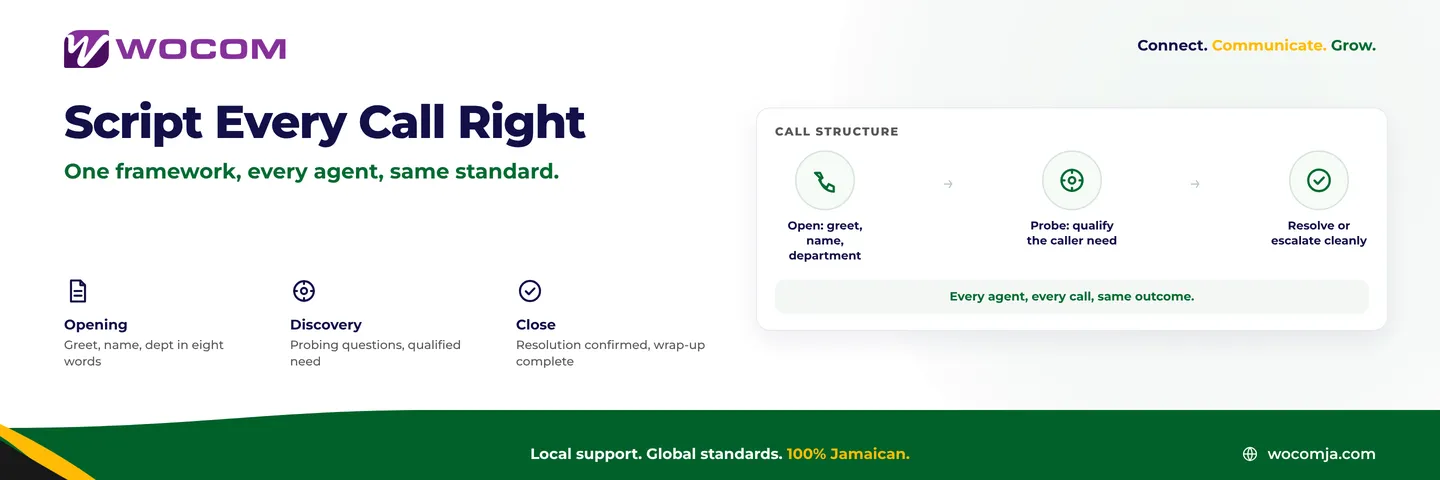
The opening greeting. How you greet a caller in the first ten seconds sets the tone for everything that follows. A warm, confident greeting often reduces caller frustration before the issue is even stated. Testing a shorter, more direct version against your current longer one frequently shows that brevity lifts both agent confidence and caller patience.
Needs-clarification questions. Agents who ask vague questions spend more time on calls and transfer more often. Testing a structured probing question — "Are you calling about an existing account or a new inquiry?" — against an open one like "How can I help you?" often shows the structured version gets agents to the right resolution faster.
Hold phrasing. How an agent asks a caller to hold directly influences whether callers stay on the line or hang up. Compare a flat "Please hold" against "I need about thirty seconds to check that for you — is that okay?" and track hold abandonment rates over two weeks. The difference is usually clear.
The close and confirmation. Calls that end without a clear confirmation step generate callbacks. Testing a defined confirmation phrase — "Before we finish, can I confirm that resolves your issue today?" — against a casual close measures whether the extra few seconds saves a repeat call the following day.
Running a Script Test in a Jamaica Contact Centre
Here is a practical framework that works for teams of any size, from a four-agent customer service desk in Portmore to a fifty-seat contact centre in New Kingston:
Step 1: Establish your baseline. Before you test anything, measure your current first-call resolution rate, average handle time, and repeat-call rate for the specific call type you plan to test. You need a number to beat — without a baseline, you cannot claim a win.
Step 2: Define exactly one variable. Write Version B. The only difference between Version A and Version B should be the section you are testing. If you rewrite the greeting and the close at the same time, you will not know which change drove the result.
Step 3: Assign agent groups fairly. Randomly assign agents to each group. Do not give Version B only to your highest-performing agents — that skews the results in a way that will mislead you. If you have six agents on a queue, three should use each version.
Step 4: Run for two full weeks. One week is not enough to filter out daily variation and anomalies. Two weeks across full Monday-to-Friday traffic gives you a reliable sample. Monitor call volume throughout to confirm both groups handled a comparable number of calls.
Step 5: Compare results and decide. Pull your call recordings, review FCR data, and compare. If Version B lifts first-call resolution or cuts handle time without reducing satisfaction, it wins. If the results are statistically equal, keep Version A — unnecessary change wastes training time and unsettles your team.
Step 6: Train and deploy formally. When a new version wins, update the official script document, retrain all agents in a structured session, and set a date for the next test cycle. Script improvement should be a quarterly habit, not a one-time event.
The Three Metrics That Decide Which Script Wins
Secondary signals like call sentiment and supervisor observation add useful colour, but three primary metrics drive script testing decisions in a well-run contact centre:
- First-call resolution (FCR): The percentage of calls resolved without a follow-up callback or transfer to a second agent. This is the primary signal. A script that genuinely lifts FCR is objectively better for your operation and your callers.
- Average handle time (AHT): If Version B resolves calls faster without dropping FCR, it is more efficient. If it is faster only because agents are rushing callers to a poor resolution, that efficiency is illusory — your repeat-call rate will expose it.
- Repeat-call rate: Track how many callers from each group call back within seven days on the same issue. A script that looks efficient but generates repeat calls is not a winner; it is just moving the problem downstream.
Mistakes That Script Testing Consistently Surfaces in Jamaican Teams
Across contact centres in Kingston, Portmore, and Montego Bay, A/B testing tends to reveal a recurring set of problems that gut-feel script reviews miss entirely:
Overlong greetings. Scripts written to sound thorough and professional often front-load information callers do not need. Testing shorter greetings almost always shows callers respond better to brevity — they called to solve a problem, not to hear a mission statement.
Passive hold language. Phrases like "you're on hold" or simply placing a caller on hold without explanation trigger more abandonment than active phrases that tell callers what is happening and set a clear time expectation.
Confirmation steps that agents skip. Many scripts include a confirmation step that agents bypass when a call feels complete. Testing a scripted confirmation phrase reveals whether the step is actually happening and whether it measurably reduces callbacks over a two-week period.
Closes without stated next steps. Callers who hang up without knowing what happens next frequently call back. Adding one clear next-step line — "You'll receive an email confirmation within two hours" — to the close consistently reduces same-issue repeat calls.
Why Technology Makes This Practical
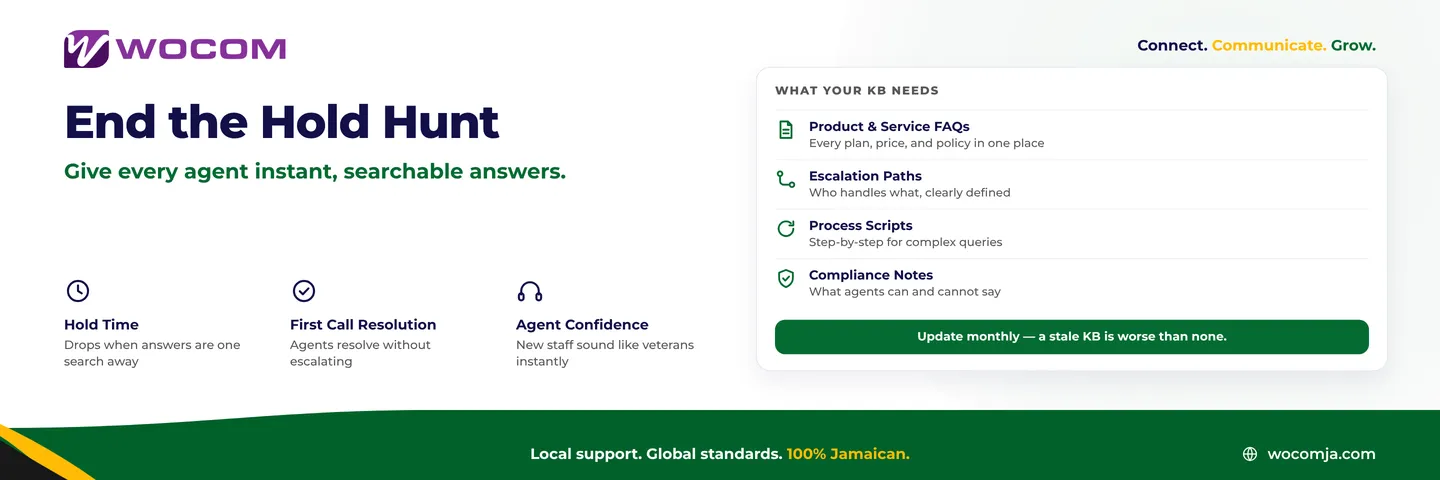
Call recording is the operational foundation of script testing. Without recordings, you cannot verify that agents are actually using the version they were assigned, and you cannot audit why outlier calls went differently than expected. Any contact centre serious about script testing needs every call recorded and easily retrievable by agent and date.
A cloud contact centre platform with structured reporting gives you handle time, queue volume, and transfer data automatically — the numbers you need to compare your two agent groups without building a manual spreadsheet after every shift. Platforms that include AI-assisted call analysis can accelerate this further by tagging phrases across hundreds of calls and flagging deviations from the assigned script version.
The most important thing is starting. Teams that run one disciplined script test every quarter accumulate genuine, evidence-based improvements. Teams that rely on supervisor instinct run the same underperforming script for three years.
Get Your Contact Centre Running Smarter with WOCOM
WOCOM provides Jamaica contact centres with cloud-based phone infrastructure, call recording, and reporting that makes structured script testing practical for teams of any size. If your team is running scripts that have not been formally tested in over a year, there is very likely a measurable improvement waiting in the data.
Contact WOCOM today to talk through how your current setup supports structured script testing and what steps to take to start improving first-call resolution on your highest-volume call types. Our team works directly with Jamaican contact centre managers to get measurable results from your existing agent team — no new headcount required.
Speak with a WOCOM contact centre specialist and find out what your call data is already telling you.
Continue exploring
Ready to upgrade your communications?
Talk to our team about the right solution for your business.
Book a Demo Contact SalesEverett Kildare is WOCOM's voice and infrastructure specialist, with more than 25 years of experience designing and running carrier-grade voice, SIP and virtualization infrastructure. Holding a BSc in Information Technology, he has built, secured and migrated phone systems for businesses of every size. Everett writes WOCOM's technical coverage of SIP trunking, cloud PBX, contact centres, business continuity and migration.