Contact Centre Agent Coaching Jamaica: Build a Programme That Lifts Every Call Score
Most contact centre supervisors in Jamaica are managing ten things at once — staffing gaps, escalations, system issues, and shift handovers. Formal agent coaching gets squeezed into a thirty-minute session once a quarter, if it happens at all. The result: agents plateau. Scores sit in the same band for months. The same mistakes recur on call after call.
Structured call coaching changes that. When supervisors review real calls with agents every week — not to discipline, but to develop — performance compounds. First-call resolution rises. Average handle time becomes more consistent. Customer satisfaction scores improve. This guide lays out the five-step coaching programme that high-performing Jamaican contact centres use to keep all three moving in the right direction.
Why Ad-Hoc Feedback Does Not Stick
Feedback without context evaporates. Telling an agent "you need to sound more empathetic" means little if they cannot hear themselves. Telling them the same thing while playing back a specific call from Tuesday morning gives them a reference point they can actually use.
Ad-hoc feedback also lacks consistency. One supervisor might prioritise call control; another focuses on compliance language. Agents learn to perform for whoever is listening rather than internalising a single professional standard. A rubric-based programme removes that inconsistency — every agent is evaluated against the same criteria, every week, regardless of who is supervising.
Step 1: Build a Scoring Rubric That Everyone Agrees On
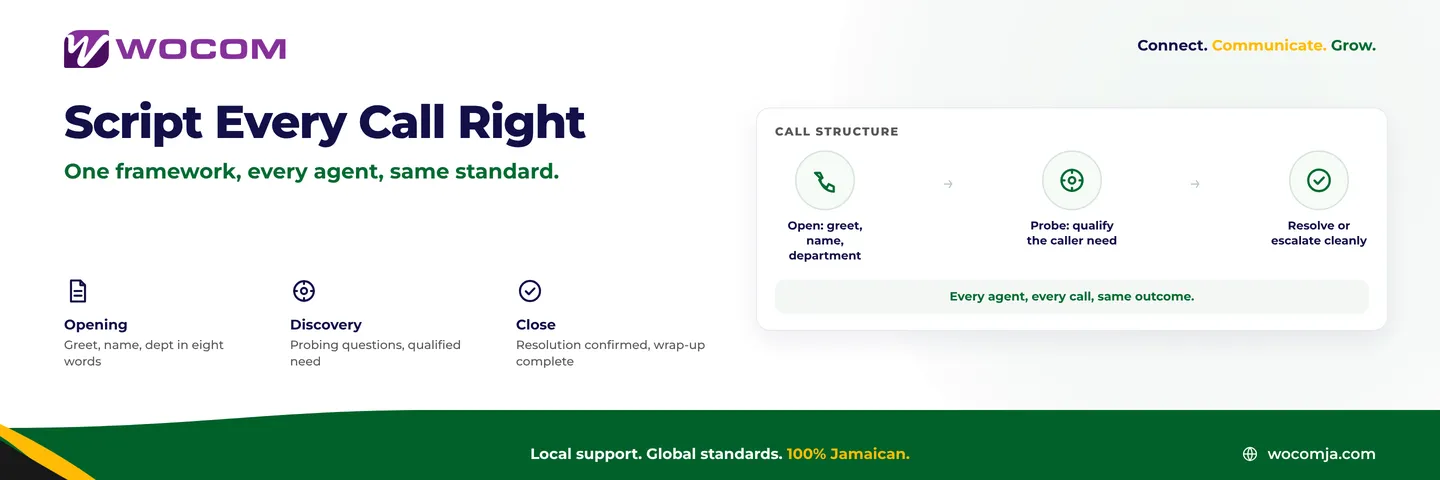
A rubric is a one-page document — or a form inside your QA tool — that lists every behaviour you want to evaluate on a call. Common categories for Jamaican contact centres include:
- Opening and verification — did the agent greet the caller correctly and confirm identity within the first thirty seconds?
- Active listening — did the agent let the caller finish, ask clarifying questions, and avoid interrupting?
- Knowledge accuracy — was the information provided correct and current?
- Resolution — was the caller's issue resolved on first contact, or was a clear next step committed to?
- Tone and professionalism — was the agent calm, courteous, and clear throughout?
- Compliance — were required disclosures, data verification steps, or call-recording notifications completed?
Weight each category based on what matters most to your operation. A financial services centre in New Kingston might weight compliance heavily. A logistics dispatcher in Montego Bay might prioritise resolution speed. The rubric does not need to be long — six to eight categories with a simple three-point scale works in practice. The point is that every supervisor scores the same behaviour the same way.
Step 2: Sample Calls Strategically, Not Randomly
Random sampling produces random lessons. Strategic sampling finds the calls that teach the most. Every week, pull at least two calls per agent across three types:
- Flagged calls — those with a long handle time, a transferred escalation, or a post-call complaint. These reveal breakdowns in real time.
- Typical calls — a representative mid-length call from the agent's usual queue. This shows baseline behaviour, not just peak-stress performance.
- Strong calls — a call the agent handled well. Coaching should reinforce excellence, not only correct gaps. Agents need to hear themselves at their best.
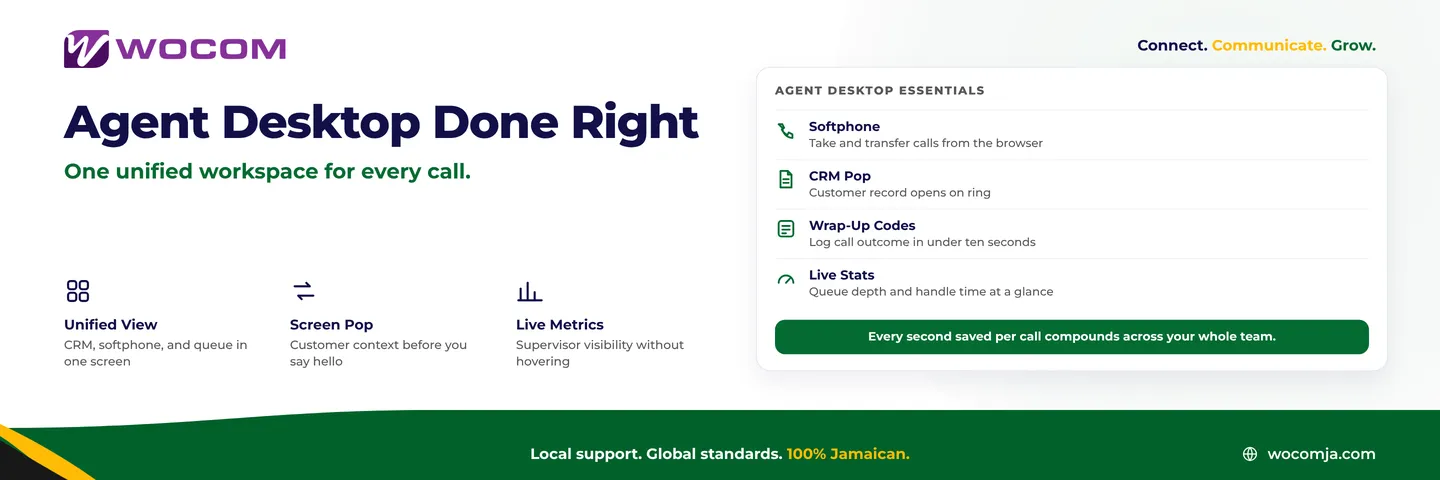
Your call recording platform should make this straightforward. WOCOM's Cloud PBX stores every inbound and outbound call with timestamps, extension, and duration. Supervisors can filter by agent, date range, and call length to pull a coaching sample in under two minutes — no digging through a shared drive or chasing IT for access.
Step 3: Score the Calls Before the Session
Never walk into a coaching session empty-handed. Score your sampled calls against the rubric before you sit down with the agent. That scored rubric gives the session a spine: instead of "how do you think that call went?", you can say "on active listening you scored one out of three — let's listen to the moment where the gap appeared."
Sharing the rubric with agents before coaching sessions is not cheating — it is transparency. Agents who know exactly what they are being assessed on perform consistently against a standard rather than guessing at supervisor preference. That consistency is what moves your aggregate scores over time.
Step 4: Run a Focused One-to-One Session
Keep coaching sessions to twenty to thirty minutes. Longer than that and attention drifts. Structure every session the same way:
- Open with a strength — play the strong call or highlight a rubric category where the agent scored well. This is not flattery; it anchors the session in what good looks like.
- Surface one or two development areas — do not attempt to fix everything in one sitting. Pick the gap with the highest impact on your key metrics and work that one.
- Play the moment — find the exact thirty seconds in the recording where the gap occurred. Let the agent hear themselves. Most agents identify the problem before you say a word.
- Practise the alternative — role-play the same scenario with a better response. Have the agent say the improved version out loud before the session ends.
- Set one measurable commitment — agree on what the agent will do differently over the coming week and how you will verify it at the next session.
Document the session outcome in your QA system. When you score that agent's calls the following week, compare directly against the commitment made. Improvement becomes visible, and the agent can track their own progress — which is the most powerful motivator of all.
Step 5: Run Monthly Calibration Sessions With Your Supervisors
Even with a rubric, different supervisors score the same call differently over time. Calibration sessions — where two or three supervisors independently score the same recording, then compare — close that drift before it undermines agent trust in the programme.
Run calibration once a month with your full supervisory team. Pick two calls: one borderline pass, one borderline fail. Score them independently, share results, and discuss discrepancies until you reach alignment. After three or four sessions, inter-rater reliability improves and your rubric becomes a true shared standard rather than each supervisor's personal interpretation. Agents then hear consistent feedback regardless of who reviewed their calls that week.
Measure Coaching ROI at the 90-Day Mark
Coaching investment should show up in your contact centre metrics. After ninety days of weekly structured coaching, look for movement in these four numbers:
- First-call resolution rate — fewer repeat contacts for the same issue signals that agents are resolving problems completely rather than deflecting.
- Average handle time variance — not necessarily a shorter average, but a tighter distribution. Wild variance is the real warning sign; coaching reduces it.
- Rubric score averages — the per-agent quality score should trend upward, quarter over quarter. A flat trend after ninety days means something in the cycle is broken.
- Escalation rate — agents who receive regular coaching escalate less, because they develop the skill and confidence to resolve more issues themselves.
If metrics are flat after ninety days, the problem is usually one of three things: supervisors are not completing sessions consistently, rubric categories are too vague to produce actionable feedback, or agents are not being held to their weekly commitments. Each is fixable — but you need the data trail to see which it is.
Start With the Recordings You Already Have
Every contact centre in Jamaica already has the raw material for a coaching programme — call recordings. The gap is almost never access to calls; it is having a structured process to turn those recordings into repeatable agent development.
WOCOM's Cloud PBX captures every call your team handles, searchable by agent, extension, date, and duration. Whether you are managing a team of eight in Portmore or running a fifty-seat contact centre in Kingston, that library becomes the foundation for a coaching programme that actually moves the needle.
To learn how WOCOM's call recording, real-time reporting, and Cloud PBX tools support your quality assurance programme, contact our team or reach us at 876-300-1876. We work with contact centres across Jamaica to build the infrastructure that makes consistent coaching possible — and the visibility to prove it is working.
Continue exploring
Ready to upgrade your communications?
Talk to our team about the right solution for your business.
Book a Demo Contact SalesEverett Kildare is WOCOM's voice and infrastructure specialist, with more than 25 years of experience designing and running carrier-grade voice, SIP and virtualization infrastructure. Holding a BSc in Information Technology, he has built, secured and migrated phone systems for businesses of every size. Everett writes WOCOM's technical coverage of SIP trunking, cloud PBX, contact centres, business continuity and migration.