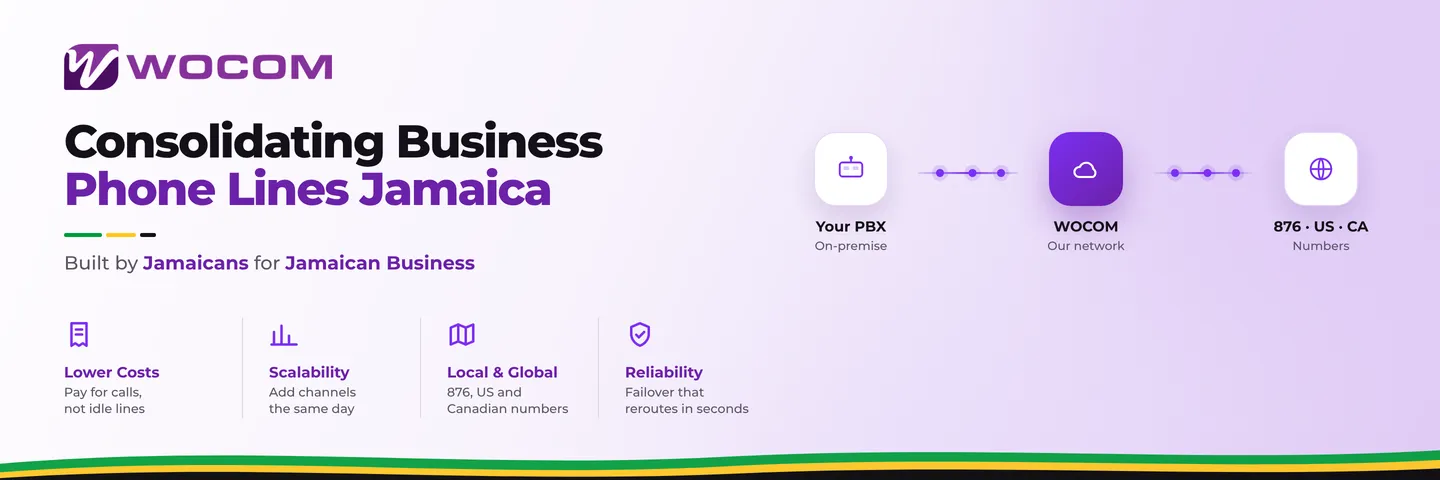
Consolidating Business Phone Lines Jamaica: Replace Multiple Bills With One SIP Trunk
Most Jamaican businesses did not plan to end up with three phone lines. It happened gradually — a second line because the first was always busy, a third for the fax machine, maybe a fourth for a new department or a second location. Each came with its own monthly bill, its own renewal date, and its own call to the carrier when something went wrong.
The result is a situation that is surprisingly common: paying for multiple fixed lines that were never designed to share capacity, that charge per-line whether fully used or not, and that take weeks to add or remove when your business needs change. SIP trunking replaces all of them — one connection, one invoice, and a channel count that reflects your actual call volume rather than the number of physical cables running into your building.
What You Are Actually Paying for With Traditional Lines
Traditional business phone lines from Jamaica's established carriers are sold on a strict per-line model. Each line carries exactly one call at a time. If your business needs four simultaneous calls, you need four lines — and you pay for each one every month regardless of how much you actually use them.
The fixed monthly rental covers a set number of included minutes to local numbers, with regional and international calls billed per minute at rates set by the carrier. When a contract ends, rates are renegotiated — often upward. Businesses that have been on the same plan for three or more years are almost always paying above the market rate for equivalent call capacity. The lines themselves have not changed; the technology options around them have moved significantly.
What a SIP Trunk Replaces — and How
A SIP trunk is a virtual connection between your internal phone system and the public telephone network. Instead of a physical copper pair per line, your calls travel as voice packets across your existing business internet connection. The number of simultaneous calls you can handle is set by the number of channels on the trunk — not by physical infrastructure.
For most Jamaican SMEs, one SIP trunk with the right channel count replaces everything:
- Multiple line bills → one monthly SIP trunk subscription
- Fixed per-line capacity → flexible channels scaled to actual demand
- Multiple carrier contracts → one provider, one support contact
- Per-line provisioning delays → changes made in a web portal, same day
- High regional and international per-minute rates → SIP trunk rates consistently lower than traditional carrier pricing
Your desk phones, Cloud PBX, or IP-PBX connect to the SIP trunk using standard credentials. From the caller's perspective — and from your staff's perspective — nothing changes. The infrastructure underneath becomes leaner and considerably cheaper.
How Line Consolidation Works Step by Step
For most businesses in Kingston, Portmore, Montego Bay, or anywhere across the island, the full transition from multiple traditional lines to a single SIP trunk takes two to four weeks and follows a predictable sequence.
- Audit every current line. List the number, monthly cost, average daily call volume, and the purpose of each line. Include dedicated fax lines — most can be retired or replaced with a virtual fax-to-email service at no additional cost.
- Check your internet connection. Each concurrent call requires roughly 100 kbps of stable bandwidth. A business handling four simultaneous calls needs 400 kbps reserved for voice — well within the headroom of most business-grade fibre connections available in Jamaica.
- Set your opening channel count. Pull your busiest-hour call volume from existing logs or bills. Add a 20 per cent buffer. That is your starting channel count. You can increase it in minutes through a portal if call volume grows.
- Port your existing numbers. Every number you currently have can be ported to the SIP trunk. Your callers continue dialling the same numbers they always have. Porting typically takes five to fifteen business days, depending on the losing carrier.
- Configure and test. Trunk credentials are entered into your PBX or Cloud PBX portal. Calls are tested on the new connection before any cut-over date is confirmed.
- Cancel the old lines. Once porting is confirmed and calls are running cleanly, you serve notice on the traditional lines. Most carriers require thirty days.
What Happens to Your Existing Business Numbers
Number portability rules in Jamaica mean your business number belongs to your business, not to the carrier that issued it. When you consolidate to a SIP trunk, every number you have comes with you.
During the porting window, calls continue landing on the old lines until the confirmed cut-over date — there is no gap in service. After porting, each number becomes a virtual DID (Direct Inward Dial) on the SIP trunk, which you assign to any extension, ring group, or department in your Cloud PBX. You can also add new 876 numbers instantly, without a provisioning delay or a field visit.
A fax number that must remain visible on stationery or documents can be retained as a virtual fax-to-email line — no physical fax machine required, and no separate phone bill to maintain.
What Jamaican Businesses Typically Save
Savings depend on how many lines you are replacing and your current contracted rates, but the pattern across the market is consistent:
- Businesses replacing three to four fixed lines see a 35 to 55 per cent reduction in monthly line rental costs.
- Regional and international outbound rates on SIP trunks run materially below what most traditional carrier business contracts charge per minute.
- One invoice replaces three or four, reducing the administrative overhead that quietly costs finance staff time each billing cycle.
- Adding capacity for a seasonal peak — a busy December, a product launch, a marketing campaign — takes minutes in a portal rather than weeks and a technician booking.
As a concrete example: a business in New Kingston paying J$4,500 per month for each of three fixed lines — J$13,500 total — that consolidates to a SIP trunk carrying the same concurrent call capacity for J$7,500 per month saves J$6,000 monthly. That is J$72,000 over a year, before accounting for lower outbound call rates and the elimination of one-time provisioning charges every time a line is added or removed.
Quick check: If your combined monthly line bills exceed J$8,000 and you are carrying more than one business number, a SIP trunk will almost certainly deliver the same or greater capacity for less.
Is Your Business Ready to Consolidate?
Line consolidation makes the clearest financial case when:
- You are paying for two or more separate business phone lines
- One or more of those line contracts is within six months of renewal
- You have a stable fibre or cable internet connection with available bandwidth headroom
- You want to scale phone capacity up or down without waiting for a technician
If you are mid-contract with an early exit fee, run the numbers before assuming it is not worth moving now. Most businesses recover the penalty cost within six to nine months of reduced monthly spend. A straightforward cost comparison — which takes less than an hour with the right information in front of you — will tell you whether acting now beats waiting for the next renewal window.
Businesses still running an analogue PBX alongside traditional lines can consolidate in stages: a VoIP gateway bridges the legacy system to the SIP trunk while a broader migration is planned, so you start capturing savings immediately rather than waiting for a full system replacement.
Consolidate With WOCOM
WOCOM owns the infrastructure behind its SIP trunks — there is no reseller layer adding margin between your business and the carrier. That translates to consistently lower rates, direct technical support when something needs attention, and number porting managed end-to-end without being passed between companies.
Our team will review your current phone bills, model your channel requirements against real call data, and produce a line-by-line cost comparison before you commit to anything. Most assessments take under an hour and produce a clear picture of what you would pay and what you would save from month one.
Reach out to WOCOM at wocomja.com to request your free line consolidation assessment. One conversation is usually enough to know whether now is the right time — and if it is, we handle the porting, the configuration, and the carrier notices so your team does not have to.
Continue exploring
Ready to upgrade your communications?
Talk to our team about the right solution for your business.
Book a Demo Contact SalesEverett Kildare is WOCOM's voice and infrastructure specialist, with more than 25 years of experience designing and running carrier-grade voice, SIP and virtualization infrastructure. Holding a BSc in Information Technology, he has built, secured and migrated phone systems for businesses of every size. Everett writes WOCOM's technical coverage of SIP trunking, cloud PBX, contact centres, business continuity and migration.