Cloud PBX vs On-Premise PBX Jamaica: 3-Year Cost Comparison
When a Kingston distribution company or a Montego Bay hotel starts shopping for a new phone system, the first question is almost always about price. But the number on the quote sheet rarely tells the full story. On-premise PBX systems carry a visible sticker price — the server, the phones, the installation — while cloud PBX looks like a recurring subscription. Three years in, the math often surprises businesses that chose on-premise thinking they were being financially conservative.
This guide lays out every cost layer for both models, including the Jamaica-specific factors that most vendor comparisons quietly leave out.
What the Two Models Actually Are
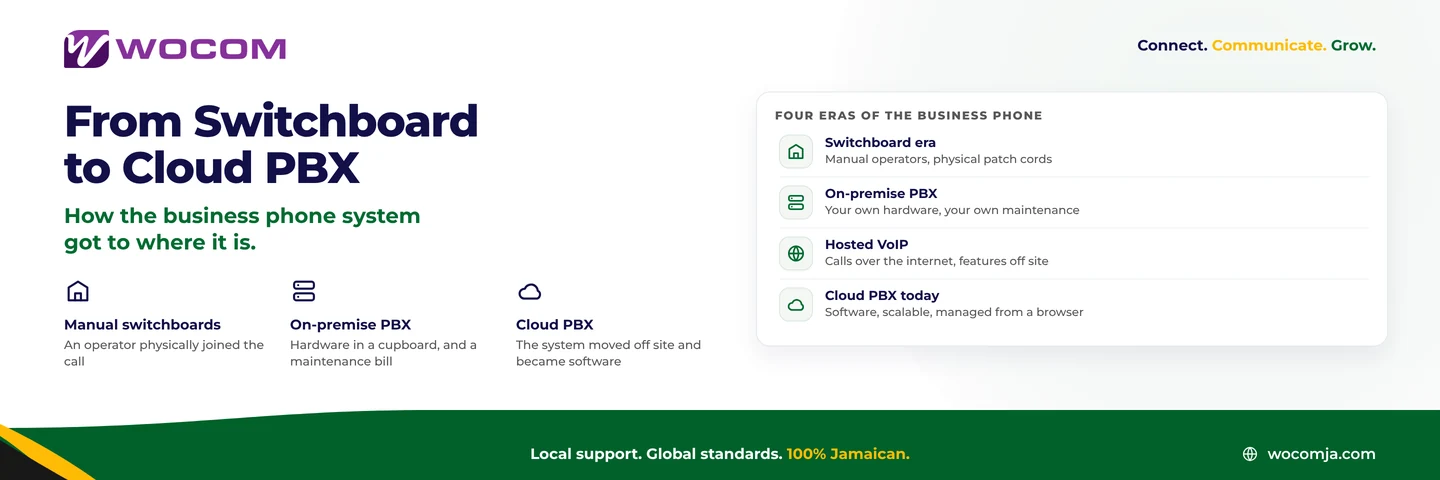
An on-premise PBX (sometimes called a PABX or IP-PBX) is hardware and software installed at your location. Your company owns the equipment, stores it in a server room or comms closet, and is responsible for maintenance, upgrades, and repairs. Brands such as Cisco, Avaya, Yeastar, and 3CX can all run on-premise.
A cloud PBX runs on your provider's infrastructure. You access it via your internet connection, manage it through a web portal, and pay a predictable monthly fee. Your phones — desk phones, softphones, or mobile apps — register to the cloud. The provider handles all underlying hardware, redundancy, and software updates.
Both models deliver calls. The difference is who owns the infrastructure, and who absorbs the cost when something fails or needs to grow.
On-Premise PBX: The Real Cost Breakdown
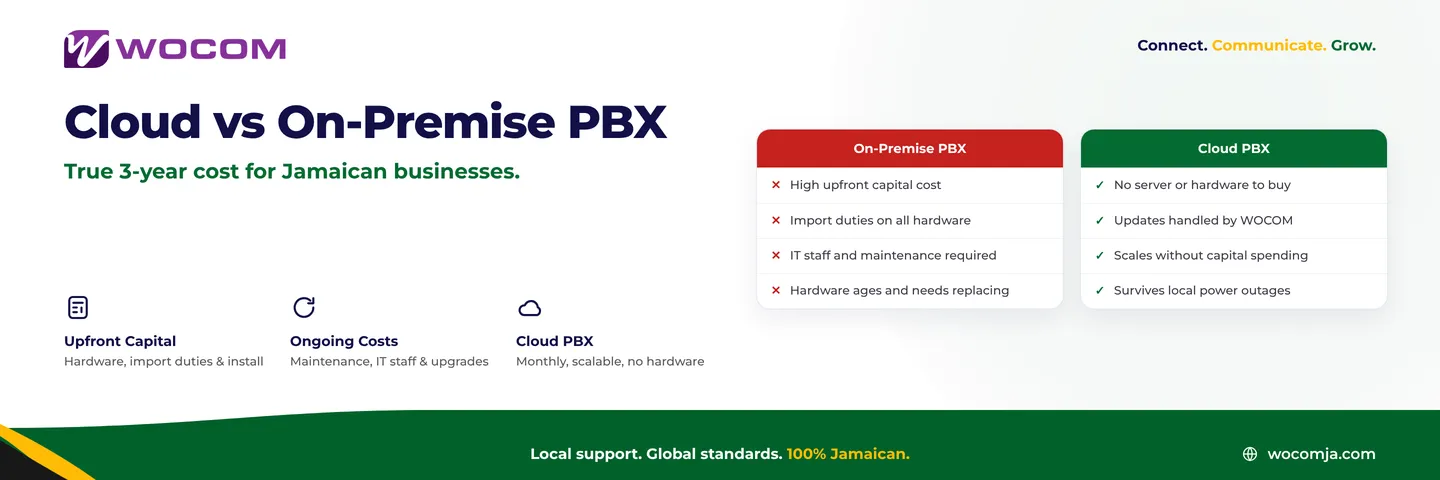
For a 20-user Jamaican business, a typical on-premise IP-PBX deployment accumulates cost across several layers that are easy to undercount at procurement time.
- Server and software licensing: The core appliance plus the PBX software licence — which may be a one-time purchase or carry an annual renewal fee depending on the platform.
- Desk phones: Each handset is a hardware purchase. Mid-range IP phones are priced in USD, and every unit must clear customs. Import duties and GCT add to the landed cost of every phone in the office.
- Installation and configuration: A qualified technician must rack the unit, configure extensions, design call routing, and commission each handset. In Jamaica, experienced VoIP engineers are not abundant — travel fees and day rates reflect that scarcity, particularly outside Kingston.
- Annual maintenance contract: Most vendors require an active support contract to keep your warranty valid and receive software patches. Budget 15–20% of the hardware value each year this contract runs.
- UPS and power protection: On-premise PBX hardware is sensitive to voltage fluctuations and outages. A suitably sized UPS for a server room adds a meaningful capital line item — plus eventual battery replacement costs.
- IT staff time: Someone at your company, or a hired consultant, must manage firmware updates, troubleshoot failures, and reconfigure the system each time you hire or restructure. This recurring labour cost is rarely line-itemed but is constant.
- Mid-cycle hardware issues: A failed power supply, a dead expansion card, or a corrupted licence server can silence an entire office. Sourcing replacement parts from overseas — and waiting for them — carries both cost and downtime.
When businesses total hardware, shipping, duties, installation, annual support, UPS equipment, and staff time, the three-year spend for a 20-user on-premise system typically exceeds the figure most buyers projected when they signed the purchase order.
Cloud PBX: What You Actually Pay
Cloud PBX cost is more transparent by design. A monthly per-seat fee covers the platform, all software updates, redundancy infrastructure, and support. With WOCOM, that fee also covers your SIP trunk capacity and DID numbers — there is no separate carrier invoice to reconcile.
- No server to buy: WOCOM owns the infrastructure. You contribute nothing toward data centre hardware, power, cooling, or replacement cycles.
- Desk phones are optional: Staff can use the WOCOM softphone app on existing laptops and mobiles — eliminating hardware cost entirely for remote or hybrid workers. Physical phones are available for those who want them, and WOCOM handles provisioning remotely.
- No annual maintenance contract: Updates, patches, and security fixes are applied by WOCOM's team. There is no renewal invoice to budget or track.
- Scales without capital expenditure: Adding five users next quarter means adding five licences — not sourcing an expansion card, booking a technician, and verifying the server has headroom.
- No UPS dependency at the PBX layer: Call routing logic and your business numbers remain live in the cloud regardless of what happens at your building. Staff with a mobile data connection can still receive and make calls.
Jamaica-Specific Factors That Shift the Equation
Generic cloud-versus-on-premise comparisons are written for markets with cheap hardware shipping, abundant local IT talent, and reliable power grids. Jamaica is none of those three things — which means the tilt toward cloud is steeper here than global averages suggest.
Import costs and duties: Every piece of on-premise PBX hardware arrives in Jamaica through customs. Shipping lead times, clearance delays, and applicable duties add material cost to every server, card, and replacement component. Cloud PBX hardware cost sits with WOCOM in a properly provisioned facility — not at your front door.
Power reliability: On-premise hardware is sensitive to the voltage interruptions that businesses in Spanish Town, May Pen, Portmore, and rural parishes plan around daily. A cloud PBX hosted in a redundant data centre continues routing calls even when your office is on NJP outage — provided your staff have a mobile data connection.
Skilled IT labour: Finding a qualified VoIP engineer in New Kingston is possible but not inexpensive. Finding one in Mandeville or Black River for a site visit is harder and carries travel premiums. Cloud PBX shifts the technical maintenance burden entirely onto WOCOM's engineering team.
Exchange rate exposure: On-premise hardware is priced in USD. The day you cut a purchase order, you lock in that day's JMD/USD rate. If the rate moves against you mid-project — as it frequently does — the installed cost rises without any change to the scope. Monthly cloud fees are predictable and can be budgeted in local currency terms.
When On-Premise Still Makes Sense
Cloud PBX is not the right answer for every organisation in Jamaica. A few scenarios where on-premise still earns serious consideration:
- No reliable internet connectivity: Locations without consistent, low-latency broadband — certain industrial sites, remote agricultural operations, or worksites in areas with limited infrastructure — may not sustain cloud PBX call quality reliably. An on-premise system with PSTN trunks can operate independently of internet quality.
- Strict data sovereignty requirements: Government agencies or heavily regulated entities with formal requirements about where call data is processed and stored may need on-premise or a private-cloud arrangement with documented data residency.
- Very large, stable, long-horizon deployments: Organisations with 200-plus seats, minimal headcount change, and dedicated in-house IT staff may see better unit economics from owned hardware across a decade-plus horizon — particularly if they already have the server room infrastructure in place.
For most Jamaican SMEs — offices of 5 to 100 users that grow, shrink seasonally, open new locations, or bring in remote workers — the on-premise model introduces friction at every change point.
The 3-Year Verdict
On-premise PBX often wins on paper in year one if you ignore the maintenance tail, the IT labour cost, and the Jamaica import premium. By year two, the comparison typically levels. By year three — factoring in at least one unexpected hardware event, at least one expansion cycle, and the accumulated support contract fees — cloud PBX has usually come out ahead on total spend for a business under 100 seats.
The cloud also wins on agility: your team can add a location in Ocho Rios, onboard ten new staff after a contract win, or shift to remote work without a hardware procurement cycle. That operational flexibility has real business value that never appears in a cost spreadsheet, but becomes very visible the first time you need to move quickly.
The businesses that regret moving to cloud PBX are rare. The businesses that regret locking capital into on-premise hardware — and then watching the vendor discontinue the product line — are common.
Talk to WOCOM Before You Sign Anything
WOCOM has migrated dozens of Jamaican businesses off legacy on-premise systems — from law firms in New Kingston to multi-branch retailers spread across the island. Before you sign a hardware purchase order or renew an on-premise support contract, let WOCOM show you what a cloud PBX would actually cost for your headcount and call volumes.
The conversation takes less than 30 minutes and costs nothing. Call 876-790-3830, reach the team at wocomenterprise.com/contact, or ask WOCOM's AI receptionist to connect you with the right advisor right now.
Continue exploring
Ready to upgrade your communications?
Talk to our team about the right solution for your business.
Book a Demo Contact SalesMichelle Goss is a data and AI analyst at WOCOM, where she studies how Jamaican businesses use voice, messaging and AI to win and keep customers. With a BSc in Data Science & Analytics, she turns call data, customer trends and AI receptionist performance into practical guidance owners can act on. Michelle writes WOCOM's coverage of AI call handling, call analytics, customer growth and industry trends.