Cloud PBX Ring Time Jamaica: How Many Seconds Should Your Business Phone Ring?
Walk into most Jamaican businesses and ask the owner how long their phone rings before going to voicemail. Blank stare. It is almost always whatever the system was set to when it was installed — usually 20 to 25 seconds — which may be completely wrong for how the team actually operates.
Ring time sounds like a minor technical detail. It is not. The number of seconds a caller waits before hitting voicemail, a queue message, or dead silence determines whether they leave a message, call a competitor, or simply assume you are not serious about your customers.
Why the Default Ring Time Is Usually Wrong
Cloud PBX platforms typically ship with a ring timeout somewhere between 20 and 30 seconds — roughly four to six rings on a standard desk phone. That number was chosen by engineers, not by anyone who studied how Jamaican customers behave when they call a business.
The problem is that 20 seconds can be too long and too short at the same time, depending on your setup. If you have a single desk phone and your receptionist steps away for five minutes, 20 seconds of ringing resolves nothing — the caller is gone long before anyone gets back to the desk. If you have a ring group where the call cycles through three agents before going to voicemail, 20 seconds per agent means a caller waits a full minute with zero feedback before hitting a recording.
Neither scenario is good. The fix is simple once you understand what the setting actually controls.
How Long Will a Jamaican Caller Actually Wait?
Research on caller patience is consistent: most people will wait through four to five rings before hanging up if there is no indication that someone is coming. That is about 20 to 25 seconds on a landline. On a mobile call, rings are slightly shorter — four rings is closer to 16 seconds.
What changes the number significantly is feedback. A caller who hears only ringback will hang up faster than a caller who hears a queue message saying "All our team members are currently assisting other customers — you are next in line." With that kind of reassurance, callers will often wait 90 seconds or more.
The practical takeaway for a business in Kingston, Montego Bay, or anywhere across the island: if your call goes to a device with no queue messaging, keep the ring timeout under 25 seconds and make sure something useful catches it after. If you have a queue or an AI receptionist as a fallback, the ring time at the first destination is less critical — but the experience from the caller's side still matters.
Ring Time Settings by Scenario
There is no single correct ring time. The right value depends entirely on how your call flow is structured:
- Single desk phone, no queue: 20–25 seconds maximum. After that, the caller should reach voicemail or an AI fallback — not silence. If your team is regularly away from the desk, consider reducing this to 15 seconds so the caller reaches a resolution faster rather than waiting through a full ring cycle.
- Hunt group ringing all agents simultaneously: 20–25 seconds total is reasonable. Someone on the team should pick up within that window if they are available.
- Hunt group ringing agents one at a time (sequential): Set each leg to 12–15 seconds. A caller burning through three agents at 20 seconds each will wait 60-plus seconds before hitting voicemail. That is too long.
- Mobile extension or softphone app: Mobile devices take a moment longer to connect through the network. Add 5 seconds to your usual setting — 25 to 30 seconds for a mobile extension is appropriate.
- Contact centre queue: The caller is already in queue with messaging and hold music. Ring time at the individual agent level is managed by your ACD. Focus on queue SLA targets and callback options rather than the per-agent ring timeout.
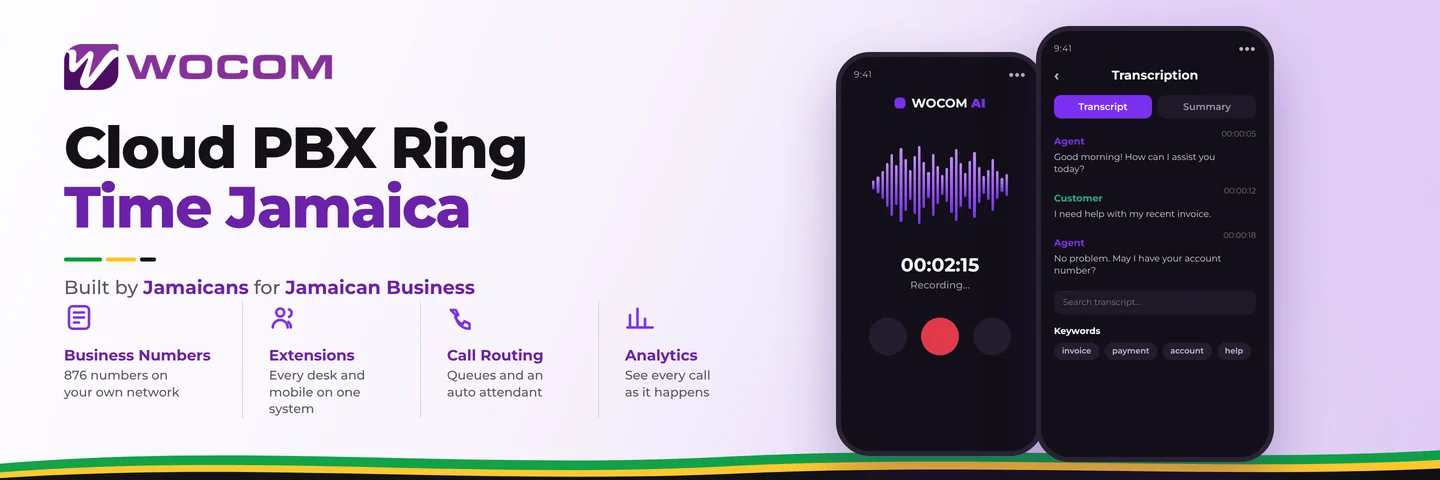
- AI receptionist (WOCOM Alex): Alex answers immediately, so ring time is effectively zero. The relevant setting here is when to escalate from Alex to a live agent — which is configured in the AI panel, not in the PBX ring timer.
What Happens When Nobody Answers — and the Gap Most Businesses Miss
When a call reaches the end of its ring timeout and nobody has picked up, your PBX needs somewhere to send it. Most systems default to voicemail. The issue is that many Jamaican businesses recorded a generic voicemail greeting on day one and have never consistently monitored the mailbox since.
The result is a working phone system with a broken answer strategy. Callers hit voicemail, leave a message, and wait. If nobody checks the mailbox until end of day — or the next morning — the caller has already moved on to the next option in their Google search results.
A smarter fallback chain typically looks like this:
- Ring the primary agent or desk phone (15–20 seconds)
- If no answer, overflow to a ring group or secondary agent (15 seconds)
- If still no answer, route to the AI receptionist — Alex captures the enquiry, books a callback, or takes a structured message that gets emailed immediately
- Only if the caller specifically opts out of AI assistance should voicemail be the final destination
This structure means a caller almost never reaches an unmanned voicemail box without first being offered a useful alternative. Building that chain in WOCOM Cloud PBX takes about ten minutes once you know where the settings live.
How to Adjust Ring Time in WOCOM Cloud PBX
Ring timeout is configured at the extension level and, separately, at the ring group level. Inside the WOCOM portal, navigate to Extensions, select the extension you want to adjust, and look for the Ring Timeout or No Answer Timeout field. The label varies slightly by PBX version but the field is always on the extension detail page.
For ring groups, the timeout applies per ring cycle. If your group rings all agents simultaneously, this is the total window before the call escalates to the overflow destination. If it rings agents sequentially, this is the time each extension gets before the group moves to the next person in the list.
After making any changes, test with a real call from a mobile phone. Time it with a stopwatch. What feels like 20 seconds inside a configuration panel can feel considerably longer to a customer standing outside a Portmore hardware store trying to reach your parts department. Always verify the experience from the caller's side, not from the admin panel.
Build a Call Answer Strategy That Works Every Time
Ring time is one small control inside a larger system, but it connects directly to whether callers reach a person, reach a useful alternative, or hang up and call someone else. Most businesses across Jamaica have never reviewed this setting since the day their system was installed — and that single oversight is quietly costing them customers every week.
Getting it right is not complicated. It requires knowing your call flow, matching the timeout to each scenario, and having a solid fallback in place so that no call ends in silence.
WOCOM's team can audit your current call flow at no charge — reviewing ring time settings, ring group configuration, overflow routing, and fallback destinations including WOCOM Alex AI — and recommend the specific adjustments that will improve your answer rate immediately.
Call us at 876-300-2888, reach us on WhatsApp, or visit wocomja.com to book your free call flow review today.
Continue exploring
Ready to upgrade your communications?
Talk to our team about the right solution for your business.
Book a Demo Contact SalesEverett Kildare is WOCOM's voice and infrastructure specialist, with more than 25 years of experience designing and running carrier-grade voice, SIP and virtualization infrastructure. Holding a BSc in Information Technology, he has built, secured and migrated phone systems for businesses of every size. Everett writes WOCOM's technical coverage of SIP trunking, cloud PBX, contact centres, business continuity and migration.