Cloud PBX Pilot Jamaica: Prove It Works in One Location Before You Commit
Why Cloud PBX Projects Stall in Jamaica
The quotes are sitting in the drawer. The demos were impressive. But nothing moves — because upgrading a live phone system feels enormous. What if calls drop on the day of cutover? What if staff can't cope? What if the investment doesn't deliver?
These are legitimate concerns, and they keep otherwise savvy business owners on ageing PABX hardware for years longer than they should be. The problem is not the technology — it is the all-or-nothing framing. When an upgrade means cutting every location and every line over at once, the risk calculus tilts heavily toward doing nothing.
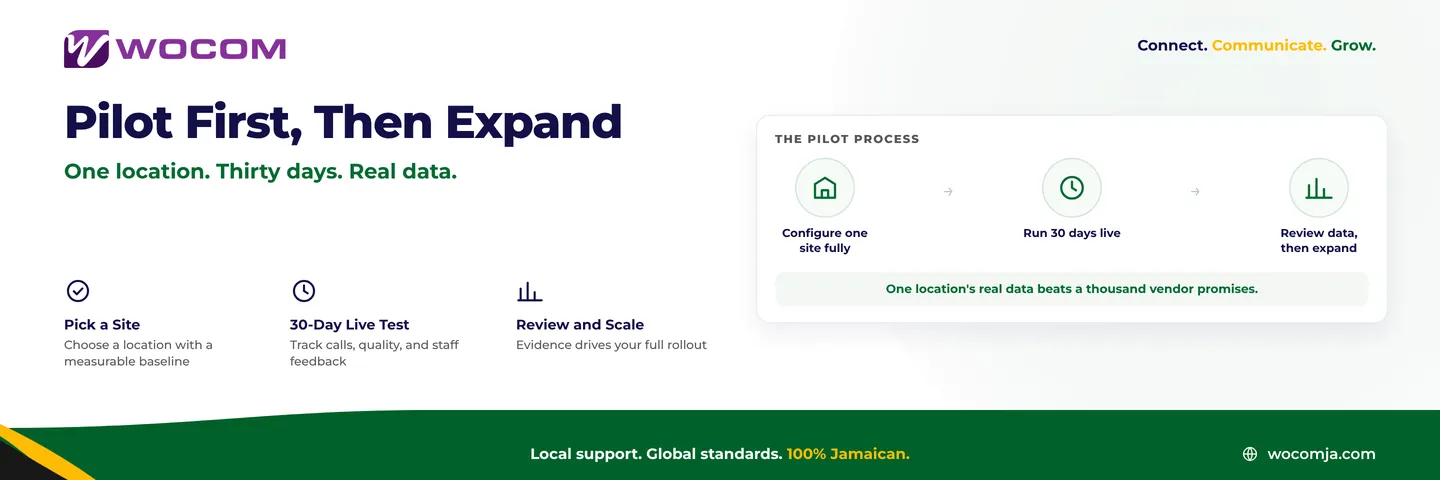
A department pilot breaks that deadlock. Instead of replacing everything at once, you activate cloud PBX at one location or one ring group. Real staff handle real calls. After 30 days you have actual performance data — not vendor projections — and a genuinely informed decision about whether and how fast to expand.
What a Cloud PBX Pilot Actually Covers
A pilot is not a demo, and it is not a half-finished deployment. It is a full, production-grade installation covering one bounded scope: typically one physical branch, one inbound number, or one team such as your reception desk or sales line.
During the pilot period:
- Real calls route to real staff through the new cloud system
- Your old system continues running in parallel on all other lines — no customer notices the test
- You track agreed metrics from Day 1
- Staff report issues through a simple daily channel so nothing gets buried
The parallel-running structure is what makes this low-risk. If anything about the pilot disappoints, you have not disrupted your wider operation. You adjust, fix, and re-test before spending anything on additional sites.
Choosing the Right Location to Start
Not every site makes an ideal pilot. The best starting point has a few specific qualities:
- Moderate inbound call volume. Enough traffic to generate meaningful data in 30 days, but not your highest-volume line where a configuration problem would be felt immediately by hundreds of customers.
- A willing team leader. You need someone at that site who will report honestly — good and bad — rather than just tolerating the experiment silently.
- A current pain point. If that location is already losing calls after hours, struggling with transfers, or relying on a mobile number as a backup, the before/after comparison writes itself.
- Reliable internet connectivity. A site already on stable fibre or coax is a better first candidate than one dependent on a consumer broadband connection. Deal with connectivity questions at expansion, not during the pilot.
For most Kingston businesses, the main reception desk is the natural starting point. For multi-branch operations, a mid-sized branch — Mandeville, Spanish Town, Ocho Rios — lets you test rigorously without touching headquarters during the learning phase.
What to Measure in Your First 30 Days
The pilot only generates value if you define your metrics before Day 1. Set up a simple tracking sheet covering:
- Missed call rate — compare directly against the same four-week window on the old system. Pull the data from your old CDR or from memory; even a rough baseline is better than none.
- Ring-to-answer time — how long do callers wait before a live agent or automated greeting picks up? Cloud PBX gives you this in the portal; your old system probably does not.
- After-hours capture rate — if you activate an AI receptionist or voicemail-to-email for the pilot number, how many calls outside business hours are now being captured versus going unanswered?
- Call quality complaints — ask the pilot team to log any echo, drops, or one-way audio. One logged complaint is useful data; ten unlogged ones are invisible.
- Staff time on call management — are agents spending less time manually transferring, chasing, and routing calls? This is often where productivity gains show up first.
WOCOM recommends a brief check-in at Day 15 — enough data to spot patterns early — and a formal review at Day 30.
Managing Staff Expectations During the Test
Not everyone will be enthusiastic. A receptionist who has operated the same PABX for seven years is not unreasonable to be cautious about a new system. Managing this well makes the difference between a clean pilot and one that generates noise without clarity.
Be direct with staff: this is a genuine test, not a decision already made. Their honest feedback — especially about what is harder or more confusing — is what makes the pilot useful. Set a clear decision date so no one feels stuck in an indefinite experiment, and make sure the team leader knows they can escalate issues immediately rather than waiting for a weekly meeting.
A 30-minute pre-launch walkthrough — which WOCOM can run remotely or on-site — is almost always enough to get staff comfortable with the basics. The learning curve on modern cloud PBX is significantly shorter than most people expect.
Using Your Pilot Results to Plan the Full Rollout
A successful pilot does not automatically mean an immediate company-wide cutover. Use what you have learned first:
- Fix configuration gaps before expanding. If certain call flows caused confusion at the pilot site, redesign those ring groups or auto attendant menus before they affect five more locations.
- Quantify the business case. What did the pilot location save? How many calls that used to be missed are now being captured? Put numbers on it and present them to decision-makers. Concrete figures move internal approvals faster than vendor brochures.
- Sequence the rollout by readiness. List remaining locations by call volume, internet quality, and staff readiness. Prioritise sites where the problem is clearest and the infrastructure is already sound.
- Negotiate from a position of knowledge. You now have real performance data. That gives you a far stronger basis for agreeing service levels and terms with your provider than you had before the pilot.
What If the Pilot Surfaces Problems?
Finding problems during a pilot is not a failure — it is exactly what the pilot is designed for. The two issues that most commonly appear in Jamaica deployments:
Internet quality at the site. If call quality is inconsistent, the fix is almost always a QoS configuration or a modest bandwidth upgrade, not a fault in the cloud PBX itself. This is far cheaper to address at one site than after a full rollout. WOCOM's support team can diagnose this remotely from call quality logs.
Call flow design. If callers are getting lost in the IVR or staff are confused by transfers, the ring group logic needs to be reworked. This takes an afternoon to adjust, not a new deployment.
Both are normal first-deployment findings. Neither warrants abandoning the project. Discovering them at one location rather than twelve is the entire point of the exercise.
Ready to Run a Pilot? WOCOM Can Set One Up This Week
WOCOM provides cloud PBX, SIP trunking, and AI receptionist services to businesses across Jamaica. A pilot deployment can be live within days — one number, one site, full production configuration — with your existing lines remaining completely untouched.
If you have been holding a decision on your phone system because the full switchover feels too large to manage, a pilot is the right next step. You will have real data within 30 days and a clear path forward either way.
Call WOCOM at 876-631-5900 or visit wocomenterprise.com to discuss a pilot deployment for your business. No commitment required — just a conversation about what one location could prove.
Continue exploring
Ready to upgrade your communications?
Talk to our team about the right solution for your business.
Book a Demo Contact SalesEverett Kildare is WOCOM's voice and infrastructure specialist, with more than 25 years of experience designing and running carrier-grade voice, SIP and virtualization infrastructure. Holding a BSc in Information Technology, he has built, secured and migrated phone systems for businesses of every size. Everett writes WOCOM's technical coverage of SIP trunking, cloud PBX, contact centres, business continuity and migration.