Caller Verification Jamaica: How to Confirm Who Is Calling Before Sharing Sensitive Account Information
Your front-desk staff cannot see the person they are speaking with. They cannot check a driving licence or a company ID. When a caller claims to be a client and asks for account balance details, prescription status, or sensitive case notes, the only thing standing between that information and the wrong person is your verification procedure — or the absence of one.
In Kingston medical practices, Montego Bay financial services firms, and legal offices across Jamaica, caller verification is not a future project. It is a gap that fraud incidents keep exposing. This guide explains the practical methods that work, the Cloud PBX features that support them, and how AI receptionists are changing what is possible in 2026.
Which Jamaica Businesses Are Most at Risk?
Not every inbound call requires scrutiny. A caller asking for your opening hours or parking directions needs no identity check at all. But certain request types carry real risk if handled without verification:
- Medical and dental practices — appointment details, prescription refill status, test results
- Financial services and cambio operations — account balances, transaction history, wire transfer or payout instructions
- Legal and accounting firms — case status, document contents, filing deadlines and outstanding balances
- Schools and training institutions — student records, fee payment history, examination results
- Pharmacies — prescription authorisations and medication history
- Property management companies — tenant financial records and maintenance access arrangements
The pattern is consistent across all of them: a caller presents as the account holder or the client, and a staff member relays information that should only reach that specific person. Social engineers rely on the fact that a friendly, confident voice rarely meets a structured challenge. When no verification standard exists, the default is to trust — and that default gets exploited.
Caller Verification Methods: From Simple to Layered
The right level of verification should match the sensitivity of the request. A tiered approach works best — lighter checks for routine enquiries, stronger checks before anything involving account changes or data release.
Knowledge-based authentication (KBA) is the most widely used starting point. Staff ask for one or two pieces of information only the genuine account holder should know: account number, date of birth, the postcode of the registered address, or the last four digits of a registered payment card. The critical requirement is consistency — every staff member must ask the same questions in the same situation, without exception. An informal approach that varies by employee is not a procedure; it is a suggestion.
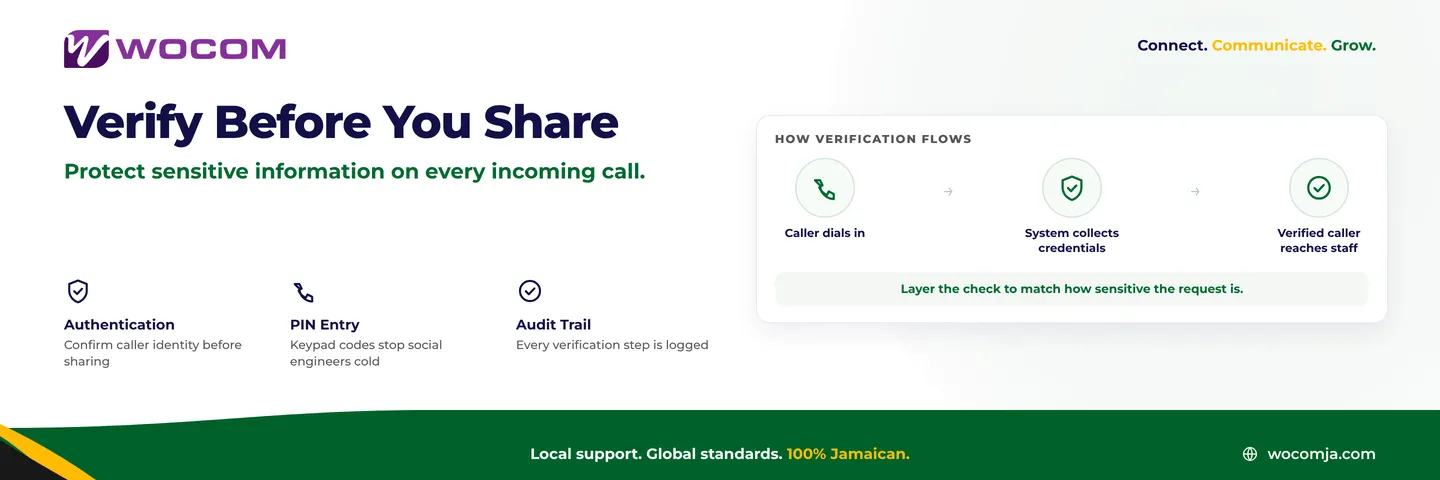
PIN-based verification assigns a unique four- or six-digit code to each account. When a caller claims to be that account holder, the auto-attendant or the agent asks for the PIN before proceeding. Cloud PBX systems can collect PIN input directly through the dial pad before the call reaches any human agent, so staff never speak to a caller who has not already cleared the first gate.
Callback verification is the most secure option for high-risk requests. Rather than acting on the call received, the staff member takes the caller's name and reason for calling, ends the call, then dials the number registered to that account. This eliminates spoofed caller IDs entirely. It adds time, so it is best reserved for requests involving account changes, large transactions, or access to particularly sensitive records.
Registered number matching uses the incoming caller ID as a supporting signal. If the number displayed matches the number registered to the account, it reduces risk — but it should never be the only check. Caller ID can be spoofed, and registered numbers change without the account being updated.
How Cloud PBX Features Support Caller Verification
A well-configured Cloud PBX removes most of the friction from verification by handling initial steps before a human agent is involved.
Auto-attendant IVR menus can be set to collect account numbers or PINs via DTMF keypad input as part of the inbound call flow. The collected digits are displayed to the agent alongside the ringing call, so the first thing staff see when they pick up is whether the caller has already cleared the initial check. No separate login, no asking callers to repeat themselves to multiple people.
Call recording, available on all WOCOM Cloud PBX lines, creates an auditable trail of every verification exchange. If a data dispute arises — a staff member who shared information they should not have, or a caller who later claims they were never asked to verify — the recording resolves it. Under Jamaica's Data Protection Act, being able to demonstrate that a reasonable verification procedure was consistently applied also supports your position if a complaint is filed with the relevant authority.
Direct Inward Dialling (DID) allows different call flows on different numbers. Your general enquiry line, your billing line, and your confidential case management line can each carry a different verification requirement, without any manual triaging by the person who answers. The routing itself enforces the standard.
AI-Assisted Caller Verification in 2026
WOCOM's AI receptionist, Alex, handles the initial verification steps that previously required a staff member to be on the line from the moment the call connected.
Alex collects the caller's name, account number, and stated reason for calling before any transfer takes place. For businesses using PIN-based verification, Alex can prompt for the PIN, confirm it against a registered value, and route the caller to the appropriate department with a summary already attached. Staff receive a caller who has already been partially screened, not a stranger they know nothing about.
For businesses running an answering service model — where Alex handles calls outside business hours — the same verification logic applies. A caller asking for sensitive case details after hours is told that a team member will follow up during business hours, and their contact details are recorded for a callback. No sensitive information is released to an unverified caller at any hour.
Alex also flags inconsistencies. If a caller claims to be a business account holder but cannot provide matching details, Alex escalates the case rather than proceeding. The interaction is logged, and the follow-up falls to a human agent who can investigate properly.
Practical Setup: Three Steps to Close the Gap
Implementing caller verification does not require a large project. For most Jamaica businesses, three steps are enough to address the most common exposure:
- Agree on a verification standard for each request type. Write it down. Decide which questions apply to routine enquiries, which additional steps apply to sensitive requests, and when a callback is mandatory rather than optional. The standard must be specific enough that any staff member can follow it without guessing.
- Configure your IVR or auto-attendant to collect the account number or PIN before the call reaches staff. WOCOM Cloud PBX supports DTMF collection and agent-side display. This takes an afternoon to configure and immediately lifts your baseline security without adding friction for callers who know their account details.
- Brief every person who answers calls. A written procedure accomplishes nothing if staff do not follow it consistently under the pressure of a confident, impatient caller. A short scripted brief — covering what to ask, what to do if the caller cannot verify, and when to escalate — is more effective than a policy document filed in a shared drive.
Businesses that have implemented PIN collection at the IVR stage report a secondary benefit beyond security: average handling time drops because agents start the conversation already knowing who they are speaking with and why they are calling. Verification does not have to slow a call down — a well-designed flow speeds it up.
Protect Your Accounts Before an Incident Forces the Conversation
Caller verification is one of the smallest operational changes with the most direct impact on account security. It does not require new hardware, a large budget, or a months-long implementation. What it requires is a decision to treat it as a standard, not an occasional reminder to staff.
WOCOM can configure caller verification into your Cloud PBX call flow or your AI receptionist setup — whether you need a simple DTMF PIN gate, a full multi-step verification IVR, or an AI-handled intake that screens callers before routing them. Contact the WOCOM team in Kingston today, or visit wocomja.com to see how Alex and Cloud PBX work together to protect every incoming call.
Continue exploring
Ready to upgrade your communications?
Talk to our team about the right solution for your business.
Book a Demo Contact SalesMichelle Goss is a data and AI analyst at WOCOM, where she studies how Jamaican businesses use voice, messaging and AI to win and keep customers. With a BSc in Data Science & Analytics, she turns call data, customer trends and AI receptionist performance into practical guidance owners can act on. Michelle writes WOCOM's coverage of AI call handling, call analytics, customer growth and industry trends.