Call Recording for Sales Training Jamaica: Turn Every Rep Call into a Coaching Moment
You Are Recording Calls. Are You Watching the Game Film?
Every competitive sports team reviews game footage. Coaches pause the tape, point out what the player did right, and correct the habits that cost the team points. Your business phone recordings are that game film — and most Jamaican companies leave them sitting untouched on a server, reviewed only when a customer complains.
Cloud PBX systems record every inbound and outbound call automatically. That data is searchable, tagged by date, duration, and extension, and stored securely. The infrastructure is already there. The problem is no one has built a habit around using it for growth. This guide shows you how to build that habit in 30 minutes a week — and what measurable improvement it produces for your sales team.
What You Are Actually Listening For
Before you pull a recording, know your criteria. You are not listening to catch someone making a mistake. You are listening for patterns that separate calls that convert from calls that stall. Mark four things as you listen:
- Discovery quality. Did the rep ask at least two open-ended questions before mentioning price? A rep who skips straight to cost will lose to a rep who spends 90 seconds understanding the caller's situation first.
- Objection response. When the caller pushed back — "we're not ready yet," "your price is higher than the other company" — did the rep acknowledge and probe, or did they cave immediately? How a rep handles the first objection is the strongest predictor of whether they close the call.
- Tone under pressure. Jamaican customers can be direct and impatient. How did the rep handle a caller who was already frustrated or comparing your service to every competitor they could name?
- Close attempt. Did the rep actually ask for the business, the appointment, or the callback — or did the call fade out with "okay, call us back if you're interested"? An unconditional open ending is a lost sale with extra steps.
Write those four criteria on a card and keep it beside you during every listening session. Consistency matters more than sophistication at this stage.
Building a Simple Weekly Review System
Large contact centres run formal QA programmes with calibration sessions and scoring matrices. A Kingston sales team of four people does not need that. You need something you will actually do every single week.
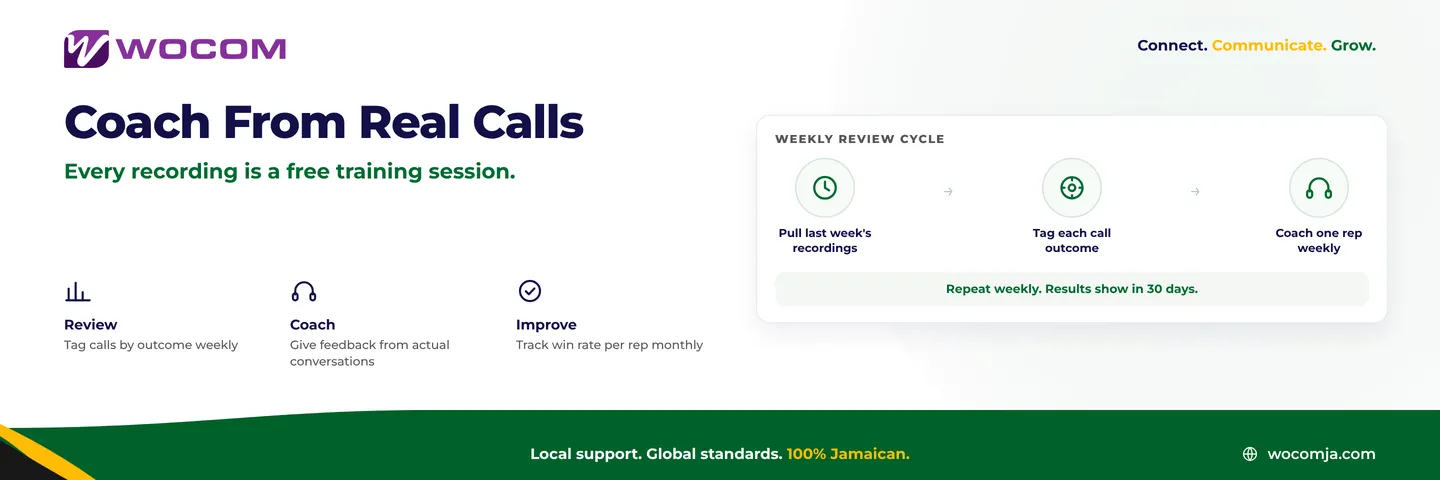
Step 1: Pull five recordings on Friday afternoon. Log into your cloud PBX admin portal, filter by the current week, and pick two from your strongest rep, two from whoever you most want to develop, and one wild card — the longest call of the week, regardless of who took it. Five recordings take roughly 20 to 30 minutes to skim, because you are not listening end-to-end. Jump to the first two minutes and the last two minutes of each call. That is where discovery happens and where the close is attempted or abandoned.
Step 2: Tag each call with a single outcome word. Won. Lost. Follow-up. Escalated. This takes five seconds per call. Over four weeks you will have 20 tagged recordings, and patterns begin to emerge: which reps convert follow-ups into sales and which ones let them die quietly, which call types run long without closing, which inbound enquiries resolve fastest.
Step 3: Pick one clip for a team listen each week. Not a lecture — a shared listen. Play 90 seconds of an actual call to the team in a private setting, then open the floor. "What did you hear? What would you try differently?" Peer learning from real calls beats scripted role-play every time, because everyone in the room knows the caller was real and the stakes were real.
Giving Feedback That Reps Accept Rather Than Dread
The fastest way to kill a call recording programme is to use recordings as evidence. If your team believes the files are being reviewed to build a case against them, performance will go underground and your best reps will start looking for a manager who coaches instead of polices. Keep the programme developmental with three rules:
Lead with the win. Start every debrief by naming one thing the rep did well on that specific call — not a generic compliment, something you actually heard. Then introduce the coaching point. "The way you handled the price pushback early on was strong. I want to show you one moment later where I think you left an opening on the table."
Make it reciprocal. Invite reps to flag their own calls. "Pick one call from this week you want feedback on" is far more effective than "I reviewed your calls and here is what I found." A rep who nominates their own recording is already thinking critically about their performance — your job is to confirm what they sensed and sharpen what they missed.
Celebrate wins publicly. If a recording captures a Montego Bay-based rep handling a difficult caller with composure and closing a deal that seemed lost, play it at the Monday standup. Public recognition of excellent calls makes the entire programme aspirational rather than punitive.
Using Your Phone System to Find the Right Calls Faster
Searching through recordings manually is the reason most managers abandon this practice after three weeks. Modern cloud PBX platforms eliminate that friction with searchable, filterable call logs.
On WOCOM's platform you can filter recordings by extension, date range, call duration, and direction. Pair that with AI-generated call summaries and you can scan 20 calls in the time it used to take to fully replay two. The summary surfaces the caller's intent, the outcome reached, and flags calls that ended without any resolution — those unresolved calls are your highest-value coaching targets, because they represent revenue that walked away.
Set up a saved filter for calls between four and twelve minutes in duration. Very short calls that go nowhere and very long calls that still end without a close are both worth examining, but the four-to-twelve-minute window is where most competitive sales conversations live. That filter alone cuts your weekly review list to the calls that actually matter.
Tracking Progress So You Know the Coaching Is Working
Coaching without measurement is encouragement. You need a number to manage against.
The simplest metric for a sales team is connection rate: of the inbound enquiry calls your team receives, what percentage result in a booked appointment, a sent proposal, or a closed sale? Pull that number from your call log the week you start the programme. Revisit it after 60 days of weekly review sessions. You will have the data to show whether the programme is moving the needle or whether you need to adjust what you are coaching.
The calls are already being recorded. The only additional cost is 30 minutes on a Friday afternoon and the discipline to make it a standing team commitment. Every week you skip is a week of free coaching data you will never get back.
Put Your Recordings to Work with WOCOM
WOCOM's Cloud PBX includes automatic call recording, searchable logs, and AI-powered call summaries as part of every business phone plan — whether your team is based in Kingston, spread across Montego Bay and Spanish Town, or working remotely. Every conversation is captured, stored securely, and ready to coach from the moment the call ends.
To activate call recording on your account, add AI call summaries, or discuss how to structure a coaching programme around your existing call data, reach WOCOM at wocomenterprise.com/contact or speak with our team directly. Your next top-performing rep may already be on your team — they just need the right feedback at the right time.
Continue exploring
Ready to upgrade your communications?
Talk to our team about the right solution for your business.
Book a Demo Contact SalesMichelle Goss is a data and AI analyst at WOCOM, where she studies how Jamaican businesses use voice, messaging and AI to win and keep customers. With a BSc in Data Science & Analytics, she turns call data, customer trends and AI receptionist performance into practical guidance owners can act on. Michelle writes WOCOM's coverage of AI call handling, call analytics, customer growth and industry trends.