Business Phone Disaster Recovery Drill Jamaica: How to Test Your Failover Before Hurricane Season
The Gap Between Having a DR Plan and Actually Being Ready
Every year, Jamaican businesses go through the same cycle. August arrives. A weather system develops in the Atlantic. Management asks, "What happens if our phone lines go down?" Someone pulls out a document last updated eighteen months ago and says, "We have a plan." But nobody has ever run it.
A disaster recovery plan sitting in a folder is not the same as a tested, verified procedure. The gap between the two is where businesses lose customers, revenue, and reputation during real incidents — whether that is a JPS outage in Kingston, a fibre cut along the Montego Bay corridor, or a storm making landfall at the worst possible hour.
This guide walks you through how to run a structured phone system DR drill: what to test, how to simulate failure without touching live calls, what to measure, and how to close the gaps you find. The drill itself takes two to three hours. The confidence it builds lasts all year.
When to Schedule Your Drill
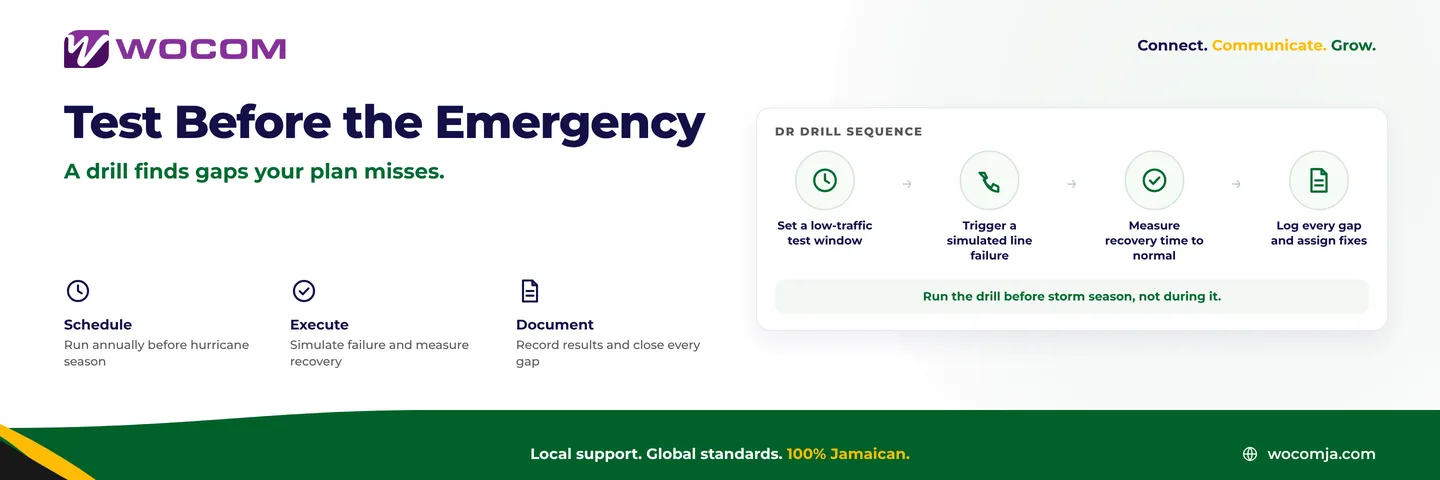
The ideal window is June — before the peak of hurricane season (August through October) and late enough that any system changes from the first quarter have had time to settle. If June passes, schedule a drill immediately after any significant incident rather than waiting another twelve months.
Choose a test window that is low-traffic for your business. For most Kingston and Montego Bay operations, Tuesday or Wednesday morning between 7:00 and 9:00 AM gives you time to run the full sequence before the first call rush, without burning a complete business day. Avoid Mondays (historically high call volume after the weekend) and Fridays, when team availability shrinks toward close of business.
Give your team at least two weeks' notice so nobody is caught off guard — but keep the specific failure scenario confidential until drill day. If every participant knows exactly which system will fail and at what minute, you are testing knowledge of a script rather than the real resilience of your setup.
Five Components Your Drill Must Cover
A phone system DR drill is not just about whether calls reroute to a backup number. It covers the full chain from the moment of failure to the moment a customer gets through to someone who can help them. Test all five areas in a single session.
- Failover routing: Does your main DID number automatically forward to a backup destination — a mobile, a secondary SIP trunk, or a cloud failover path — when the primary route becomes unavailable? Confirm the call lands at the correct destination, not just that a forwarding rule exists in the portal.
- Staff reachability: Can your team receive and place calls from alternative devices — softphone apps, mobile apps, or personal numbers with masking — within your target recovery window? Time how long it takes from "primary system down" to "first agent answering calls."
- Voicemail and message capture: If a caller reaches voicemail during the failover window, does the message actually reach the right inbox? Test the full notification path: email delivery, mobile push alert, or portal visibility.
- Customer-facing announcement: Is there a recorded message or updated auto-attendant telling callers you are experiencing a disruption and offering them an alternative? An honest, professional message during an outage retains far more goodwill than silence, a busy signal, or a default carrier tone.
- Recovery and restoration: When primary service returns, does call traffic automatically revert to normal routing — or does someone need to flip a switch manually? If manual, who is responsible, and do they know every step without reading from a document?
How to Simulate Failure Without Disrupting Live Calls
The most common reason Jamaican businesses skip DR drills is fear of interrupting production. The good news is that modern cloud phone systems allow you to test without touching your live traffic at all.
Work with your provider to identify a test DID — a secondary number that mirrors your main line's routing configuration — used exclusively for drill purposes. When you trigger the simulated failure on that number, your main lines remain completely untouched. Customers never experience anything unusual, while your team exercises the full failover sequence in real conditions.
If a test DID is not available, run the drill during a confirmed zero-call window: before business hours on a Saturday morning, or during a scheduled maintenance period coordinated with your provider. Confirm in writing that all routing changes from the drill will be reversed within a defined time window, and document the start and end of the test clearly.
For SIP trunk testing specifically, a controlled failover test involves disabling the primary trunk registration and confirming that calls route to a secondary trunk within your target switchover time. WOCOM customers can adjust routing configuration directly in the admin portal in real time — no waiting on a support ticket during a drill or a real emergency.
What to Measure and Record
A drill produces value only in what you learn from it. Capture these four metrics during every test and document them before the debrief ends.
- Actual Recovery Time (vs. your RTO target): Measure the elapsed time from the moment of simulated failure to the moment calls are being handled on the backup path. Most businesses target under five minutes. Many are surprised to find the real figure is closer to twenty.
- Message integrity: Were voicemails captured and delivered correctly? Was the customer-facing announcement clear, current, and professional? Have someone call the test number from an external mobile and listen as a first-time caller would.
- Missed steps: Every step a team member skipped, did incorrectly, or did not know about is a documented gap. Record each one without assigning blame — the goal is the list, not the individual.
- Manual dependencies: Note every action during recovery that required a specific person. If that person had been unreachable — on leave, without signal, or unavailable — what would have stopped?
After the drill, produce a single summary document: what was tested, what worked, what failed, and what changes are required before the next real incident. Assign an owner and a deadline to every gap before the debrief meeting ends. Gaps with no owner never close.
Common Gaps Jamaican Businesses Find in Their First Drill
Across real-world failover scenarios in Jamaican businesses, the same categories of gap appear repeatedly. Knowing them in advance helps your team look in the right places.
- Failover routing rules that were set up correctly — but never updated after staff changes. Calls forward to a former employee's personal mobile that has since been reassigned to someone else entirely.
- The softphone app is listed in the DR plan but nobody on the team has it installed, configured, or knows their login credentials for the backup system.
- The customer-facing announcement was recorded two years ago. It references business hours, services, or a staff member's name that no longer applies.
- Recovery requires a manual step that only one person knows how to execute — and that person happened to be the one on leave the day of the drill.
- Secondary SIP trunk credentials have expired silently. The failover fires, the backup route is attempted, and it fails with no alert and no fallback.
None of these gaps are catastrophic to discover in a drill. Every single one of them is catastrophic to discover during a real storm, a real fibre cut, or a real power event.
Build the Habit Before the Season Builds the Urgency
A one-time drill is better than none. An annual drill, run at the same time every year, becomes institutional knowledge. New staff join and learn the procedure in a controlled environment. Routing configurations get reviewed and updated on a schedule rather than only after something goes wrong. The customer-facing announcement stays current.
Businesses that run annual phone system drills consistently report two outcomes: they find at least one significant gap every time (which is the point), and their recovery time decreases year over year as the procedure becomes familiar rather than theoretical.
A phone system that has only ever been tested in good conditions is not a reliable phone system — it is an untested one that happened to work so far.
Run Your Drill With WOCOM Before the Season Peaks
WOCOM's Cloud PBX and SIP Trunk platform includes built-in failover routing, redundant trunk paths, and a live admin portal where you can adjust routing rules in real time — no waiting on a support queue during an emergency. For businesses ready to run their first structured DR drill, WOCOM's team can help you configure a test DID, walk through the simulated failure sequence, and review your results to identify gaps before the next real incident finds them first.
If you have not tested your phone system failover this year, do not wait for the next outage to find out whether it works. Speak to the WOCOM team today and schedule your pre-season DR review. Your customers will keep calling when things go wrong — the question is whether your system is ready to answer.
Continue exploring
Ready to upgrade your communications?
Talk to our team about the right solution for your business.
Book a Demo Contact SalesEverett Kildare is WOCOM's voice and infrastructure specialist, with more than 25 years of experience designing and running carrier-grade voice, SIP and virtualization infrastructure. Holding a BSc in Information Technology, he has built, secured and migrated phone systems for businesses of every size. Everett writes WOCOM's technical coverage of SIP trunking, cloud PBX, contact centres, business continuity and migration.