The Business Communication Guide for Jamaican SMEs
For a Jamaican small or medium-sized business, business communication is not an overhead to be trimmed; it is the single most reliable lever for growth you control. Every quotation request, every repeat order, every referral and every complaint passes through a phone line, a WhatsApp thread or an email inbox before it ever becomes revenue. When those channels work, the till rings. When they fail, the customer simply moves on to the shop down the road that picked up. This guide is written for owners and managers running real businesses in Kingston, Montego Bay, Portmore, Mandeville and everywhere in between, and it pulls together everything you need to build communications that win and keep customers without the cost and inflexibility of the old landline world.
WOCOM is a licensed Jamaican telecommunications provider that owns and operates its own network, so the advice here is grounded in what actually works on the ground for local SMEs, not theory borrowed from somewhere colder and bigger. Use this as your hub: each major section links down to a deeper, dedicated guide if you want to go further.
The hidden cost of poor communication
Most owners can tell you to the dollar what their rent costs, what their stock costs and what their staff cost. Almost none can tell you what their missed calls cost, and that is precisely why poor business communication is the most expensive problem in Jamaican SMEs that nobody puts on the books. A missed call is not a neutral event. It is a customer who had their wallet open, decided to ring you, and got nothing. They do not leave a voicemail and wait patiently. They ring the next name on the list.
Consider the arithmetic. Say your average sale is J$8,000 and you miss just five genuine enquiry calls a day because the line was engaged, the one person who answers was serving a walk-in customer, or it was after 5pm. That is roughly 25 missed opportunities a week. Even if only one in five would have converted, you have quietly handed away five sales a week, twenty a month, J$160,000 a month in revenue you never knew existed. Over a year that is close to two million dollars walking out the door, and you paid rent and salaries the whole time hoping that phone would ring more.
The damage is not only in lost sales. Poor communication erodes trust. A customer who cannot reach you to ask where their delivery is, or who leaves three messages and gets no callback, does not just abandon that one transaction; they tell their family and their WhatsApp groups. In a market as relationship-driven as Jamaica, reputation travels faster than any advert you could buy. The shop in Half Way Tree that always answers and always follows up will out-earn the better-stocked competitor that lets the phone ring out, every single time.
There is also an internal cost. When communications are chaotic, staff waste hours chasing each other, re-typing messages, forwarding voicemails and apologising to customers for things that were never written down. That friction is invisible on a profit-and-loss statement but it is very real in wasted wages and burned-out employees. Fixing communication is therefore one of the few business investments that simultaneously increases revenue, protects reputation and reduces internal waste.
The channels every Jamaican SME needs
Your customers are not all the same, and they do not all want to reach you the same way. A wholesale buyer wants to phone and confirm pricing in real time. A younger retail customer would rather send a WhatsApp and get a reply when convenient. A corporate client expects a proper email with a quotation attached. Building good communications means meeting customers on the channel they prefer rather than forcing everyone down a single pipe. Here are the channels that matter for a modern Jamaican SME.
Voice and your 876 number. Despite all the new messaging apps, the phone call remains the highest-intent channel there is. Someone who picks up the phone is usually ready to buy, ready to book or ready to complain, and all three deserve an instant human-quality response. A proper local 876 business number signals permanence and trust in a way a personal mobile number scrawled on a flyer never can. With WOCOM you can carry a single memorable Business Number across all your devices and locations. To understand the full landscape of options here, our ultimate guide to business phone systems in Jamaica walks through every choice from a single line to a full multi-site system.
Business mobile. Field teams, delivery drivers, sales reps moving between New Kingston and Spanish Town, and tradespeople on site all need to make and take business calls on the move without giving out their private numbers. Tying mobile devices into your business phone system means a call to your main 876 number can ring a rep's phone in Ocho Rios just as easily as the desk in head office, with the business identity preserved on the caller ID.
SMS. Text messaging is unbeatable for short, time-sensitive, one-way information: appointment reminders, "your order is ready for collection", delivery confirmations, payment links. Open rates for SMS dwarf email. For an SME running a clinic in Mandeville or a parts shop in Portmore, automated SMS reminders alone can dramatically cut no-shows and chase-up calls.
WhatsApp. In Jamaica, WhatsApp is not a "nice to have"; for many customers it is the default. It carries catalogue images, voice notes, location pins and back-and-forth conversation that customers genuinely enjoy. Treating WhatsApp as a first-class business channel, with proper coverage during opening hours, captures a huge slice of enquiries that would otherwise never reach you.
Email. Email remains the channel of record for quotations, invoices, contracts and anything a customer or auditor may need to refer back to months later. A professional email on your own domain, consistent with your phone branding, completes the impression of a serious, established business.
AI answering. The newest channel, and the one quietly transforming small businesses, is the AI receptionist. An AI answering assistant such as WOCOM's Alex can greet every caller in a natural voice, answer common questions, take messages, capture details and even book appointments around the clock, so a two-person business can present the always-on front desk of a much larger company. If this is new to you, start with our beginner's guide to AI phone systems in Jamaica.
Building a professional phone presence on a small budget
One of the most damaging myths in Jamaican small business is that a "proper" phone setup is something only big corporates in New Kingston towers can afford. That was true twenty years ago when a business phone system meant a costly box bolted to the wall, an engineer's visit for every change, and per-line rental that punished you for growing. It is simply no longer the case. Cloud technology has collapsed the price of looking and operating like a serious enterprise.
The foundation is a Business Number, also called a DID (Direct Inward Dial). This is a real 876 number that belongs to your business and that you keep no matter how you grow, how many staff you add, or where you relocate. Putting a clean local number on your shopfront, your van, your social media and your invoices instantly raises how customers perceive you. It costs a fraction of what most owners assume.
On top of that number you layer a Cloud PBX: a complete phone system that lives in WOCOM's network rather than in a cupboard in your office. With it, a single counter assistant in a Montego Bay shop can have the same professional greeting, menu options, voicemail-to-email and call routing as a company ten times the size, all configured through a web browser and all running over the internet connection you already pay for. Because there is no hardware to buy and no per-line rental, the cost scales gently with your business rather than in painful jumps. Our complete guide to Cloud PBX in Jamaica explains exactly how this works, and you can see plans on the Cloud PBX product page.
The practical upgrade path for a tight budget looks like this. Start with one memorable Business Number and a simple greeting so every call is answered professionally. Add voicemail-to-email so no message is ever lost. Introduce an auto-attendant ("press 1 for sales, 2 for accounts") once you have more than one function to route to. Bring in the AI receptionist to cover the hours and overflow your people cannot. At no point do you need to find a large lump sum, and at every point you look bigger and more reliable than your actual headcount.
Never missing a call again
If the cost section convinced you that missed calls are bleeding money, this is the section that stops the bleeding. The goal is simple: every call that comes in should be answered by something useful, every time, day or night, busy or quiet. There are four layers that together get you there.
The auto-attendant. Also known as an IVR or "virtual receptionist menu", this answers instantly and directs callers to the right place. Even a tiny business benefits, because it means a caller never hears an unanswered ring; they hear a confident, branded greeting and a clear set of options. It also filters out time-wasters and lets genuine customers self-route to the person who can actually help them.
Intelligent call routing. Behind the menu, routing decides where calls actually land. You can ring several phones at once so the first free person grabs it, ring in sequence so calls roll from the counter to the office to the manager, or route by time of day so after-hours calls behave differently from business hours. A call to your Kingston head office number can quietly ring a colleague in Spanish Town when the main team is tied up, and the customer never knows the difference.
The AI receptionist (Alex). This is the layer that changes everything for understaffed SMEs. When no human can pick up, Alex answers in a warm, natural voice, handles the common questions, captures the caller's name, number and reason for calling, and where appropriate books the appointment, then delivers a tidy message to you by email or notification. A caller at 9pm on a Sunday gets a helpful, human-sounding interaction instead of a dead line, and you wake up to a qualified lead instead of a missed call you will never identify.
Mobile failover. The final safety net ensures that even if the office internet drops or you are out on the road, calls reach you. Calls can automatically fall back to mobile devices so the business stays reachable through almost any disruption. Layered together, the auto-attendant, routing, AI and mobile failover mean that "sorry, we missed your call" simply stops happening.
Connecting multiple locations and remote staff
Growth in Jamaica often means a second branch, a warehouse across town, a sales rep covering the north coast, or staff who work part of the week from home. The old phone world made this painful and expensive, because every location needed its own lines and its own little system, and none of them talked to each other. Customers had to remember different numbers for different branches, and calls could not be transferred between sites without hanging up and dialling again.
A cloud-based system erases the distance entirely. Your Kingston shop, your Montego Bay branch and your stockroom in Portmore can all live on one phone system with one main number and shared extensions, even though they are kilometres apart. A customer rings the single business number; whoever is best placed to help, in any location, can answer. Internal calls between branches are free because they ride over the network rather than the public phone lines, and transferring a customer from the Ocho Rios counter to head office accounts is a two-second action rather than a dropped call and an apology.
Remote and hybrid staff slot into the same system. A team member working from home in Mandeville simply uses a softphone app on their laptop or mobile, and to the customer they are indistinguishable from someone sitting in the office. They have the same extension, the same caller ID, the same access to transfer and conference. This is how a lean Jamaican SME can run distributed and flexible operations that used to require a corporate budget. Much of this flexibility comes from how calls are carried between sites; if you want the technical underpinning, our complete guide to SIP trunking in Jamaica covers it in depth.
Customer experience and follow-up
Answering the call is the start, not the finish. What separates businesses that grow from businesses that merely survive is what happens after first contact. The customer experience you deliver across every channel either builds a relationship worth thousands over the years or squanders a hard-won enquiry.
The first principle is consistency. A customer who phones, then WhatsApps, then emails should feel like they are dealing with one coherent business that remembers them, not three disconnected departments. Keeping a simple, shared record of who called, what they wanted and what was promised means anyone on your team can pick up where a colleague left off. With messages captured automatically by voicemail-to-email and by the AI receptionist, you build that memory without anyone having to scribble notes on a pad that gets lost.
The second principle is speed of follow-up. The enquiry you return within the hour is worth far more than the one you get to next week, because intent fades fast. When the AI receptionist captures a lead overnight, the discipline of ringing that person back first thing in the morning, while they still need you, is where the real money is made. Set yourself a simple rule, for example that every captured message is actioned within one business hour, and watch your conversion rate climb.
The third principle is using the right channel for the moment. Confirm a booking by SMS because it is read instantly. Send the formal quotation by email because the customer needs it on record. Handle the warm, chatty pre-sale on WhatsApp because that is where the customer is comfortable. Take the high-stakes negotiation by voice because tone and reassurance matter. Matching channel to purpose makes every interaction feel effortless to the customer, and effortless is what earns loyalty.
Measuring what matters: analytics and sentiment
You cannot improve what you do not measure, and for most Jamaican SMEs their communications are a complete black box. They have no idea how many calls they get, how many they miss, what time of day they are busiest, or how those calls actually go. Moving to a modern cloud system turns that black box into a dashboard.
Basic call analytics answer the questions every owner should be asking. How many calls came in this week, and how many went unanswered? What are our peak hours, so we can roster staff to match instead of guessing? Which days are quiet enough to do deliveries? How long are callers waiting before someone picks up? Just seeing your missed-call rate in black and white is often the wake-up call that justifies the whole upgrade, because suddenly that abstract "lost revenue" from the first section becomes a hard number you can act on.
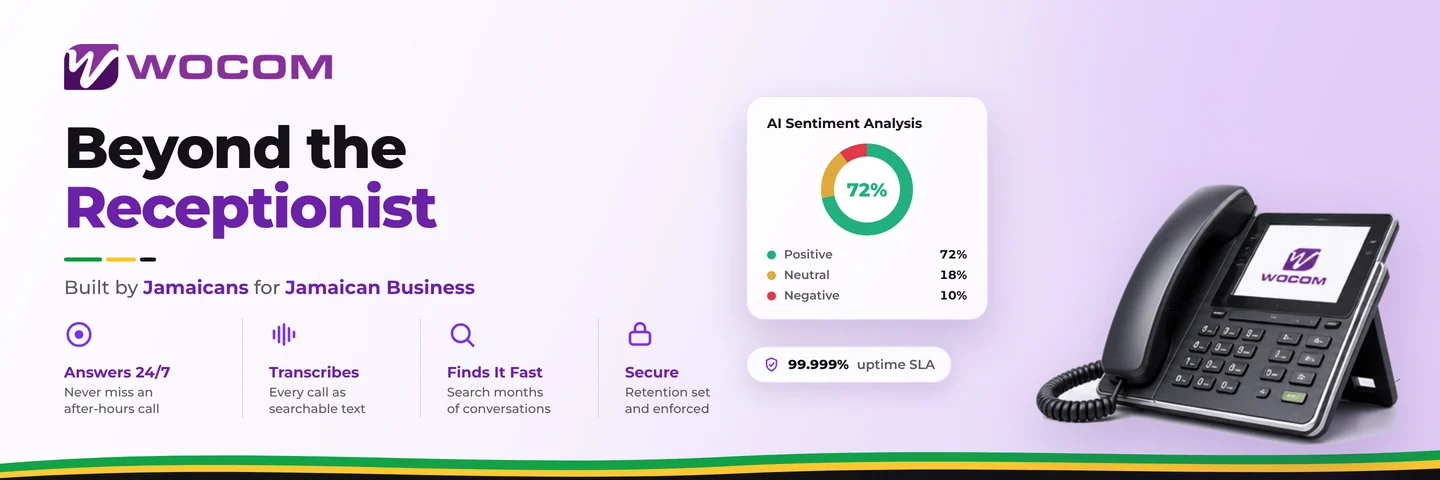
Beyond the raw numbers, AI sentiment analysis listens to how your calls actually feel. It can flag calls where the customer sounded frustrated, highlight where conversations went well, and surface recurring complaints you might never hear about second-hand. For an owner who cannot personally sit in on every interaction across three branches, this is like having a quality-control supervisor on every line. It tells you not just that you handled 400 calls last month, but whether your customers came away happy, and where exactly your service is letting you down so you can fix it before it costs you trade.
The point of all this measurement is action. Use the peak-hour data to schedule staff. Use the missed-call data to decide when to lean on the AI receptionist. Use sentiment trends to coach your team. Communications stop being a thing you hope is going fine and become a system you manage with real evidence.
Business continuity: staying reachable through storms and outages
Every Jamaican business owner knows the season. A hurricane warning goes up, the rain sets in, the power flickers, and suddenly the question is whether customers can reach you at all. Traditional phone lines are physically tied to your building, so when that location loses power or its copper is damaged, your business simply goes silent at exactly the moment customers most need to know whether you are open, whether their order is safe, or whether you can help.
This is where owning the network and engineering for resilience genuinely matters. Because a cloud phone system is not tied to a single building, your number keeps working even when one location does not. If the office goes dark, calls can automatically redirect to mobiles, to a second branch on the other side of the island, or to the AI receptionist, so customers still get answered. Your 876 number becomes a virtual front door that no storm can knock down, because it does not depend on any one physical site staying powered.
WOCOM backs this with a 99.999% uptime service level agreement, the so-called "five nines" standard, which translates to only minutes of downtime across an entire year. As a licensed provider running its own network, WOCOM controls the infrastructure end to end rather than reselling someone else's, which is what makes that level of reliability a commitment rather than a hope. For an SME, the practical meaning is simple: through outages, storms and the everyday hiccups that take competitors offline, your phones keep ringing and your business keeps trading. In a market where the business that stays reachable in a crisis wins the customers of every business that did not, continuity is not a technical detail; it is a competitive weapon.
Your communications upgrade roadmap and checklist
Knowing what good looks like is one thing; getting there without overwhelm is another. Here is a sensible, staged roadmap for an SME upgrading its communications, designed so you see benefit at each step rather than waiting for a big-bang switchover.
Stage one: secure your identity. Claim a memorable 876 Business Number and start putting it everywhere your old mobile number used to be. Set a professional greeting and turn on voicemail-to-email so no message is ever lost. This alone lifts how customers perceive you.
Stage two: stop missing calls. Add an auto-attendant to answer instantly and route callers, and configure call routing so calls roll between staff and devices instead of ringing out. Switch on mobile failover so you stay reachable away from the desk.
Stage three: cover the gaps with AI. Deploy the AI receptionist to handle after-hours, overflow and weekend calls, capturing every lead and booking appointments while you sleep. This is usually where owners feel the biggest jump in captured revenue.
Stage four: unify your channels and sites. Bring WhatsApp, SMS and email into a consistent customer experience, connect any additional branches and remote staff onto one system, and establish your one-business-hour follow-up rule.
Stage five: measure and refine. Turn on call analytics and sentiment analysis, review the numbers monthly, roster staff to your real peak hours, and coach your team on the patterns the data reveals.
A quick checklist to keep handy as you go:
- One memorable 876 Business Number on every touchpoint
- Professional greeting and voicemail-to-email enabled
- Auto-attendant and call routing configured
- Mobile failover switched on
- AI receptionist (Alex) covering after-hours and overflow
- WhatsApp, SMS and email handled consistently within opening hours
- All branches and remote staff on one system with shared extensions
- A written follow-up rule (action every captured lead within one business hour)
- Call analytics and sentiment reviewed monthly
- A continuity plan that redirects calls during outages
Budgeting in JMD without the landline tax
Perhaps the most pleasant surprise for owners who make the move is what happens to the monthly bill. Traditional providers built their pricing around the physical landline: you paid line rental for every line whether you used it or not, you paid again to add capacity, and you paid an engineer to make changes. That line-rental model is effectively a tax on growth, because every step up in size meant another fixed monthly charge bolted on whether the calls were flowing or not.
A cloud system changes the maths entirely. There is no per-line rental, because the "lines" are virtual and flex with your needs. You are not paying for hardware that depreciates in a cupboard. You add a staff member by creating an extension in a browser, not by ordering a new physical line and waiting weeks for installation. For a Jamaican SME budgeting carefully in JMD, this means your communications cost becomes predictable, proportionate to your actual size, and free of the punitive jumps that used to make owners avoid upgrading at all.
When you build your budget, think in terms of value captured rather than cost incurred. Recall the figures from the start of this guide: even a handful of recovered missed calls a week can mean over a hundred thousand dollars a month in revenue that was previously walking away. Against that, the monthly cost of a Business Number, a Cloud PBX and an AI receptionist is modest, and much of it replaces spending you were already making on the old landline. For most SMEs the upgrade does not increase the communications budget at all; it redirects the same money away from line rental and toward tools that actually win customers. That is the rare investment that pays for itself in the first month and keeps paying every month after.
Channel-to-use quick reference
Use this table as a fast guide to which channel suits which job, and which WOCOM product delivers it.
| Channel | Best for | WOCOM product |
|---|---|---|
| Voice (876 number) | High-intent sales, bookings, urgent issues, negotiation | Business Numbers / DIDs + Cloud PBX |
| Business mobile | Field reps, drivers and tradespeople staying reachable on the move | Cloud PBX softphone with mobile failover |
| SMS | Reminders, "order ready", delivery and payment confirmations | Cloud PBX messaging |
| Catalogue chat, warm pre-sale conversation, voice notes, photos | Contact Center | |
| Quotations, invoices, contracts and anything kept on record | Voicemail-to-email + business email | |
| AI answering | After-hours, overflow, weekends, lead capture and bookings 24/7 | AI Receptionist (Alex) |
| Multi-site voice | Connecting branches and remote staff on one number | SIP Trunks + Cloud PBX |
Frequently Asked Questions
What is the single most important communication upgrade for a small Jamaican business?
Securing a memorable 876 Business Number and making sure every call to it is answered, by a person, an auto-attendant or the AI receptionist. Most lost revenue in SMEs comes from missed calls, so closing that gap delivers the fastest, biggest return before you do anything else.
Do I need to buy expensive equipment to get a professional phone system?
No. A Cloud PBX runs over your existing internet connection with no hardware to buy and no per-line rental. Staff can use a desk phone if they prefer, or simply a softphone app on a laptop or mobile, so you can look and operate like a large company at a small-business cost.
Can one phone system cover branches in different parishes?
Yes. A cloud system puts your Kingston, Montego Bay and Portmore locations, plus any remote staff, on a single system with one main number and shared extensions. Calls transfer instantly between sites and internal calls between branches are free because they ride over the network.
How does the AI receptionist help if I already have staff answering the phone?
Alex covers the moments your people cannot: after hours, weekends, lunch breaks and the overflow when everyone is already on a call. Instead of those callers hitting a dead line, they get a natural-sounding assistant that answers questions, captures their details and can book appointments, so you wake up to qualified leads rather than missed calls.
What happens to my phones during a hurricane or power cut?
Because your number lives in the network rather than in your building, calls can automatically redirect to mobiles, another branch or the AI receptionist when one location loses power or connectivity. Backed by a 99.999% uptime SLA on WOCOM's own network, your business stays reachable when many competitors go silent.
Will upgrading actually increase my monthly bill?
For most SMEs, no. A cloud system removes the per-line rental that traditional providers charge, so the same budget that went to landline rental is redirected to tools that win customers. With even a few recovered missed calls covering the cost many times over, the upgrade typically pays for itself in the first month.
Ready to turn your communications into a growth engine? WOCOM is a licensed Jamaican provider that owns its own network, with local 876 support and a 99.999% uptime SLA behind every line. Get in touch with our team to map out the right setup for your business, whether you are a single shop in Spanish Town or a multi-branch operation across the island.
Continue exploring
Ready to upgrade your communications?
Talk to our team about the right solution for your business.
Book a Demo Contact SalesMichelle Goss is a data and AI analyst at WOCOM, where she studies how Jamaican businesses use voice, messaging and AI to win and keep customers. With a BSc in Data Science & Analytics, she turns call data, customer trends and AI receptionist performance into practical guidance owners can act on. Michelle writes WOCOM's coverage of AI call handling, call analytics, customer growth and industry trends.