Asterisk vs Cloud PBX Jamaica: Should You Keep Self-Hosting in 2026?
Why Jamaican IT Managers Are Rethinking Asterisk
For over a decade, Asterisk was the smart choice for any Jamaican business that wanted a serious phone system without paying carrier prices. A server in the comms room, a handful of SIP handsets, and a capable IT technician — that was enough. Today, Kingston law firms, Montego Bay hotels, and distribution companies across the island still run Asterisk. Many work fine. But the question for 2026 is not whether Asterisk works — it is whether the total cost and widening capability gap between self-hosted and cloud still makes sense.
This guide is for IT managers and business owners currently running Asterisk, FreePBX, or another self-hosted PBX who want an honest framework for deciding whether to stay or migrate.
What Asterisk Actually Costs (Beyond the Free Licence)
Asterisk itself is open source and free. But the licence has never been the main cost. The real expense shows up in four places:
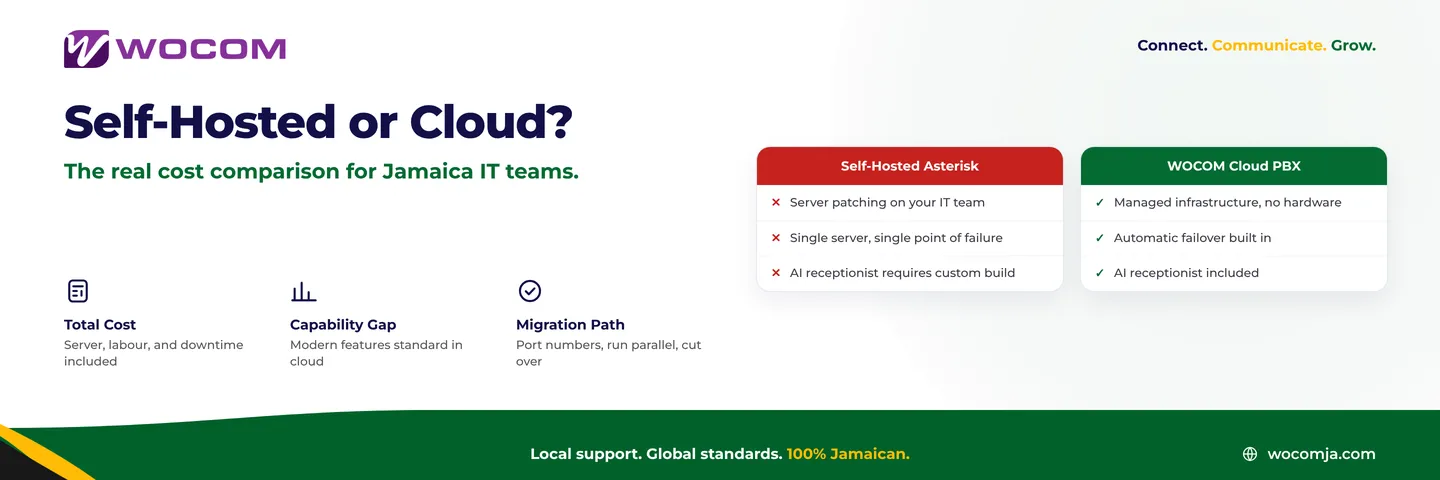
- Server hardware — a physical box that depreciates, requires UPS backup, and sits in a server room that must stay cooled year-round. In Jamaica's climate and with the frequency of power fluctuations, hardware failure is a persistent risk.
- IT labour — someone has to patch Asterisk security vulnerabilities, update FreePBX or the underlying Linux OS, and debug SIP registration failures when handsets go quiet. That time has a cost, whether it comes from a salaried IT person or a contracted technician called in on short notice.
- Downtime risk — when the Asterisk server fails, the entire business is without phones until someone fixes it. No caller redirect, no fallback, no answering service. A Monday morning server crash at an Ocho Rios resort during peak check-in week is a revenue event, not just an IT inconvenience.
- Carrier management — SIP trunks are purchased separately and configured manually into Asterisk. Any change — adding a DID, adjusting a route — requires editing dial plan files and reloading the configuration.
A business with one IT person maintaining Asterisk alongside a full network and end-user support workload should honestly estimate what proportion of that role goes to PBX upkeep. In most Jamaican SMEs, the true cost exceeds what a fully-managed cloud subscription would charge — before counting the risk of the next hardware failure.
What Cloud PBX Offers That Asterisk Cannot Match Easily
The capability gap between self-hosted and cloud has widened significantly since 2020. Features that once required weeks of Asterisk configuration — and risked breaking under the next upgrade — now come standard in managed cloud platforms:
- Automatic failover — cloud platforms distribute traffic across redundant infrastructure. If one node has an issue, calls reroute without any action from your team. Asterisk on a single server has one failure mode: complete outage.
- Mobile extensions and softphone apps — staff pick up their cloud extension on a smartphone or laptop. Asterisk supports mobile clients, but every configuration change is a dial plan edit that must be tested before it reaches users.
- AI receptionist — answering, routing, qualifying callers, and taking structured messages with conversational AI. Adding this capability to Asterisk means writing a custom AGI (Asterisk Gateway Interface) application from scratch. That is a significant development project that becomes a permanent maintenance burden the moment your IT person changes jobs.
- Real-time reporting — cloud portals surface missed calls, answer times, call volumes, and agent activity through a browser without any additional tooling. Asterisk reporting requires third-party tools, custom database queries, or a CDR viewer that must be installed and maintained separately.
- Number management — adding a seasonal number, a new department DID, or a temporary campaign line takes minutes in a cloud portal. In Asterisk, it means editing configuration files, reloading the dial plan, and hoping nothing else breaks in the process.
When Self-Hosted Still Makes Sense
Asterisk is not obsolete. There are legitimate scenarios where keeping a self-hosted PBX is the right decision:
- Genuinely unique dial plan logic — if your routing rules are tightly coupled to proprietary internal systems that no standard cloud PBX can replicate, the migration complexity may outweigh the benefit. This is the exception, not the rule.
- Regulatory data isolation — rare in Jamaica, but certain financial institutions operate under policies requiring that call records never leave their own infrastructure. Most cloud PBX providers can satisfy this requirement through appropriate data handling agreements, but if your legal team has specifically excluded cloud processing, self-hosted remains a valid option.
- Large-scale contact centre operations — if you are running a 250-seat inbound centre with a dedicated telephony team, the economics of self-hosted can still be favourable. Below 100 seats, they rarely are once honest labour costs are included.
- Your current system is genuinely well-maintained — if your Asterisk box has had no unplanned downtime in the past year, your team is current on security patches, and your feature requirements are not changing, migration risk may not justify the disruption right now.
For most Jamaican SMEs, none of these conditions apply. The Asterisk box in the comms room is maintained by one person who also handles the switches, the laptops, and the email server — and who has not opened FreePBX in several months.
The Migration Path: Asterisk to Cloud Without a Risky Cutover
Moving from Asterisk to a managed cloud PBX does not require a high-stakes flag-day cutover. The standard approach for a Jamaican business with 10 to 80 extensions:
- Audit your current dial plan — document every extension, ring group, IVR menu, time-based rule, and trunk configuration. This step consistently reveals complexity that has been forgotten and sets the true scope for the migration.
- Port your business numbers — your existing Jamaica DDI numbers (876 or 658 area codes) can be ported to the new provider. Callers continue reaching the same number they have always used. The porting process in Jamaica typically takes 7 to 10 business days once the request is submitted with the correct authorisation from your current carrier.
- Run in parallel — provision the cloud PBX and replicate your current configuration before you move a single live call. Your SIP trunks can point to either platform during testing, so the new system can be validated thoroughly without any caller impact.
- Migrate in batches — move one department or team first. Confirm call quality, feature parity, and staff comfort. Then extend to the rest of the business over the following days.
- Decommission the hardware — once the new system is verified under real load, point all SIP traffic to the cloud and retire the server. The comms room gets back its floor space, and one class of infrastructure risk disappears from your roster.
What to Look for in a Cloud PBX Replacement
Not all cloud PBX providers are suitable replacements for Asterisk in a Jamaican business context. Key criteria when evaluating options:
- Jamaican carrier infrastructure — your provider should terminate calls locally, not route through a US or UK gateway. Transatlantic routing adds latency and introduces an international dependency for what should be a domestic call. WOCOM is licensed by OUR as a telephone provider and operates its own SIP infrastructure within Jamaica.
- Standard SIP handset compatibility — you should be able to register existing Yealink, Grandstream, or Polycom handsets to the new platform via SIP credentials. A provider that forces proprietary hardware procurement is adding cost and creating a new form of lock-in.
- Local support with real response times — a provider with engineers based in Kingston or Montego Bay can respond to a production issue in hours. An offshore helpdesk that logs a ticket and responds on the following business day is not viable for business-critical communications infrastructure.
- API and CRM integration — if your business uses Zoho, a custom management system, or any CRM, the platform should offer webhooks or a documented API. Many cloud platforms advertise integrations but require premium tiers or professional services engagements to actually connect them.
Making the Decision
The honest benchmark: could your business absorb a 48-hour Asterisk outage right now? If the answer is "we would manage with personal mobiles" — callers reaching personal numbers, no recording, no reporting, no routing — the resilience case for cloud migration is already made.
If your Asterisk system is genuinely healthy, your IT team is fully capable, and your total costs are lower than cloud alternatives, keep it. But run the numbers honestly: server depreciation over three years, IT labour allocation for PBX tasks specifically, the features you are not currently getting, and the cost of the downtime events you have already had.
Most Jamaican businesses that complete this exercise honestly find that cloud is already cheaper — and that is before counting the AI receptionist, the mobile extensions, and the automatic failover they would gain.
WOCOM migrates Jamaican businesses from Asterisk, legacy PABX, and on-premise systems to fully managed cloud PBX with Jamaican SIP trunks, an included AI receptionist, and local support. Our team can map your current setup and produce a migration estimate — no commitment required.
Speak with the WOCOM team at 876-300-1400 or visit wocomja.com/contact to start the conversation about your migration path.
Continue exploring
Ready to upgrade your communications?
Talk to our team about the right solution for your business.
Book a Demo Contact SalesEverett Kildare is WOCOM's voice and infrastructure specialist, with more than 25 years of experience designing and running carrier-grade voice, SIP and virtualization infrastructure. Holding a BSc in Information Technology, he has built, secured and migrated phone systems for businesses of every size. Everett writes WOCOM's technical coverage of SIP trunking, cloud PBX, contact centres, business continuity and migration.