AI Receptionist Disclosure in Jamaica: What the Rules Say and What Callers Actually Expect
The moment a business caller first hears an AI voice answer a call, something interesting happens in their mind. They may not know for certain whether they are speaking to a person or a machine—and for a growing number of Jamaica businesses deploying AI receptionists, that ambiguity sits at the centre of a surprisingly practical question: are you legally or ethically required to say so?
It is a question with real stakes. Handle it poorly and you risk undermining caller trust the moment a customer figures it out on their own. Overthink it and you make your AI sound clunky before it has answered a single question. Here is what you actually need to know.
The Regulatory Landscape in Jamaica and Beyond
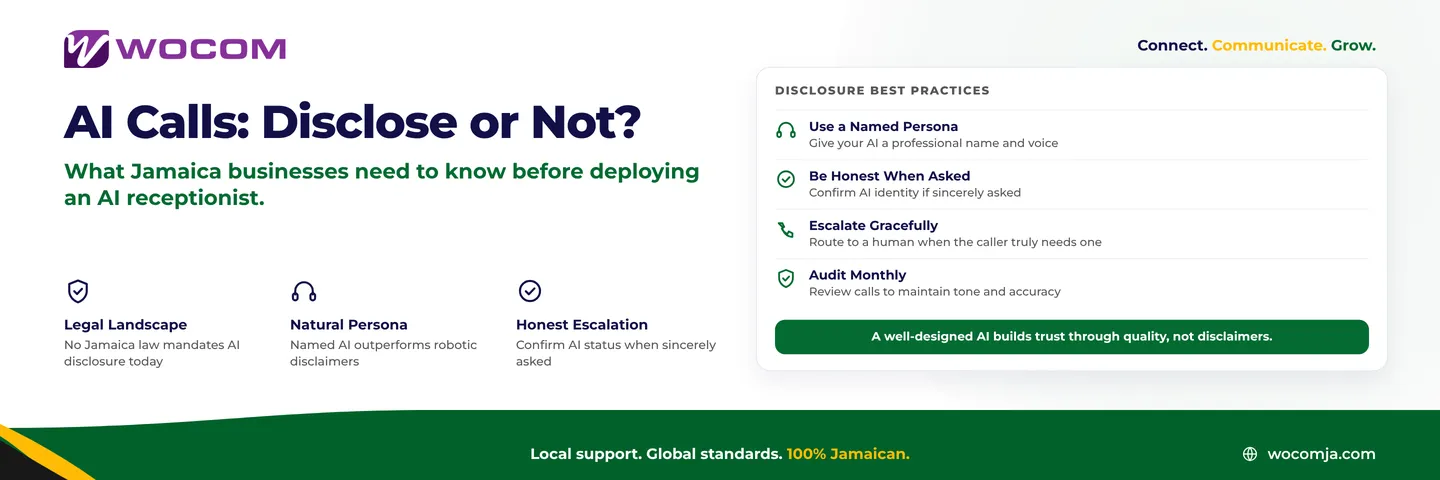
As of late 2026, Jamaica has no specific legislation requiring businesses to disclose that a caller is interacting with an AI system at the start of a call. The Jamaica Data Protection Act (2020) governs how personal data collected during calls may be used and retained, but it does not mandate an AI identity announcement. Similarly, call recording disclosure—required under widely accepted best-practice guidelines—concerns the recording itself, not the nature of the party doing the recording.
Internationally, the picture is shifting. The United States state of California introduced rules in 2019 requiring bots to identify themselves as automated in certain consumer contexts, but those rules apply to social media and online chat, not traditional business phone calls. The European Union's AI Act, now in force, includes transparency obligations for AI systems that interact directly with people—but enforcement timelines in third-party jurisdictions like Jamaica remain unclear for this year.
In practice, Jamaica businesses today operate in a disclosure-optional environment for AI phone assistants. That means the decision is a design and ethics choice, not a legal requirement—for now. That said, the direction of travel globally is toward greater transparency, and businesses that establish honest practices early will be better positioned as standards evolve.
What Callers Actually Care About
Research from customer experience firms across the Americas consistently shows that callers care less about who is answering and more about how the call is handled. A call answered professionally, accurately, and efficiently by an AI receptionist leaves callers more satisfied than a poorly handled call from a distracted or undertrained human agent.
Caller frustration rises sharply when an AI system:
- Fails to understand what they need after repeated attempts
- Loops them through dead-end menus with no exit
- Cannot connect them to a live person when the situation genuinely calls for it
- Gives wrong or invented information about the business
Notice that "didn't announce it was AI" does not appear on that list. What callers resent is poor service—not the technology behind the voice.
Why Natural Personas Work Better Than Upfront Disclaimers
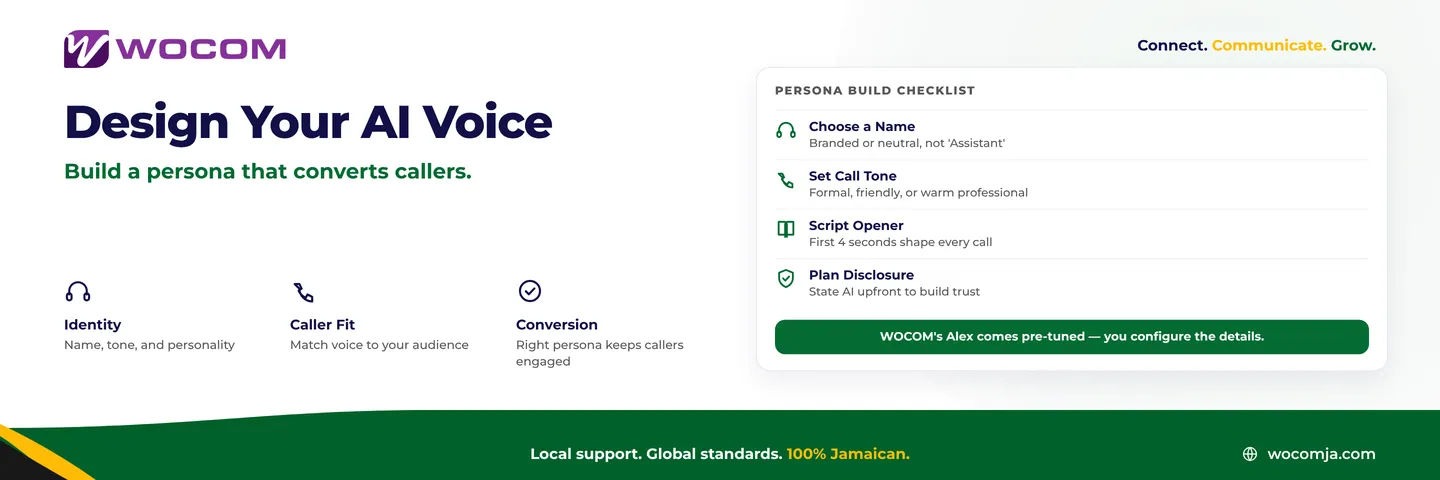
There is a practical reason that most leading AI phone platforms—including WOCOM's Alex—use a named persona rather than an opening disclaimer. Compare these two greetings:
"Thank you for calling Riverside Hardware. You are now speaking with an automated virtual assistant. Please state your query after the tone."
"Thanks for calling Riverside Hardware, this is Alex. How can I help you today?"
The first greeting immediately signals limitation. The caller hears "automated" and starts thinking about how to bypass the system to reach a person. The second greeting invites a conversation. If Alex handles the call correctly—answers the question, takes a message, or connects the caller to the right staff member—the experience is simply good service.
A named persona also gives your business a consistent voice identity. Whether a Kingston caller reaches Alex at 8 a.m. on a Monday or 10 p.m. on a Friday night, they hear the same tone, the same professionalism, the same knowledge of your services, your hours, and your team. That consistency is hard to achieve with human staff and almost impossible with a patchwork of voicemail boxes.
The Rule That Cannot Be Broken: Honesty When Sincerely Asked
While upfront disclosure is optional and often counterproductive, there is a line no well-designed AI should cross: deny being an AI when a caller directly and sincerely asks.
If a caller pauses mid-conversation and says, "Wait—am I speaking to a real person or is this a computer?", the AI must answer honestly. A response along the lines of "I'm an AI assistant helping manage calls for [Business Name]—would you like me to take a message or connect you with someone directly?" is truthful, non-disruptive, and keeps the call moving forward productively.
This is the standard recommended by AI ethics bodies globally, and it is the right approach for Jamaica businesses of every size. Deceiving a caller who directly asks is the kind of experience that ends up in a Google review or a complaint to the Consumer Affairs Commission. Honest, well-handled disclosure keeps trust intact and the call on track.
WOCOM's Alex is built with this principle embedded from the ground up. It engages naturally and professionally, responds truthfully when asked directly, and escalates to a live team member whenever the situation genuinely requires a human touch.
Designing Your AI Receptionist for Trust, Not Worry
The disclosure question is ultimately downstream of a more important one: how well does your AI actually serve your callers? These design decisions are what build real, durable trust:
- Give it a name and consistent voice. A named AI with a warm, clear voice presents as a professional point of contact—not an obstacle to navigate around.
- Ground it in your actual business knowledge. An AI that knows your services, hours, pricing, and locations gives accurate answers. One that guesses erodes trust faster than any disclosure issue ever could.
- Build in a clean escalation path. Every caller should be able to reach a live person when they need one—through a direct transfer, a scheduled callback, or a message that is genuinely acted on before close of business.
- Review calls regularly. Monthly audits of AI call handling reveal where the AI misunderstands a question, hesitates unnecessarily, or needs better information about your business. Treat your AI receptionist as a team member who benefits from structured coaching.
- Do not use AI to avoid accountability. If a caller has a complaint or an escalating issue, the AI should move them toward resolution—not cycle them through a holding pattern while nothing gets done.
What This Means for Jamaica Businesses Right Now
If you are a Kingston accounting firm, a Montego Bay property developer, or a financial services company anywhere across the island weighing an AI receptionist, the practical guidance is clear:
You do not need to announce AI on every call. You do need to ensure that every call is handled with the accuracy, professionalism, and human fallback that your callers deserve. An AI that consistently delivers on those standards will receive fewer complaints about its identity than a poorly designed system that announces itself loudly and then fails to help.
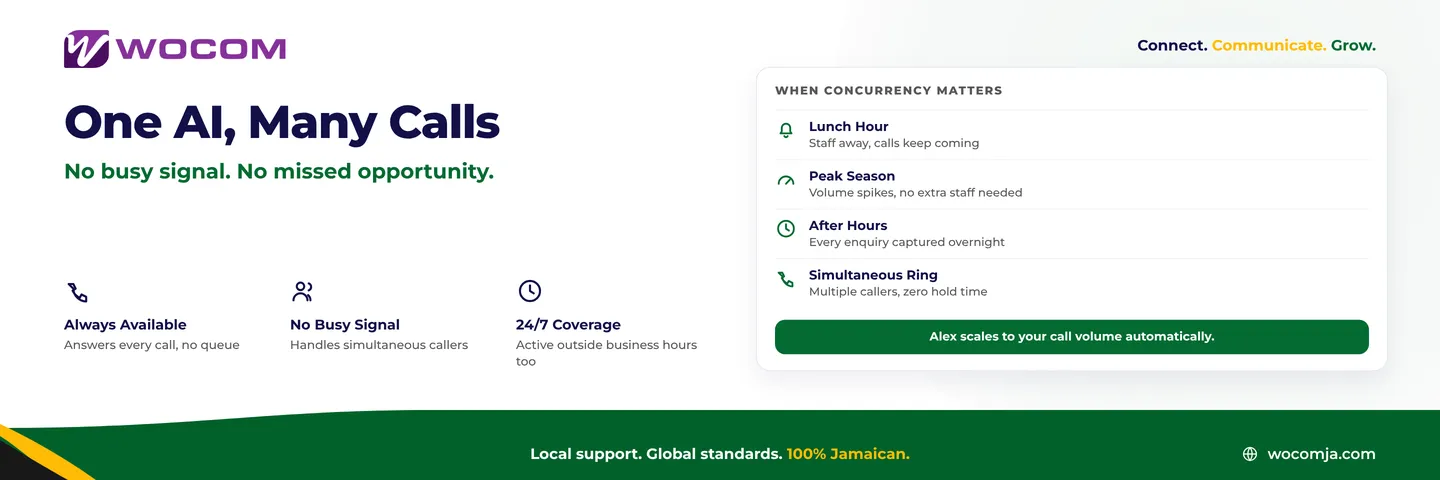
Jamaica's business communication standards are rising. Callers in 2026 expect answers—fast, accurate, and respectful. Whether those answers come from a trained human agent or a well-configured AI assistant is secondary to whether they come at all, at any hour, without a missed call or a voicemail that goes unheard.
Ready to Deploy an AI Receptionist Your Callers Will Trust?
WOCOM's AI receptionist (Alex) is built specifically for Jamaica businesses: grounded in your business knowledge, consistent in its voice, honest when it matters, and designed to escalate to your team seamlessly when a caller needs a human. It handles enquiries, captures messages, routes calls, and represents your business professionally around the clock—so every call that reaches your number gets a real answer.
Contact the WOCOM team today to find out how Alex can be configured for your business, your callers, and your industry. Visit wocomenterprise.com or speak with our team directly to get started.
Continue exploring
Ready to upgrade your communications?
Talk to our team about the right solution for your business.
Book a Demo Contact SalesMichelle Goss is a data and AI analyst at WOCOM, where she studies how Jamaican businesses use voice, messaging and AI to win and keep customers. With a BSc in Data Science & Analytics, she turns call data, customer trends and AI receptionist performance into practical guidance owners can act on. Michelle writes WOCOM's coverage of AI call handling, call analytics, customer growth and industry trends.