Introducing AI to Jamaica's Telephony System: What Changes When the Network Itself Can Listen
What “AI in the Telephony System” Actually Means
Most businesses meet artificial intelligence as an app. You sign up for something, connect it to your phone number, and hope the handoff between the two holds together. When it works it is useful. When it breaks — a dropped call leg, a two-second delay before the assistant speaks, a transfer that lands nowhere — it breaks in public, in front of a customer.
WOCOM has taken a different route. Because WOCOM is a licensed carrier that owns and operates its own network in Jamaica, the AI does not sit outside the call looking in. It sits inside the call path, on the same infrastructure that carries the audio. There is no third-party bridge to fail, no external service holding your caller in limbo while two systems negotiate.
That is the whole point of the phrase. AI is not an add-on bolted to the side of a Jamaican phone line. It is becoming part of how the line itself behaves.
Why It Matters That the Intelligence Lives in the Network
The practical differences show up in three places, and they are the differences your callers notice.
- Latency. When the AI is a hop away on someone else’s platform, every exchange pays a round trip. In the network, the assistant answers in the natural beat a person would — which is the difference between a caller who keeps talking and a caller who says “hello? hello?” and hangs up.
- Control of the call. An in-network assistant can do things an external one cannot: warm-transfer to a live extension, drop a caller into a queue with its position announcement intact, hand back to your receptionist mid-conversation without tearing the call down and dialling out again.
- One accountable party. When something goes wrong on a call, there is one company to ring, and it is in Jamaica. Nobody is pointing at the other vendor.
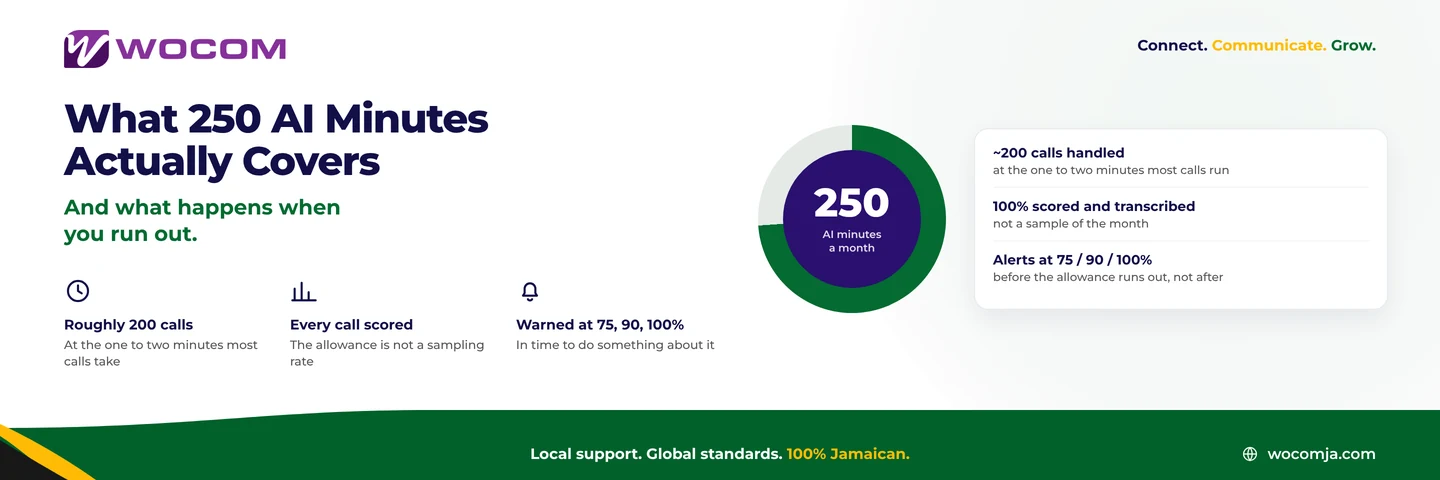
This is also why the AI arrives bundled rather than sold separately. WOCOM retired standalone AI signup in mid-2026 precisely because the feature is not a separate product any more — it is a property of the phone system. Every Cloud PBX account gets the Starter AI receptionist included, with 250 minutes a month, at no extra charge. Larger allowances exist for businesses that outgrow it, arranged through the sales team rather than a self-serve upgrade button.
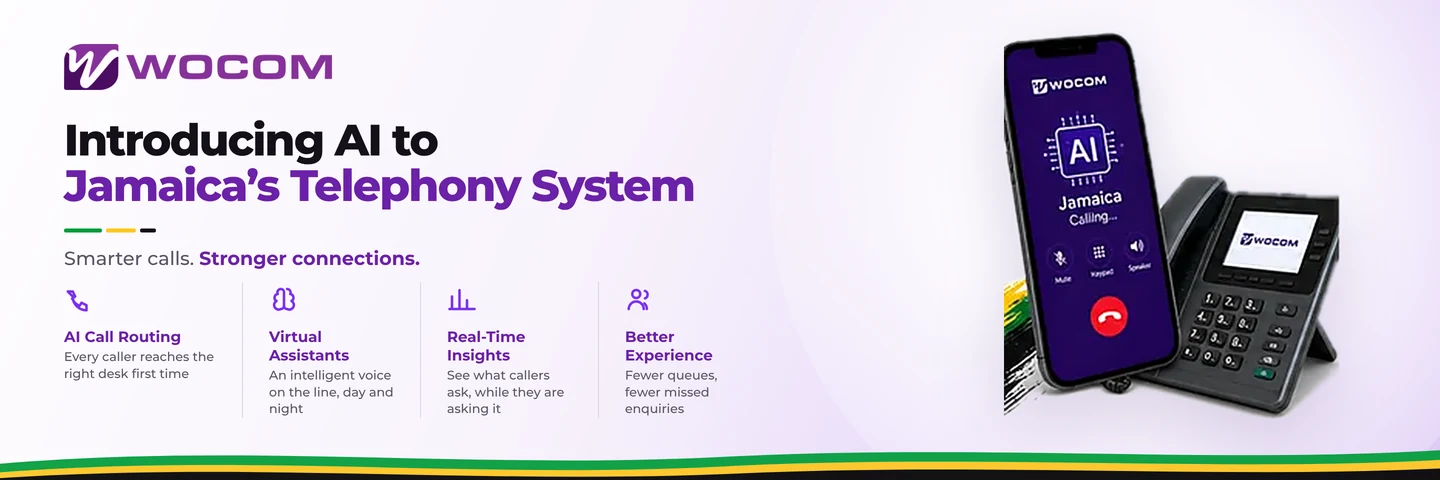
Pillar One: AI-Powered Call Routing
Traditional routing is a decision tree you wrote once and now maintain forever. Press 1 for sales, press 2 for accounts, press 3 to hear these options again. It works right up until a caller does not fit the tree, which in most Jamaican businesses is a large minority of calls.
AI routing works from what the caller actually says. Someone who opens with “I paid on Friday and the receipt never came” goes to accounts without pressing anything. Someone who says “I want to know if you have the 20-litre in stock” goes to the branch that holds stock. The caller never navigates a menu because the menu never appears.
Where it earns its keep hardest is at the edges of the day. A call at 7:40 in the morning, before the front desk is staffed, does not need to hit voicemail. It needs to be understood, answered if it can be, and routed or captured if it cannot. Our analysis of missed calls and the Jamaican business day found that more than half of inbound calls arrive outside the hours anyone is sitting at a desk.
If you want the mechanics of how routing rules interact with ring groups and hunt lists, the ring strategy guide covers what happens after the AI has decided where a call belongs.
Pillar Two: Intelligent Virtual Assistants
The assistant — WOCOM customers know it as Alex — answers in a natural voice, holds a real conversation, and works from a knowledge base you control. It can take a message, answer a frequently asked question, book an appointment, quote your opening hours, and transfer to a human when the conversation needs one.
Two things are worth being straight about.
First, the assistant is only as good as what you put in it. A knowledge base with three entries produces an assistant that says “let me take a message” a great deal. Businesses that load real answers — delivery areas, deposit policy, what to bring to an appointment — get an assistant that resolves calls instead of collecting them. The guide to what an AI receptionist should and should not answer is the honest version of where that line sits.
Second, accent. The underlying speech models handle Jamaican Standard English well and handle heavy Patois less well. We have written about where accent recognition currently stands rather than pretend the problem is solved. For most business calls this is a non-issue; for a business whose callers speak deep Patois by default, it is worth testing before you rely on it.
An AI receptionist that answers 60% of your calls completely and hands the rest to a person cleanly is worth far more than one that claims to answer 100% and gets a quarter of them wrong.
Pillar Three: Real-Time Insights and Analytics
The third change is the one owners tend to underestimate, and the one that alters decisions.
Because every call passes through a system that understands it, the system can report on it. Not just how many calls and how long they lasted — that has been available for decades — but what the calls were about. Which questions come up most. Which enquiries convert. Which hours generate demand you are not staffed for. Whether the caller sounded satisfied at the end.
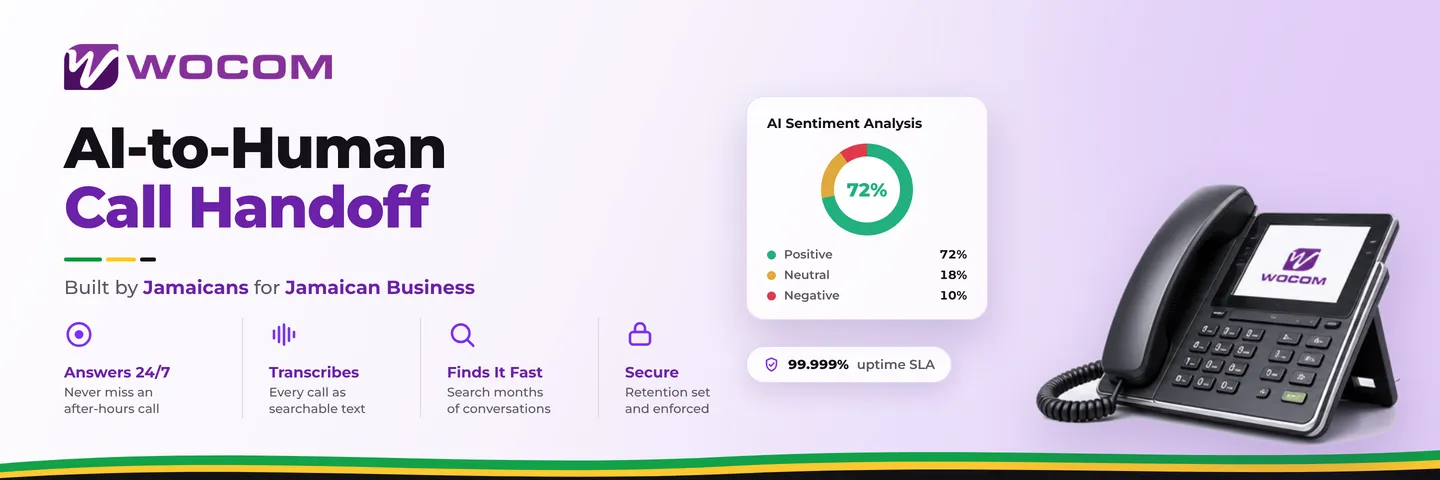
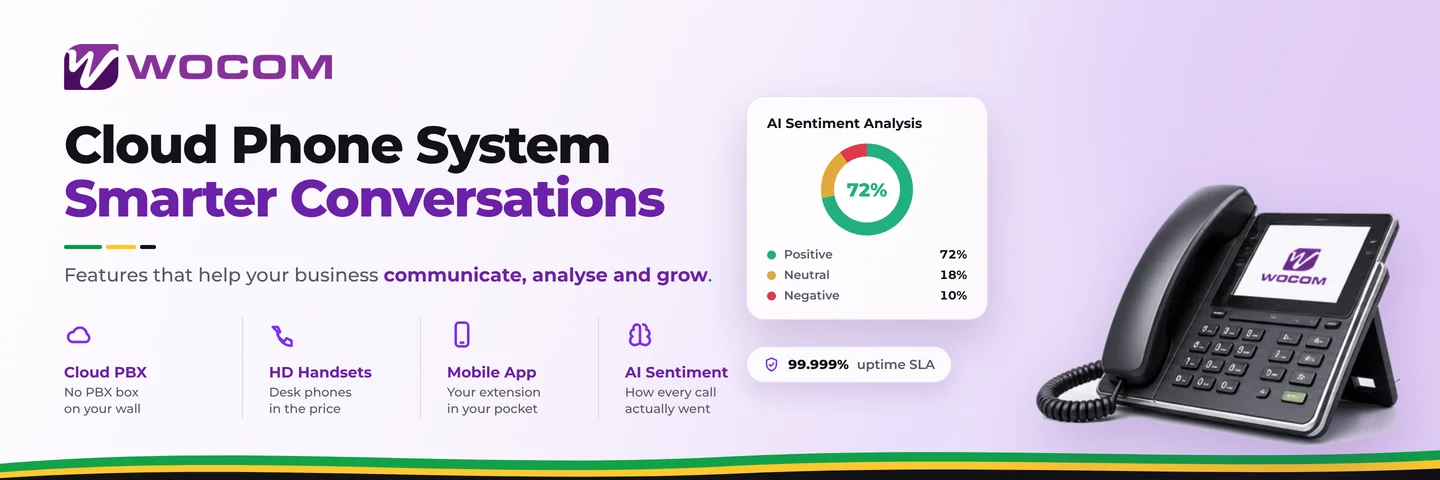
Every WOCOM AI account includes 500 sentiment analyses a month alongside the call minutes, which is enough for a small business to sentiment-score every call it takes. The call analytics overview and the sentiment analysis guide go into what those reports look like in practice.
The pattern we see repeatedly: a business installs AI expecting to save receptionist time, and within two months is using the reports to change opening hours, restock a product, or hire in a department nobody realised was underwater.
What It Does Not Do
An honest introduction needs a boundary section.
- It does not replace your team. It replaces the ringing, the hold, and the message pad. The judgement calls still belong to people.
- It does not know what you have not told it. There is no magical inference of your pricing or your policies from the internet.
- It is not a good fit for calls that need real discretion — a complaint that has already escalated, a bereavement, a legal matter. Route those to a person on the first ring.
- It does not remove your obligations under the Data Protection Act. Recording, transcribing and storing calls is regulated. Set up notice and retention properly before you switch anything on.
How to Switch It On
If you already have a WOCOM Cloud PBX, the Starter AI receptionist is on your account. It needs three things from you before it is useful: your business hours, a greeting, and a knowledge base with real answers in it. Budget an hour. The beginner’s guide to AI phone systems walks through the setup in order.
If you are still on traditional lines, the AI is one of several reasons to move, but it is not the first one — the cloud PBX overview covers what changes about your phone system before any AI is involved. You can also see the full feature set on the AI Call Intelligence and Cloud PBX pages.
To talk it through with someone who can look at your actual call flow, call 876-906-7240 in Jamaica or 877-906-7240 from the US, email support@wocomja.com, or use the form on the contact page. Ask for an AI readiness review — it is free, and it will tell you quickly whether your call volume justifies more than the included Starter allowance.
Continue exploring
Ready to upgrade your communications?
Talk to our team about the right solution for your business.
Book a Demo Contact SalesMichelle Goss is a data and AI analyst at WOCOM, where she studies how Jamaican businesses use voice, messaging and AI to win and keep customers. With a BSc in Data Science & Analytics, she turns call data, customer trends and AI receptionist performance into practical guidance owners can act on. Michelle writes WOCOM's coverage of AI call handling, call analytics, customer growth and industry trends.