AI-Powered Call Analytics: Turn Every Conversation Into Business Intelligence
Turn every conversation into valuable business intelligence. Your phone calls are full of insight — what customers want, what they are frustrated about, which opportunities your team is winning and which are slipping away. WOCOM's built-in AI Analytics helps Jamaican businesses understand those interactions and improve performance, automatically.
AI-Powered Call Analytics
Most businesses have no idea what actually happens on their calls. AI Analytics changes that by listening, summarising, and surfacing what matters — turning raw conversations into clear, searchable information you can act on.
AI Analytics Features
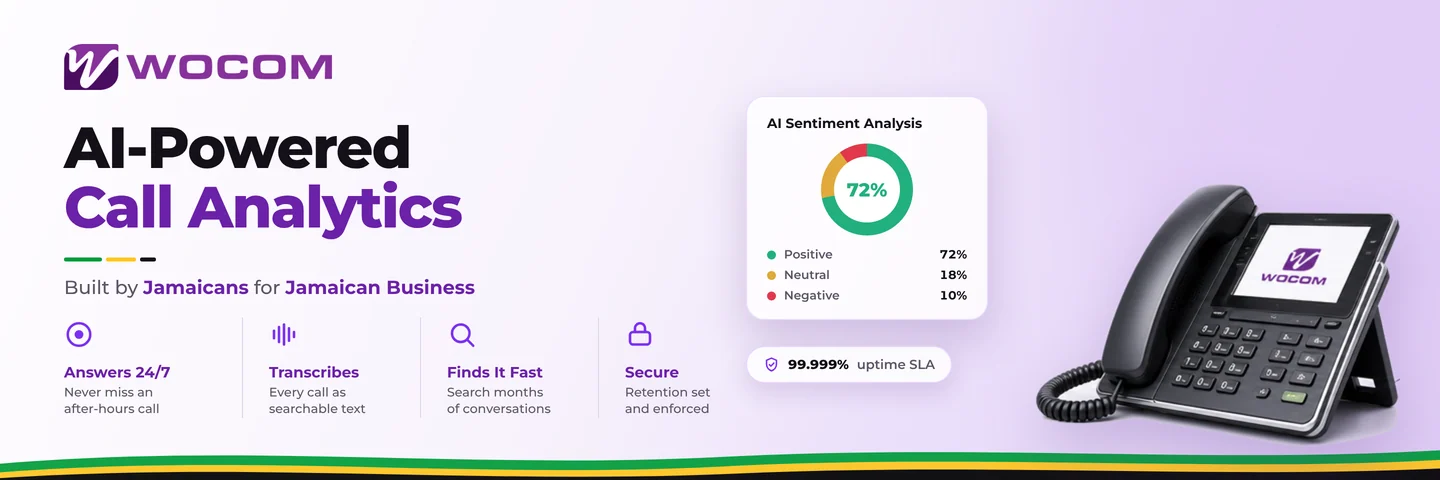
Call summaries — the gist of every call, without listening back.
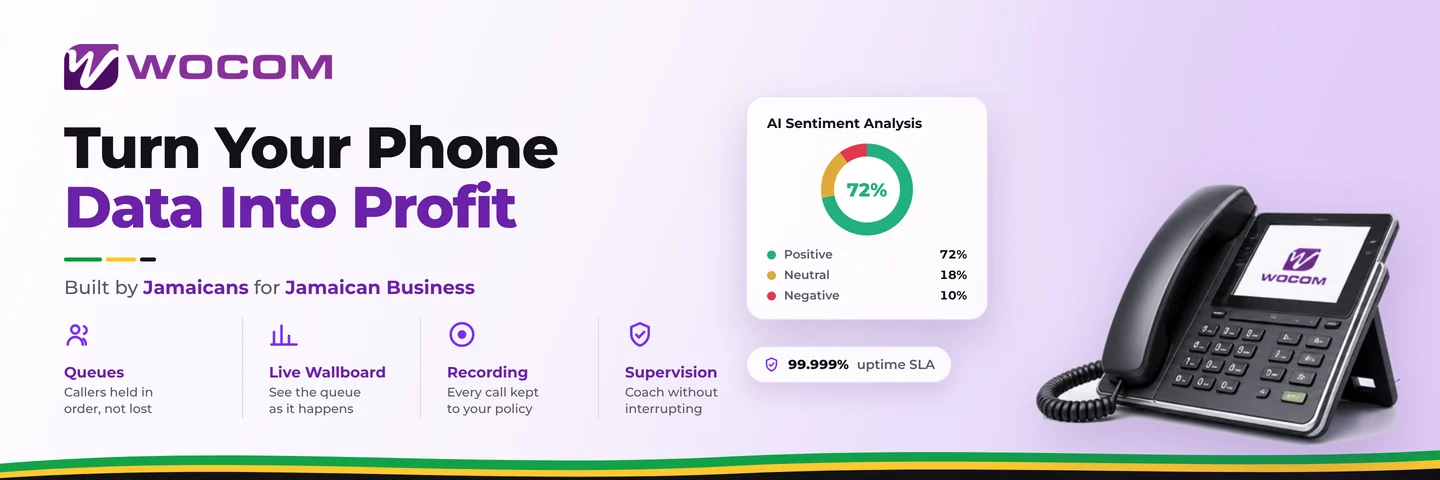
Customer sentiment analysis — know how callers really felt.
Call outcome tracking — see what each conversation led to.
Missed opportunity identification — catch the leads that nearly got away.
Agent performance insights — understand how your team is responding.
Business intelligence reporting — trends and patterns across all your calls.
Searchable conversation history — find any call in seconds.
See What Customers Are Really Calling About
With AI Analytics, you gain visibility into what customers are calling about and how your team is responding. You can spot a surge in a particular question and fix the root cause, identify your best-performing staff and what they do differently, and recover missed opportunities before they are gone for good. Decisions that used to be guesswork become grounded in real data.
Intelligence Built In
AI Analytics is included in the WOCOM platform, working hand-in-hand with the AI Receptionist and your multi-location phone system. There is nothing extra to install — every call your business handles quietly becomes intelligence that helps you serve customers better and grow. Built for modern businesses. Designed for growth.
The questions call analytics can answer
Feature lists are abstract. These are the specific questions a Jamaican business can put to its own call data once conversations are transcribed and analysed — and which are effectively unanswerable without it:
- What are people actually calling about? Not what you assume. A recurring question that occupies fifteen percent of your calls is usually a sign of something fixable — an unclear price, a confusing delivery policy, a website page nobody can find.
- When do enquiries arrive? If a third of your new-business calls land after closing time, that is a staffing and coverage decision hiding in plain sight.
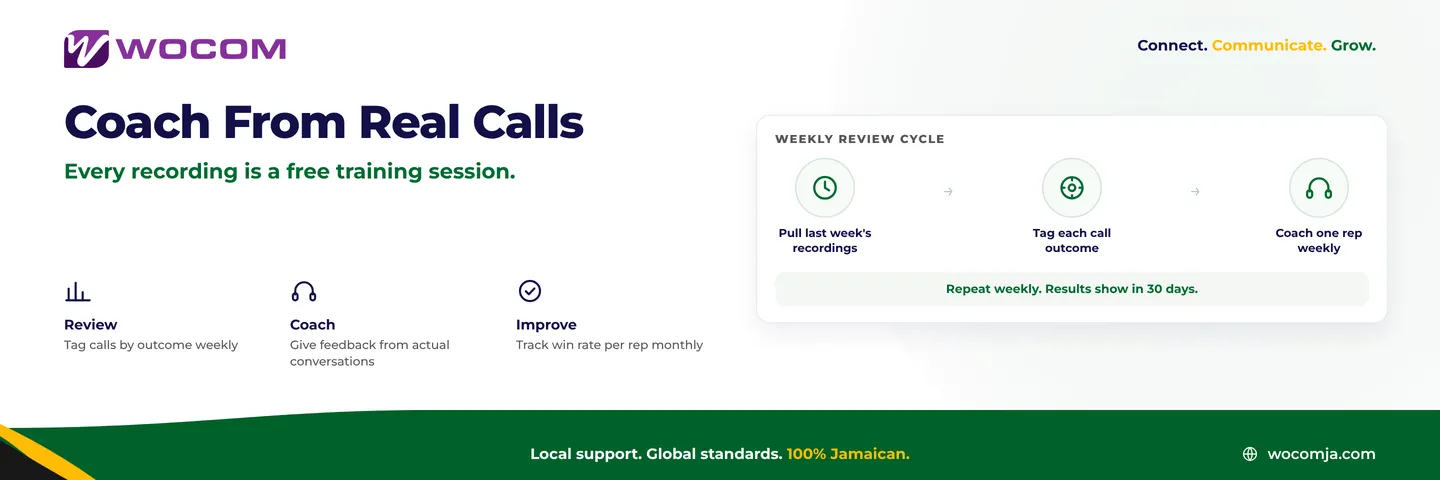
- Which conversations went wrong, and where? Sentiment shifting part-way through a call points precisely at the moment the customer became frustrated.
- What do your best people do differently? Comparing transcripts across the team surfaces the phrasing and sequence that correlate with good outcomes — which is exactly what a new hire needs to be taught.
- Which enquiries were never followed up? Calls that ended with a promise to ring back, where no outbound call followed, are recoverable revenue sitting in the log.
Turning an insight into a change
Analytics only pays back when something changes as a result. A simple discipline works better than an elaborate reporting process: once a month, take the single most frequent call topic and ask whether it should be a call at all. Often the answer is a clearer web page, a line added to an invoice, or an answer added to the AI receptionist's knowledge base — after which those calls stop arriving and your team's capacity increases without hiring.
The second discipline is reviewing negative-sentiment calls as a group rather than individually. One difficult call is a bad day. Twelve difficult calls that all turn at the same point in the conversation is a process problem you can fix.
What it cannot tell you
Sentiment analysis reads tone and language, not intent. A direct speaker can be scored negatively while being perfectly satisfied, and Jamaican conversational directness is easy for a model to misread. Treat sentiment as a way of finding calls worth listening to, not as a verdict on them — and never as a metric to performance-manage staff against on its own.
Transcription accuracy also varies with line quality and accent. It is more than good enough to find themes across hundreds of calls; it is not a court transcript.
Getting value from it in the first month
Start narrow. Pick one question — most usefully "what are the five things people call about most often" — and act on the answer before adding anything else. Businesses that switch on every report at once generally read none of them.
AI Analytics is included in the WOCOM platform alongside the AI receptionist, so there is nothing to install or integrate. See AI Call Intelligence for how scoring and sentiment work across a whole team, or book a demo to see it running on real calls.
Continue exploring
Ready to upgrade your communications?
Talk to our team about the right solution for your business.
Book a Demo Contact SalesMichelle Goss is a data and AI analyst at WOCOM, where she studies how Jamaican businesses use voice, messaging and AI to win and keep customers. With a BSc in Data Science & Analytics, she turns call data, customer trends and AI receptionist performance into practical guidance owners can act on. Michelle writes WOCOM's coverage of AI call handling, call analytics, customer growth and industry trends.