Adding SIP Trunk Channels Mid-Contract: What Jamaica Businesses Need to Know
When Your SIP Trunk Runs Out of Room
Your business signed up for four SIP channels twelve months ago. That was the right number for a team of eight handling a steady daily call volume. Then you hired three more staff, opened a second counter in your Portmore branch, and ran a promotion that tripled inbound call volume for two weeks. Now callers are getting busy signals during peak hours, and your front desk is fielding complaints about not being able to get through.
This is one of the most common growing pains for Jamaica businesses on cloud phone systems: the capacity you planned for no longer matches the business you have. The good news is that SIP trunking is specifically designed to solve this problem quickly, and you do not need to wait for a contract renewal cycle to fix it.
What a SIP Channel Actually Limits
A SIP channel represents a single active voice call path. If your SIP trunk has four channels, a maximum of four calls can be in progress at the same time — inbound or outbound combined. A fifth caller who dials in while all four channels are occupied will receive a busy signal or be disconnected, depending on how your PBX handles overflow.
This is different from how many phone numbers or extensions you have. You can have ten staff members with individual extensions, but only four of them can be on calls simultaneously with a four-channel trunk. The channel is the pipe; extensions are the destinations on top of it.
For most Jamaica businesses, the right channel count depends on:
- Peak concurrent callers — the highest number of calls active at the same time during your busiest hour
- Call hold behaviour — held calls still consume a channel until they are completed or disconnected
- Outbound calling volume — staff making outbound calls while inbound calls arrive use channels from the same pool
- Queue depth — callers waiting in a queue are typically held on the trunk, consuming capacity
Signs You Have Hit the Channel Ceiling
Most Jamaica business owners do not discover a capacity problem from a report — they discover it from a customer complaint or a staff observation at the worst possible moment. Watch for these signals:
- Callers report busy signals despite the office being open and staffed
- Queue wait times spike sharply during certain hours each day — particularly Monday mornings and midday in Kingston commercial areas
- Outbound calls fail because inbound traffic has already consumed all available channels
- CDR reports show calls terminating immediately with no ring duration — a reliable indicator of channel exhaustion rather than caller hang-up
- Staff cannot reach internal extensions when external call volume is high
If you see these patterns consistently — especially around promotional periods or seasonal rushes — you are hitting the ceiling on your current trunk capacity, and the fix is straightforward.
What Mid-Contract Expansion Involves
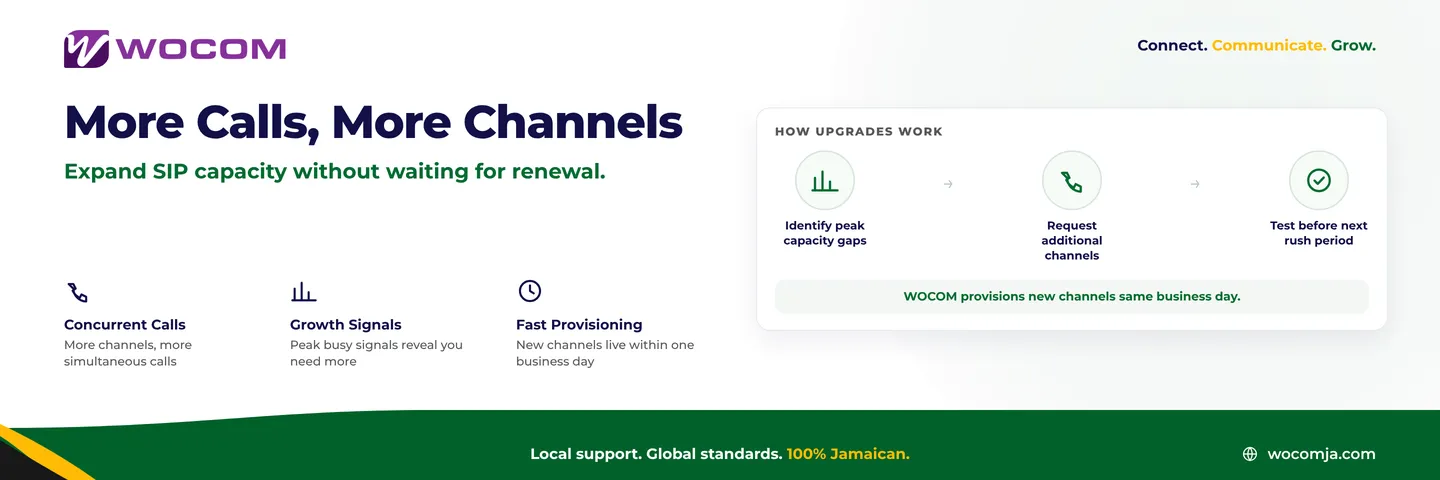
Adding channels to an existing SIP trunk is a provisioning operation, not a new contract. Most carriers treat additional channels as an addendum to your existing service agreement. The process typically works like this:
- Request — contact your provider and specify how many additional channels you need. If you are unsure, a good provider will size the upgrade based on your CDR data.
- Pricing confirmation — additional channels are billed at your existing per-channel rate, or at the current rate if pricing has changed. A reputable provider confirms the cost in writing before any provisioning begins.
- Provisioning — the carrier activates additional capacity at the network level. With modern SIP infrastructure, this is often completed within hours rather than days.
- Configuration update — your PBX or hosted phone system may need its trunk configuration updated to recognise the new capacity ceiling. Your provider or a WOCOM technician handles this step.
- Testing — before closing the request, simulate concurrent calls to confirm new channels are live and routing correctly under load.
For Jamaica businesses on WOCOM SIP trunking, additional channels can typically be provisioned and live within the same business day.
How Billing Changes When You Add Channels
Businesses on a per-channel monthly model will typically see a prorated charge for the current billing month, then the full additional channel cost on subsequent invoices. Businesses on a pay-per-minute model are generally capacity-uncapped by design — their cost rises with usage rather than with channels, so the mid-contract upgrade concept works differently for them.
Before requesting additional channels, confirm the following with your provider:
- Is there a minimum commitment period for additional channels?
- Can channels be removed again after a seasonal peak if volume drops?
- Is the per-channel rate for added capacity the same as your original agreement?
- Will the expanded trunk appear on the same invoice as your existing service?
A transparent provider answers these questions before any billing change takes effect. If yours cannot, that gap in communication is worth noting when your contract comes up for renewal.
Sizing the Upgrade Correctly
The most common mistake Jamaica businesses make when adding channels is adding just enough to solve today's problem — and then needing another upgrade three months later. A better approach is to analyse your peak call data, add enough to cover a reasonable growth buffer, and revisit capacity at your next annual review.
A practical sizing method: take the highest concurrent call count observed during your busiest week in the past quarter. Multiply by 1.3 to add a 30% growth buffer. Round up to the nearest whole channel. That is your target.
For example: if your CDRs show a maximum of six simultaneous calls during peak hours, your target is six × 1.3 = 7.8, rounded to eight channels. Running at eight instead of six gives you headroom for unexpected spikes — a marketing campaign, a promotional rush, a public holiday callback wave — without immediately exhausting capacity again.
Note for Montego Bay tourism and hospitality businesses: SIP channel demand correlates directly with high-season arrivals. Businesses near the resort corridors in Montego Bay and Negril commonly need 40 to 60 percent more channels between December and April than during the low season. Plan channel capacity for your peak, not your annual average.
When to Add Channels vs When to Reassess the Whole Trunk
Adding channels is the right move when your call volume has grown but your provider relationship, pricing, and call quality remain sound. It is the wrong move when you are adding channels to compensate for reliability problems, poor routing, or high latency that extra capacity will not resolve.
Consider a full trunk review — not just a channel upgrade — if you are also experiencing:
- Consistent one-way audio or echo on calls, regardless of call volume
- SIP registration failures that require manual intervention to restore
- No disaster recovery or failover option on your current trunk
- Pricing that no longer reflects the current market rate for SIP trunking in Jamaica
- A provider that does not offer a clear SLA or uptime commitment
Adding channels to a trunk that needs replacing delays a necessary decision. A capacity upgrade should solve a capacity problem — not paper over a deeper reliability or quality issue.
Get the Right SIP Capacity for Your Jamaica Business
Your SIP trunk should grow with your business, not hold it back. Whether you need two additional channels for a Kingston professional services firm handling a new client intake campaign, or a full capacity review for a Portmore distribution company preparing for Q4, WOCOM can assess your current CDR data, recommend the right channel count, and have the upgrade live without disrupting active service.
Contact WOCOM today to review your current SIP trunk capacity and find out exactly what an upgrade costs and how quickly it can be provisioned. Your next peak period should not be the one where you find out you ran out of room.
Continue exploring
Ready to upgrade your communications?
Talk to our team about the right solution for your business.
Book a Demo Contact SalesEverett Kildare is WOCOM's voice and infrastructure specialist, with more than 25 years of experience designing and running carrier-grade voice, SIP and virtualization infrastructure. Holding a BSc in Information Technology, he has built, secured and migrated phone systems for businesses of every size. Everett writes WOCOM's technical coverage of SIP trunking, cloud PBX, contact centres, business continuity and migration.