AI Call Scoring: How Every Call Gets a Score, and How to Read It
What a Call Score Actually Is
Every call handled on a WOCOM Cloud PBX can be scored automatically. Not sampled, not spot-checked by whoever had a quiet afternoon — scored, all of them, against the same criteria, within moments of the caller hanging up.
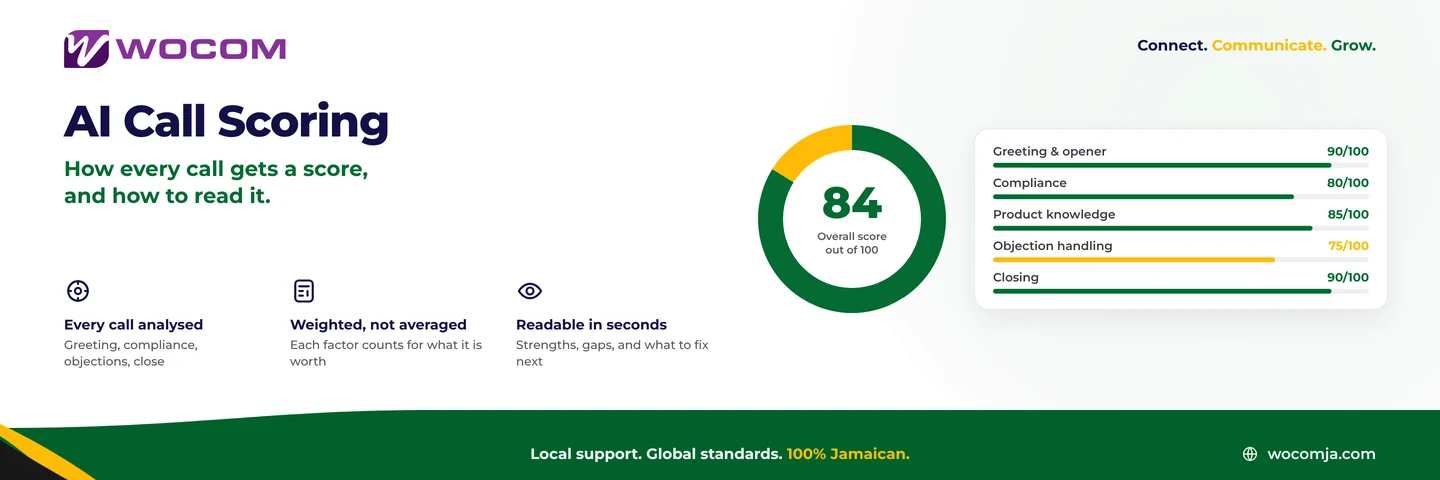
The score is a number out of 100 built from several weighted factors. A typical breakdown looks like this: greeting and opener, compliance, product knowledge, objection handling, and close. Each factor is assessed from the call transcript, each carries a weight, and the weighted result is the overall score.
It matters that the factors are weighted rather than averaged. A perfect greeting does not make up for a missed verification step, and treating them as equal would tell you the opposite of what you need to know.
Why Manual QA Stopped Working
Most Jamaican contact centres and support desks still do quality assurance the traditional way: a supervisor listens to a handful of calls per agent per month and fills in a scorecard.
The arithmetic is unkind. A ten-agent team taking 3,000 calls a month, with a supervisor reviewing five calls per agent, is scoring fifty calls — about 1.7% of the total. Every conclusion drawn about agent performance, customer experience and compliance rests on that 1.7%, and the fifty calls were not chosen randomly. They were chosen because they were convenient.
A sample of 1.7% cannot tell you whether a problem is systemic or an accident. It can only tell you what happened on the calls someone had time to listen to.
Automatic scoring changes the denominator. When 100% of calls carry a score, an outlier is genuinely an outlier and a pattern is genuinely a pattern.
How to Read the Score
The overall number is the least useful part of the report. It is a headline, and like all headlines it hides the story.
Read the factors instead, and read them in this order:
- The lowest factor, not the average. An agent scoring 84 overall with objection handling at 60 does not have an 84-shaped problem. They have an objection-handling problem, and it is entirely coachable.
- Compliance separately from everything else. A compliance miss is not a quality issue to be traded off against a warm manner. Treat that factor as pass or fail and look at it on its own.
- The spread across the team, not the individual. If every agent scores badly on the same factor, the fault is in your script, your knowledge base or your training — not in your people.
- The trend, not the snapshot. One week is noise. Four weeks is a direction.
What Good Looks Like
Benchmarks depend on how strictly your criteria are written, but as a starting point for a Jamaican business:
- 85 and above — consistently strong. Use these calls as coaching material rather than as a problem to solve.
- 70 to 84 — solid, with one or two specific weak factors. This is where coaching produces the fastest return.
- Below 70 — look at the transcript before you look at the agent. A low score often reflects a call that should never have reached that desk.
Set your own thresholds once you have a month of data. Borrowed benchmarks are worse than none, because they invite you to explain away your own numbers.
Using Scores Without Wrecking Morale
This is where scoring programmes usually fail, and the failure is always the same: the score becomes a stick.
A few rules that keep it useful:
- Show agents their own scores. A number an agent cannot see is a number being used against them. A number they can see is feedback.
- Never rank publicly by overall score. Leaderboards on a single composite metric drive people to optimise the metric, not the call. If you publish anything, publish improvement.
- Coach the factor, not the number. “Your score is 71” is not actionable. “On four calls this week the customer asked about delivery twice before getting an answer” is.
- Let agents challenge a score. The transcript is right there. If an agent can show the score misread the call, that is useful information about your criteria.
Scoring works best alongside the softer signals. Where the score says the call went well and sentiment analysis says the customer was unhappy, you have found something a scorecard alone would have missed.
Where the Score Comes From
Scoring depends on transcription, which depends on audio quality. A call carried cleanly end to end over the network transcribes accurately and scores accurately; a call chewed up by packet loss produces a transcript with holes in it and a score you should not trust.
If a particular agent’s scores are inexplicably low, check their call quality before you check their technique. Our guides to MOS and call quality and to transcription cover what to look at.
Getting Started
AI call scoring is part of AI Call Intelligence, included with every WOCOM Cloud PBX plan. Practical first month:
- Week one: leave the default criteria alone and just collect data. Do not coach from it yet.
- Week two: read ten transcripts alongside their scores and check the scoring matches your judgement. Adjust the weights if it does not.
- Week three: set your own thresholds from your own distribution.
- Week four: start one-to-one coaching, one factor per agent.
To set up scoring criteria that match how your business actually sells or supports, call 876-906-7240 in Jamaica or 877-906-7240 from the US, email support@wocomja.com, or use the contact page.
Continue exploring
Ready to upgrade your communications?
Talk to our team about the right solution for your business.
Book a Demo Contact SalesMichelle Goss is a data and AI analyst at WOCOM, where she studies how Jamaican businesses use voice, messaging and AI to win and keep customers. With a BSc in Data Science & Analytics, she turns call data, customer trends and AI receptionist performance into practical guidance owners can act on. Michelle writes WOCOM's coverage of AI call handling, call analytics, customer growth and industry trends.