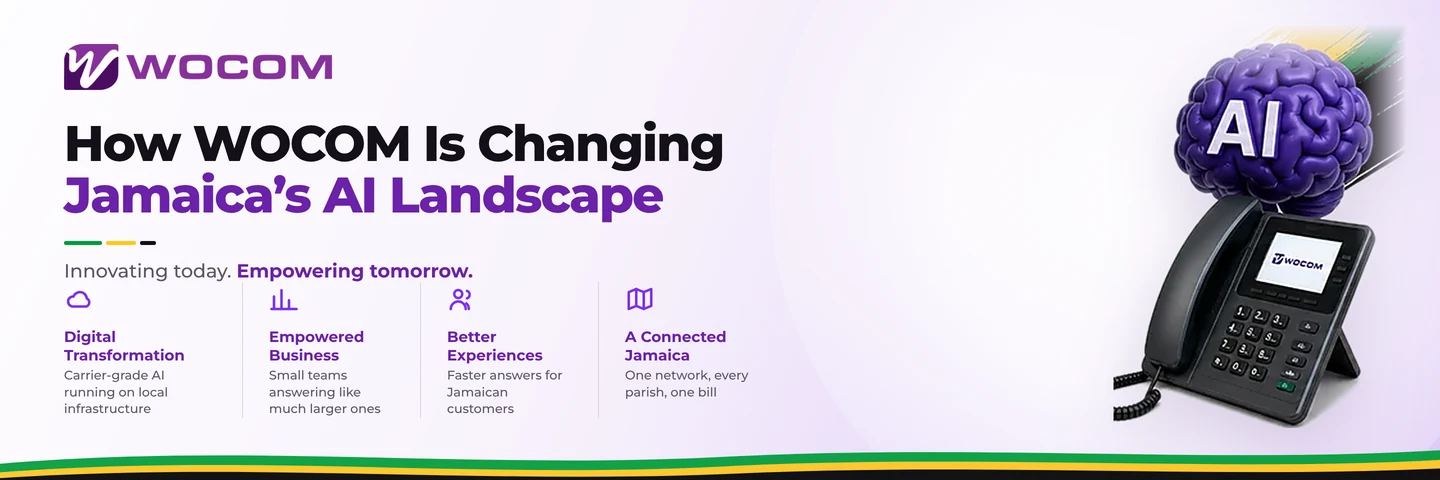
How WOCOM Is Changing Jamaica's AI Landscape
Innovating Today, Empowering Tomorrow
Jamaica’s conversation about artificial intelligence has mostly been about somewhere else. The models are built elsewhere, the case studies are from elsewhere, and the pricing is quoted in a currency that is not ours. It is easy for a Jamaican business owner to conclude that AI is something that will arrive here eventually, aimed at companies much larger than theirs.
That conclusion is now out of date, and the reason is unglamorous: the AI that matters most to a small business is not a chatbot on a website. It is the thing that answers the phone. And the phone network is one of the few pieces of serious technology infrastructure that Jamaica owns, operates and regulates for itself.
WOCOM is a 100% Jamaican-owned, OUR-licensed carrier. That is the starting condition for everything below. It is why AI arrived on Jamaican business lines as a standard feature rather than an imported subscription.
Driving Digital Transformation Where It Actually Bites
Digital transformation is a phrase that has been worn smooth by overuse, so here is the concrete version.
A large share of Jamaican businesses still run their customer relationship through a phone number and a person. Not a CRM, not a ticketing system — a number and a person. When that person is on lunch, at the bank, or already on a call, the business is closed to the caller who is trying to spend money with it.
The transformation that matters is not replacing that model with enterprise software nobody has time to learn. It is making the phone line itself capable — so it answers at 7pm, understands what the caller wants, and either handles it or captures it properly. Our worked analysis of missed calls across the Jamaican business day put more than half of inbound calls outside staffed hours. That is not a technology gap. It is a revenue gap with a technology fix.
Doing it at the network layer matters. The same infrastructure question that decides whether a business gets AI at all — connectivity, call quality, who owns the trunk — is examined in what the market data says about how Jamaica works now: strong mobile coverage, thin fixed broadband, and a customer base that expects to be answered immediately.
Empowering Businesses Across Jamaica
The most consequential thing about bundling AI with the phone system is who it reaches.
Priced as a standalone product, an AI receptionist is bought by companies with a budget line for experiments. Included with every Cloud PBX plan — Starter, with 250 minutes a month, at no additional charge — it reaches the eight-person hardware store in May Pen, the two-van plumbing outfit in Portmore, the guesthouse in Port Antonio that closes reception at 6pm. Those businesses do not run pilots. They either have the capability or they do not.
What it changes for them is scale of presence rather than headcount:
- A three-person firm answers every call on the first ring, all day, every day, including the ones that arrive while all three are with customers
- A single-location business takes enquiries from every parish without anybody working a night shift
- An owner stops being the overflow receptionist for their own company, which is the most expensive hour in most small Jamaican businesses
This is what including it with every plan was designed to do. A capability that only large companies can afford widens the gap between large and small companies. A capability that comes with the phone line narrows it.
The measure of whether AI has changed a country’s business landscape is not how advanced the largest companies become. It is how ordinary the capability becomes for the smallest ones.
Enhancing Customer Experiences
Jamaican customers are not short of opinions about service, and phone service is where most of those opinions are formed. Long hold times, being transferred in circles, leaving a message that nobody returns, ringing out entirely.
Each of those has a specific fix, and none of the fixes is exotic:
- Ringing out — an assistant that answers on the first ring, at any hour, and knows your business
- Transfer roulette — routing that works from what the caller says rather than a menu they must decode
- Unreturned messages — structured capture with the callback details filled in, delivered to a named person rather than a shared voicemail nobody owns
- Repeating yourself — a searchable transcript of the last conversation, so the second call starts where the first one ended
The appointment booking case is the clearest single example: a caller books at 9pm, gets a confirmation, and the diary is right in the morning without anyone having touched it.
Building a Smarter, More Connected Jamaica
There is a national dimension to this that is worth stating without overstating.
When the intelligence layer runs on infrastructure inside the country, three things follow. Call audio and transcripts stay on local infrastructure rather than being shipped abroad by default, which matters for Data Protection Act compliance and for the businesses that ask us where their data lives. Support is local, so a fault at 2pm on a Tuesday is fixed by someone who can be on site. And the expertise accumulates here — the engineers tuning voice models for Jamaican callers are in Jamaica, which is the only way problems like Patois recognition ever get worked on seriously, because nobody else has a commercial reason to care.
That last point deserves emphasis, because it is the honest limit of the current position. Accent handling is not solved. Deep Patois is transcribed and understood less reliably than Jamaican Standard English, and we publish that rather than paper over it. It is being worked on because the company doing the work is here and its customers are the people affected.
What This Looks Like From Where You Sit
If you run a business in Jamaica, the practical read is short.
The AI capability that would have been an enterprise project three years ago is now a property of a business phone line, included with the plan, configured in about an hour. It will answer your calls, route them sensibly, transcribe them, and tell you what your customers keep asking for. It will not replace judgement, it will not know what you have not told it, and it will not exempt you from the Data Protection Act.
The question is no longer whether AI is coming to Jamaican business. It is whether your phone line is on a network that has it. Start with the cloud PBX overview if you are still on traditional lines, or the AI receptionist guide if you already have the phone system and have not switched the assistant on.
Talk to a Jamaican Team About It
You can see the full picture on the AI Call Intelligence, AI Solutions and Cloud PBX pages, or read what it has meant for businesses already running it in our case studies.
To talk it through with people who will look at your actual call flow before recommending anything, call 876-906-7240 in Jamaica or 877-906-7240 from the US, email support@wocomja.com, or use the contact page. Local support, local expertise, and a network that answers when you call it.
Continue exploring
Ready to upgrade your communications?
Talk to our team about the right solution for your business.
Book a Demo Contact SalesMichelle Goss is a data and AI analyst at WOCOM, where she studies how Jamaican businesses use voice, messaging and AI to win and keep customers. With a BSc in Data Science & Analytics, she turns call data, customer trends and AI receptionist performance into practical guidance owners can act on. Michelle writes WOCOM's coverage of AI call handling, call analytics, customer growth and industry trends.