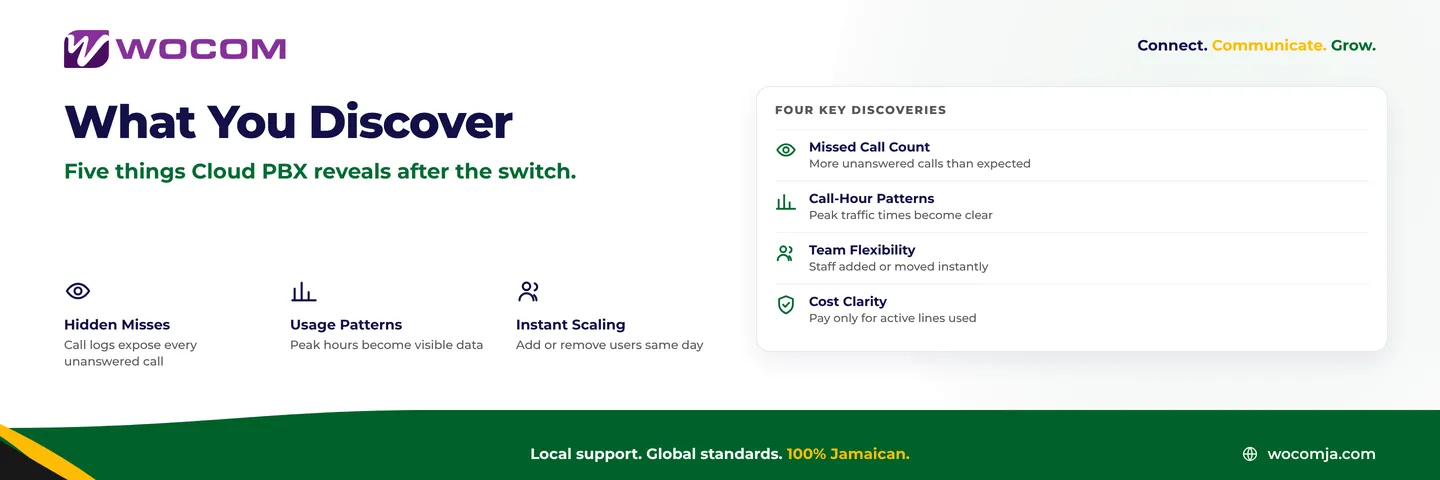
Five Things Jamaica Businesses Discover After Switching to Cloud PBX
The Move Nobody Regrets — But Most Don't Fully Anticipate
When a Jamaica business switches from an old PABX or a traditional landline bundle to Cloud PBX, the conversation almost always starts with cost. How much will the monthly bill change? What's the saving over a year? Those answers come quickly. But owners and managers who have made the move consistently report that the most valuable changes were the ones they didn't anticipate — things nobody explained during the sales process, because they're genuinely hard to describe until you're inside the system looking at real data.
This is a summary of what businesses across Kingston, Portmore, Montego Bay, and Spanish Town have actually found in the first weeks and months after going live on Cloud PBX. Five discoveries that, once made, tend to reshape how owners think about their phone operation entirely.
1. The Missed Call Count Is Higher Than You Think
This is the discovery that lands hardest, and it hits almost every business that makes the switch. On a traditional phone line, a missed call disappears without a trace. The phone rang, nobody picked up, the caller moved on — and you have no record it ever happened. You assume your team is answering most calls. You have no data to challenge that assumption.
Cloud PBX keeps a detailed log of every call that touches your number: answered, missed, abandoned in a queue, or redirected to voicemail. When Jamaica businesses first open those reports, the volume of missed calls during normal working hours is almost always a shock. Calls that rang at the wrong extension. Calls that hit a voicemail box nobody had set up properly. Calls during the lunch window when the front desk walked away and nobody was set as backup.
Knowing the number doesn't fix the problem on its own. But it creates the motivation to fix it. Businesses that discover they're missing 20 to 30 percent of their inbound calls during the working week tend to act fast — adding a ring group so multiple extensions alert at once, activating an AI receptionist as a fallback, or simply changing who the overflow extension is when the main line is busy.
A Kingston distribution company found through their first Cloud PBX report that 18 percent of their weekly calls arrived on Saturday mornings — a time when no one was scheduled to cover the phone. The calls were from hardware stores wanting to place orders before the week began. That gap had been invisible for years.
2. You Learn When Your Callers Actually Call
Most business owners have a rough sense of their busy periods. Cloud PBX reporting gives them precision. Call volume data breaks down by hour of day and day of week, and what businesses find rarely matches their expectations.
Your Monday morning may not be your busiest window — it might be Thursday between 10 a.m. and noon. Friday afternoons might drop off faster than you assumed. Your weekend line, which you thought was quiet, might be receiving calls that sit unanswered until Monday morning.
For Jamaica businesses that do any staffing planning — rotas, lunch cover, who handles reception — this data is immediately actionable. It tells you where to position your people and your coverage. It also tells you whether your current office hours actually match the hours your customers are trying to reach you. Some businesses discover a meaningful gap: their phones open at nine, but most of their callers start trying at half past eight.
3. Adding a New Staff Member to the Phone System Takes Minutes
On a traditional PBX, adding an extension means calling a technician, scheduling a visit, possibly purchasing hardware, and working around someone else's calendar. Jamaica businesses describe typical wait times of several days to two weeks between hiring someone and getting them onto the phone system. During that time, the new staff member either borrows someone else's extension or simply doesn't take calls.
Cloud PBX eliminates that entirely. A new extension is a software action. You name the user, assign a number or extension, set their credentials, and the person can be taking business calls on their laptop or desk phone the same afternoon. The same applies in reverse: when someone leaves, their line is deactivated immediately — no hardware to touch, no technician to call, and no risk of a former employee's extension sitting live on your system for weeks.
This discovery matters most to businesses that grow in short bursts: a retail chain opening a new branch before Christmas, an insurance office taking on additional agents during a busy season, a law firm onboarding new associates. The phone system stops being a constraint on your hiring timeline. You scale when you need to, not when a technician is available.
4. The Bill Makes Sense for the First Time
A common frustration with legacy phone contracts across Jamaica is that the monthly bill is difficult to understand. Bundled packages, line rental fees, maintenance charges, and legacy add-ons stack up over time, and most business owners pay the total without examining it because unpicking the detail feels harder than leaving it alone.
Cloud PBX billing is per seat, per month. Each active user has a cost, and you can see exactly what you're paying for every extension on the system. When someone leaves and their line is deactivated, that seat disappears from your bill the following cycle. There's no residual charge for a desk phone gathering dust since a staff member left in February.
Businesses that move to Cloud PBX regularly find that their old system included two or three ghost lines — extensions or numbers they had forgotten about entirely but were still paying for. Some find they were maintaining a fax number that had not received a document in years. Clearing those out at migration often produces a saving that wasn't part of the original justification. The first clean Cloud PBX invoice tends to be noticeably lower not because the rates are cheaper, but because the waste is gone.
5. Remote Work Stops Being a Phone Problem
The final discovery is one that continues to surprise Jamaica businesses even years after remote and hybrid work became common. Because Cloud PBX is internet-based, your staff can answer the business number from anywhere — a laptop at home in Portmore, a mobile phone in a vehicle on Washington Boulevard, a temporary office in Montego Bay.
Callers always reach the same number. Calls can be transferred between a Kingston office and a May Pen branch as easily as between two desks in the same room. The business line remains consistent regardless of where your team is physically sitting, and no personal mobile numbers are ever exposed to customers.
Businesses with field teams find this especially valuable. A technician on a service call in St. Catherine can still receive a transferred call from the office. An account manager stuck in traffic on Constant Spring Road receives the call presented as a business call, logged as a business call, with the company name on the display — not a random mobile number the client doesn't recognise.
How to Get the Most From Your Switch
These discoveries happen naturally once you're using Cloud PBX. But you can accelerate all of them with a few deliberate habits in the first month:
- Review your call logs weekly for the first four weeks. You'll establish a real baseline for answered versus missed calls and spot routing gaps before they become habits.
- Use hourly call volume data to adjust coverage. Match your team's availability to when callers are actually calling, not when you assume they do.
- Audit extensions at the three-month mark. Remove any lines that are no longer active. It simplifies your bill and your routing tree.
- Build ring groups that include mobile numbers for any role where the person is frequently away from their desk. Calls shouldn't stop at an empty desk phone.
- Add an AI receptionist as a fallback, not a replacement. For calls that arrive when staff are unavailable, an AI keeps the caller engaged and gathers the details rather than sending them to voicemail they may never check.
See What You've Been Missing
WOCOM's Cloud PBX is built for Jamaica businesses — from sole operators in Ocho Rios to multi-branch companies running across the island. Our team handles the setup, your existing number ports across in a few working days, and your staff are trained and ready within an afternoon.
If you're still running a traditional phone line or an ageing PABX, the discoveries above are waiting for you. Most businesses wish they had moved sooner — not because the old system failed them dramatically, but because they had no idea what they were missing until they could finally see it.
Contact WOCOM today for a Cloud PBX quote matched to your business size, location, and call volume. Visit wocomja.com or speak directly with one of our business advisors. Your call logs are ready to tell you something your old phone system never could.
Continue exploring
Ready to upgrade your communications?
Talk to our team about the right solution for your business.
Book a Demo Contact SalesEverett Kildare is WOCOM's voice and infrastructure specialist, with more than 25 years of experience designing and running carrier-grade voice, SIP and virtualization infrastructure. Holding a BSc in Information Technology, he has built, secured and migrated phone systems for businesses of every size. Everett writes WOCOM's technical coverage of SIP trunking, cloud PBX, contact centres, business continuity and migration.