T1 and PRI Lines for Jamaican Business: Keeping Your TDM Phone System Connected
A PRI (Primary Rate Interface) is a digital trunk that delivers up to 23 simultaneous phone calls to a traditional PBX over a single connection — and WOCOM now provides T1 and PRI services in Jamaica so businesses can keep their existing TDM phone system running on a modern carrier network. If your organisation invested in an on-premise PBX years ago and it still answers every call, routes every extension, and handles your auto-attendant exactly the way your staff expect, there is no reason to throw it away. What you can change is the carrier behind it.
For decades the only way to feed a TDM PBX in Jamaica was a copper PRI from the legacy network — expensive per channel, slow to provision, and painfully slow to repair when a fault appeared. WOCOM delivers the same clean T1/PRI handoff your PBX expects, but over our own modern IP backbone. You get the reliability and economics of today's network with the exact interface your existing equipment was built for. This guide explains what T1 and PRI actually are, who still needs them, how WOCOM delivers the service, and how it becomes a bridge to SIP trunking or Cloud PBX whenever you are ready.
What T1 and PRI actually are
A T1 is a standard digital circuit that carries 24 channels of 64 kbps each over a single line. It is the North American digital trunk standard, and it is what Jamaica uses. When a T1 is configured to carry voice using the ISDN signalling standard, it becomes a PRI — a Primary Rate Interface.
On a T1-based PRI, those 24 channels are split into 23 B-channels and 1 D-channel — usually written as 23B+D. The B-channels (B for "bearer") each carry one live phone call, so a single PRI gives you 23 simultaneous calls. The D-channel (D for "data") carries the signalling: it tells the PBX who is calling, which number was dialled, when to ring, and when a call has ended. Because signalling rides on its own dedicated channel, a PRI sets up calls fast and passes full caller ID and dialled-number information cleanly.
That dialled-number information is what makes DID (Direct Inward Dialling) work. With DID, a block of phone numbers maps straight through to individual extensions, so a caller dialling a staff member's direct number rings that person's desk without going through the operator. The PRI's D-channel tells your PBX which DID number was dialled, and your PBX routes accordingly. This is exactly why larger organisations chose PRI in the first place — one trunk, many channels, and direct-dial numbers for every desk.
For regional context: outside North America, the equivalent is an E1 PRI, which carries 30 voice channels (30B+D). Jamaica and the rest of the North American numbering region are T1-based, so a WOCOM PRI gives you the standard 23 voice channels per trunk.
Who still needs a T1 or PRI
The honest answer: any organisation that owns a working TDM PBX and is not ready to replace it. These are physical, on-premise phone systems — the cabinet in the comms room with line cards and a T1/E1 or PRI card that expects a digital trunk handing it many voice channels at once. Replacing one is a capital project, and if the system still does its job there is no urgency to do that.
Typical WOCOM T1/PRI customers include:
- Hospitals and health facilities — large extension counts, nurse stations, and life-safety reliability requirements built around an existing PBX.
- Hotels and resorts — room phones, front desk, and property-management integration that is wired into a TDM system.
- Government agencies and ministries — established PBX estates with hundreds of DID numbers already published on letterheads and signage.
- Larger offices and corporate headquarters — multi-floor sites with reception, departments, and direct-dial extensions.
- Call centres and contact centres — high concurrent-call counts where many channels on a single trunk are exactly what the dialler and ACD were designed around.
If that describes you, a WOCOM PRI lets you keep every bit of that investment and simply change who carries the calls. If, on the other hand, you run a small site that only needs a handful of analogue lines, a PRI is overkill — see our analogue business line service, which starts from a minimum of four lines delivered via a voice gateway.
How WOCOM delivers your T1/PRI
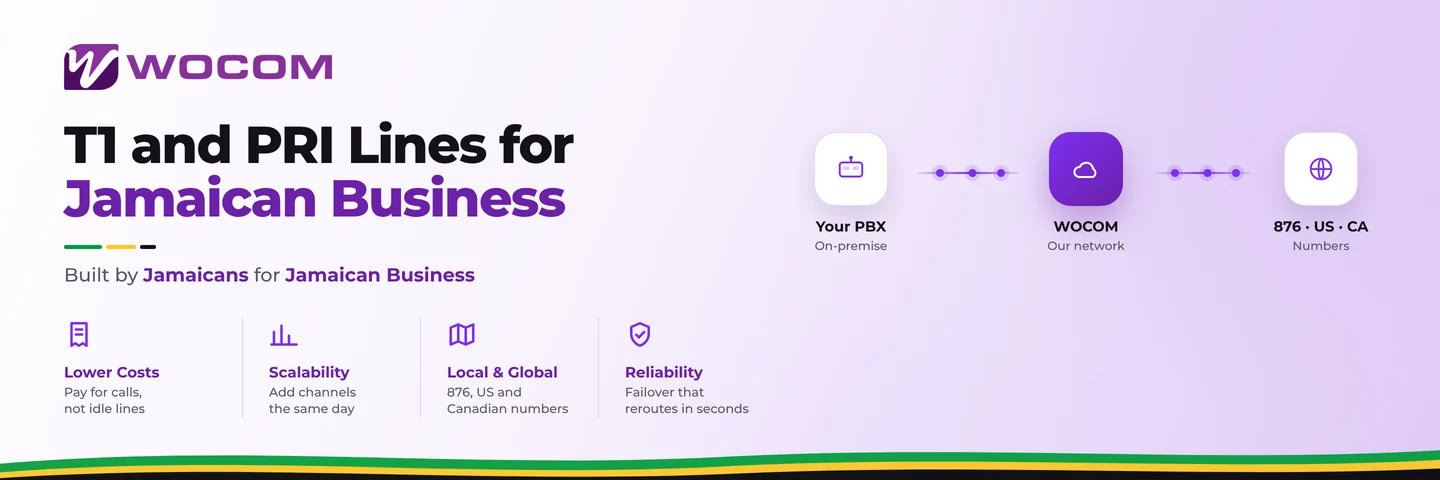
Here is the part that surprises people: your PBX still sees a perfectly ordinary PRI, but there is no copper PRI from the old network behind it. WOCOM carries your voice over our own modern IP backbone and converts it to a clean T1/PRI handoff right at your premises using a WOCOM gateway. Your PBX plugs into that handoff exactly as it always has.
The chain looks like this:
- Calls travel across WOCOM's licensed carrier network as IP — the same backbone that runs our SIP trunking and Cloud PBX services.
- At your building, a WOCOM-managed gateway terminates that IP connection and presents a standard 23B+D PRI (or T1) on the physical interface your PBX card expects.
- Your existing PBX connects to the handoff. Nothing inside the PBX changes — same dial plan, same auto-attendant, same extensions.
The benefit is that you get the cost and reliability of a modern IP network with the interface your legacy equipment needs. You are no longer paying legacy copper-PRI prices, and you are no longer waiting days for the old network to dispatch a technician when something breaks. Because the transport is IP on WOCOM's own network, provisioning is faster and faults are diagnosed and resolved far more quickly.
Channels and capacity
A single WOCOM PRI gives you 23 simultaneous voice channels. That means up to 23 calls can be in progress at the same time across that trunk — inbound and outbound combined. For most offices, 23 channels comfortably covers far more than 23 staff, because not everyone is on a call at once. A common planning rule is roughly one channel for every three to five busy-hour users, but the right ratio depends on your call patterns.
When you need more concurrency, PRIs scale by simply adding more of them. Two PRIs deliver 46 channels, three deliver 69, and so on. Call centres and large hospitals frequently run multiple PRIs trunked together so the PBX treats them as one large pool of channels. WOCOM will size the number of PRIs to your actual busy-hour call volume rather than selling you idle capacity — and because the underlying transport is IP on our network, growing your channel count later is a configuration change, not a new cable pull.
Keeping your numbers and DID ranges
Your phone numbers are part of your brand, and you do not lose them by moving to WOCOM. You can port your existing 876 numbers across to our network and keep them exactly as they are. You can also add brand-new 876 numbers or toll-free numbers at the same time if you are expanding.
Critically, WOCOM supports DID ranges, so your direct-dial extensions keep working without any change to how staff are reached. If your organisation has published a block of direct numbers — say a few hundred consecutive DIDs — those route straight through the PRI to the same extensions on your PBX as before. Reception still gets the main number, each department still gets its published direct line, and nobody on the outside needs to learn a new number. The port and the DID mapping are handled as part of bringing your PRI live.
PRI vs SIP trunking
People often ask whether they should take a PRI at all or jump straight to SIP trunking. The honest answer is that it depends entirely on your PBX. If you own a TDM PBX with a PRI card, a PRI is the natural fit — it is the interface the hardware was built for. If your phone system (or a planned new one) can speak IP directly, SIP trunking is usually the more flexible and lower-cost choice because it removes the gateway and the physical card altogether.
| Factor | PRI (T1) | SIP trunking |
|---|---|---|
| Best for | Existing TDM PBX with a PRI/T1 card | IP-capable PBX or Cloud PBX |
| Connection | Physical T1 handoff via WOCOM gateway | IP over your data connection |
| Channels | 23 per PRI; add PRIs to scale | Flexible — scale channels in software |
| Provisioning speed | Fast on WOCOM's network; needs on-site handoff | Fastest — largely a configuration task |
| Cost per channel | Lower than legacy copper PRI | Typically the lowest |
| Hardware needed | Existing PBX + WOCOM gateway | IP PBX or session border controller; no T1 card |
| Keeps legacy PBX investment | Yes — no rip-and-replace | Only if the PBX already supports SIP |
For a deeper side-by-side, including how to read your own PBX's capabilities, see our dedicated PRI vs SIP trunking comparison. The good news is that with WOCOM you are not forced to choose forever — both run on the same network, so you can start on a PRI today and move to SIP later without changing carrier.
The migration path
Think of the WOCOM PRI as a bridge, not a dead end. The sequence most established organisations follow looks like this:
- Today: keep your TDM PBX exactly as it is. Move it onto WOCOM's network via a T1/PRI handoff, port your numbers, and immediately benefit from lower cost and better reliability. Nothing internal changes for your staff.
- When you are ready: migrate to SIP trunking or a fully managed Cloud PBX — on your own schedule, as a planned project rather than an emergency. Because you are already a WOCOM customer, this is a change of service on the same network, not a carrier switch.
- Throughout: your numbers and DID ranges follow you. The investment you protected with the PRI continues to pay off until the day you decide to retire the hardware.
This is the whole point of taking a PRI from a forward-looking carrier rather than the legacy copper network. You de-risk the present and you keep the future open. If you want the full picture of where SIP fits, our complete guide to SIP trunking in Jamaica walks through it end to end.
Getting started
Bringing a PRI live with WOCOM is a structured, low-drama process. First, we survey your existing PBX — make, model, the type of PRI or T1 card installed, and how many channels you actually use at peak. From there we confirm how many PRIs you need, plan the port of your existing 876 numbers and DID ranges, and schedule the on-site gateway installation that presents the clean handoff to your system. Because the transport is IP on our own network, the cut-over is quick and reversible, and we can stage it so there is no gap in service for your callers.
You do not need to know the technical details yourself — that is what the survey is for. If you can tell us roughly how many phones you have and how busy your lines get, we can take it from there.
Frequently Asked Questions
How many calls can one PRI handle at the same time?
A T1-based PRI carries 23 simultaneous voice calls (23 B-channels plus one D-channel for signalling). If you need more concurrent calls, additional PRIs are added and trunked together — two PRIs give 46 channels, three give 69, and so on.
Do I have to replace my existing PBX to move to WOCOM?
No. That is the entire purpose of the service. WOCOM delivers a standard T1/PRI handoff to your existing TDM PBX, so the system keeps running exactly as it does now. There is no rip-and-replace and no change to your dial plan or extensions.
Can I keep my current 876 numbers and direct-dial extensions?
Yes. You can port your existing 876 numbers to WOCOM and keep your DID ranges, so every published direct number continues to ring the same extension. You can also add new 876 or toll-free numbers at the same time.
How is a WOCOM PRI different from the old copper PRI?
Your PBX sees the same standard PRI interface, but WOCOM carries the calls over a modern IP backbone and converts them to a clean PRI handoff at your premises. That means lower cost per channel, better reliability, faster provisioning, and much quicker fault resolution than the legacy copper network.
Should I choose a PRI or SIP trunking?
If you own a TDM PBX with a PRI or T1 card, a PRI is the natural fit. If your phone system can speak IP directly, SIP trunking is usually more flexible and lower cost. Both run on the same WOCOM network, so you can start on a PRI and move to SIP later. See our PRI vs SIP comparison for details.
What if I only need a few lines, not 23 channels?
A PRI is designed for organisations that need many channels at once. If you only need a handful of lines, our analogue business line service is a better match — it starts from a minimum of four lines delivered via a voice gateway.
Ready to keep your TDM phone system running on a faster, more reliable, lower-cost network? Call WOCOM on +1-876-906-7240 or email info@wocomja.com and ask about T1 and PRI services. We will survey your existing PBX, confirm how many channels you need, and plan the port of your numbers and DID ranges — so the move is smooth and your callers never notice the change. You can also reach us through our contact page.
Continue exploring
Ready to upgrade your communications?
Talk to our team about the right solution for your business.
Book a Demo Contact SalesEverett Kildare is WOCOM's voice and infrastructure specialist, with more than 25 years of experience designing and running carrier-grade voice, SIP and virtualization infrastructure. Holding a BSc in Information Technology, he has built, secured and migrated phone systems for businesses of every size. Everett writes WOCOM's technical coverage of SIP trunking, cloud PBX, contact centres, business continuity and migration.