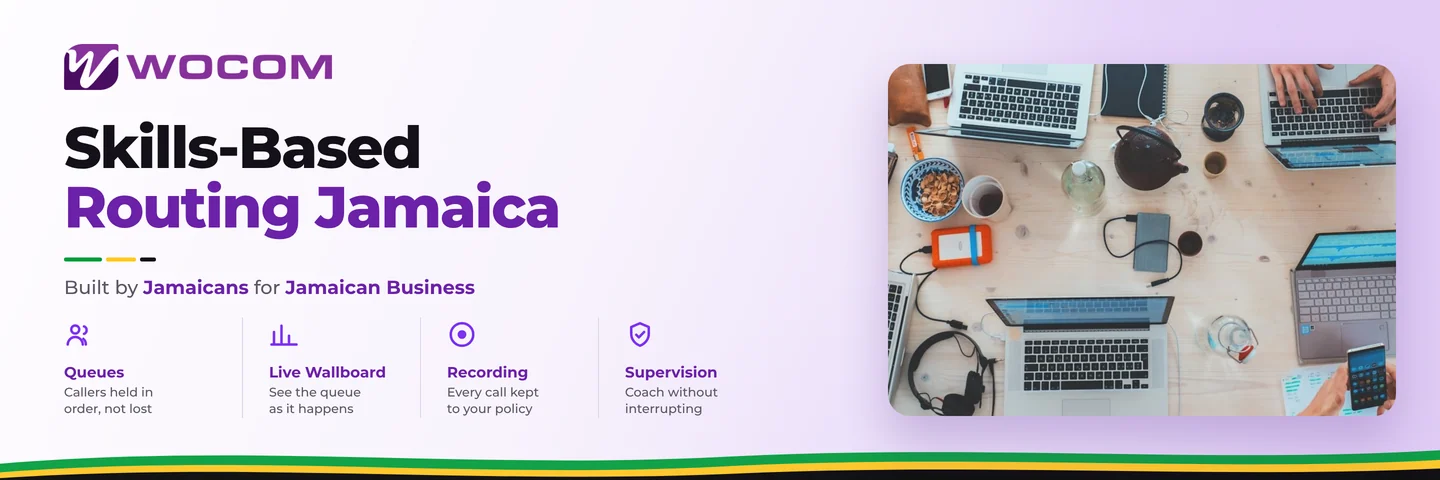
Skills-Based Routing Jamaica: Direct Every Call to the Agent Best Qualified to Handle It
What Skills-Based Routing Does — and What It Does Not Do
In a standard queue, calls land on whoever has been idle the longest. That agent might be your billing specialist — but the caller needs technical support for a PBX configuration issue. The result: a transfer, a frustrated customer, and unnecessary time added to your average handle time.
Skills-based routing changes this. Before a call ever rings at an agent's station, the system checks what the caller needs — typically identified by which number they dialled, which IVR option they pressed, or data pulled from a CRM lookup — and then matches that call to an agent tagged with the relevant skill profile. Billing calls go to billing-trained agents. Technical escalations go to tier-two staff. Callers who need to speak to a senior account manager are not answered by a junior agent reading from a general script.
What skills-based routing does not do is solve a staffing problem. If you have three qualified agents handling a queue that receives thirty calls an hour, routing logic cannot close that gap. It works best when you already have the right people — it just makes sure those people receive the right calls.
How It Differs From Standard Call Distribution
Most contact centres in Jamaica start with one of three basic distribution methods:
- Round robin: calls cycle through available agents in order, regardless of who handled the last call or how complex it was
- Least-occupied: calls go to whoever has handled the fewest interactions that shift
- Sequential (fixed order): agent one always receives the first call, agent two is only reached if agent one is busy
These methods distribute load. They do not consider competence. Skills-based routing adds a filter layer: an agent must be both available and qualified before the system offers them a call from a specific queue. You can also set proficiency weights, so a highly experienced agent handles overflow when a specialist queue backs up — without permanently pulling that person away from complex work.
Where Jamaica Contact Centres Benefit Most
The principle applies broadly, but these are the configurations we see working well for Jamaican operations of all sizes.
Billing and collections queues. Conversations about overdue accounts or disputed charges need agents trained in payment negotiation and compliance. Routing all billing calls to a dedicated group — even a small one of three or four people — reduces the chance of a customer receiving contradictory information from a general agent reading from a generic script. This matters especially in financial services and remittance operations serving Kingston and the wider island.
Technical support tiers. A two-tier model works well for technology providers and BPOs handling software or hardware queries. Tier-one agents handle password resets, basic troubleshooting, and account queries. Tier-two engineers receive escalated calls directly from the IVR or via an agent-initiated transfer into a skills-tagged queue — not a personal extension. This keeps your senior staff available for the calls that genuinely need them.
Language and regional routing. Operations serving both Jamaica and international markets — remittance companies, financial services, tour operators — often need to route callers from the US, Canada, or UK to agents familiar with those markets. A caller dialling from a North American area code can be routed to an agent with an "international-facing" skill tag, without any IVR prompt asking the caller to select a language or wait for redirection.
Product line separation. Businesses with distinct offerings — a Kingston hardware supplier that also runs a service division, for example — can create separate skill groups so a call about a new purchase does not land with a service technician who has no pricing authority and no way to close a sale.
Setting Up Skills Groups: A Five-Step Configuration
The setup process is straightforward once you have a clear skills matrix. Here is the typical sequence:
- Define your skill categories. List the distinct competencies in your operation: billing, sales, technical-tier-1, technical-tier-2, bilingual, escalations, VIP accounts. Keep categories meaningful — five or six clear groups outperform twenty overlapping ones that nobody maintains.
- Profile each agent. Assign skill tags and, where your platform supports it, proficiency levels (1–5 or basic/intermediate/expert). A higher proficiency score means the agent receives calls from that queue sooner in the routing priority order.
- Map IVR paths to queues. Each IVR option should point to a named skills queue, not a ring group or a direct extension. The queue then applies skills filtering before ringing any agent.
- Set overflow rules. Define what happens when no qualified agent is available: hold with a position announcement, overflow to a lower-proficiency agent after a set number of seconds, or route to voicemail during off-hours. Leaving this undefined — so the call simply keeps ringing — is one of the most common causes of high abandonment rates in Jamaican contact centres.
- Test before going live. Call each IVR path from an external number and verify the call reaches the correct agent group. Check overflow behaviour by marking all skilled agents as busy. Do this during a low-traffic window, not on a Monday morning.
"When we separated our technical queue from our billing queue, average handle time dropped by nearly two minutes — not because agents worked faster, but because fewer calls ended in a transfer to someone who had to start the conversation from scratch."
KPIs to Monitor in the First 60 Days
Skills-based routing is only as effective as the data you use to refine it. Watch these metrics closely after implementation:
- First-call resolution by queue: if your billing queue has poor FCR after routing is live, the skill tagging or agent training needs attention — not the routing logic itself
- Transfer rate per queue: a high transfer rate signals that calls are reaching the wrong skill group from the IVR, or that IVR options are ambiguous
- Queue abandonment rate: spikes in a specific queue suggest that skill group is understaffed relative to its call volume
- Agent utilisation by skill: if one group runs consistently at 90% while another sits at 40%, rebalance proficiency assignments or cross-train agents to cover both queues
- Average speed of answer by queue: skills-based routing should reduce ASA for complex queues by preventing unnecessary calls from landing there in the first place
Most contact centre platforms surface these metrics in real-time dashboards and historical reports. If your current system requires exporting spreadsheets to calculate these figures manually, that is a capability gap worth addressing before you try to optimise routing further.
Ready to Route Smarter?
WOCOM's contact centre platform supports full skills-based routing with agent proficiency weighting, IVR path mapping, overflow rules, and real-time queue dashboards — accessible from Kingston, Montego Bay, or any browser. Whether you run a five-seat internal support desk or a 50-agent BPO operation, the configuration principles are the same.
Our team can audit your current routing setup and show you exactly where calls are being mismatched or abandoned. We will map your routing requirements and have a configuration proposal ready within 48 hours.
Visit wocomja.com/contact to get started, or speak directly with our business solutions team. Every call your agents handle well is a customer who does not have to call back.
Continue exploring
Ready to upgrade your communications?
Talk to our team about the right solution for your business.
Book a Demo Contact SalesEverett Kildare is WOCOM's voice and infrastructure specialist, with more than 25 years of experience designing and running carrier-grade voice, SIP and virtualization infrastructure. Holding a BSc in Information Technology, he has built, secured and migrated phone systems for businesses of every size. Everett writes WOCOM's technical coverage of SIP trunking, cloud PBX, contact centres, business continuity and migration.