SIP Trunk Contract Jamaica: What to Check Before You Sign in 2026
Why Most Jamaican Businesses Sign Without Reading
A SIP trunk contract is not a formality. It determines who owns your phone numbers, how fast your provider responds to an outage, how much you actually pay for each call, and — critically — how easily you can leave if the service disappoints. Yet most business owners in Kingston and Montego Bay sign on the dotted line without reviewing a single clause.
That changes when something goes wrong. A provider goes silent during a Saturday outage. Numbers cannot be ported when you try to switch. An auto-renewal locks you in for another year at rates that no longer make sense. The contract is not just paperwork — it is the only protection you have when the relationship breaks down.
This guide covers the five clauses that matter most, the red flags to watch for, and the questions every Jamaican business owner should ask before signing a SIP trunk agreement.
Clause 1: Number Ownership and Portability
Your Direct Inward Dialling (DID) numbers are a business asset. They appear on your signage, your Google Business Profile, your invoices. Customers have memorised them. The question is: do you own them, or does your provider hold them on your behalf?
A provider that owns your numbers can refuse to release them when you leave — or charge a penalty to do so. Look for contract language that explicitly states:
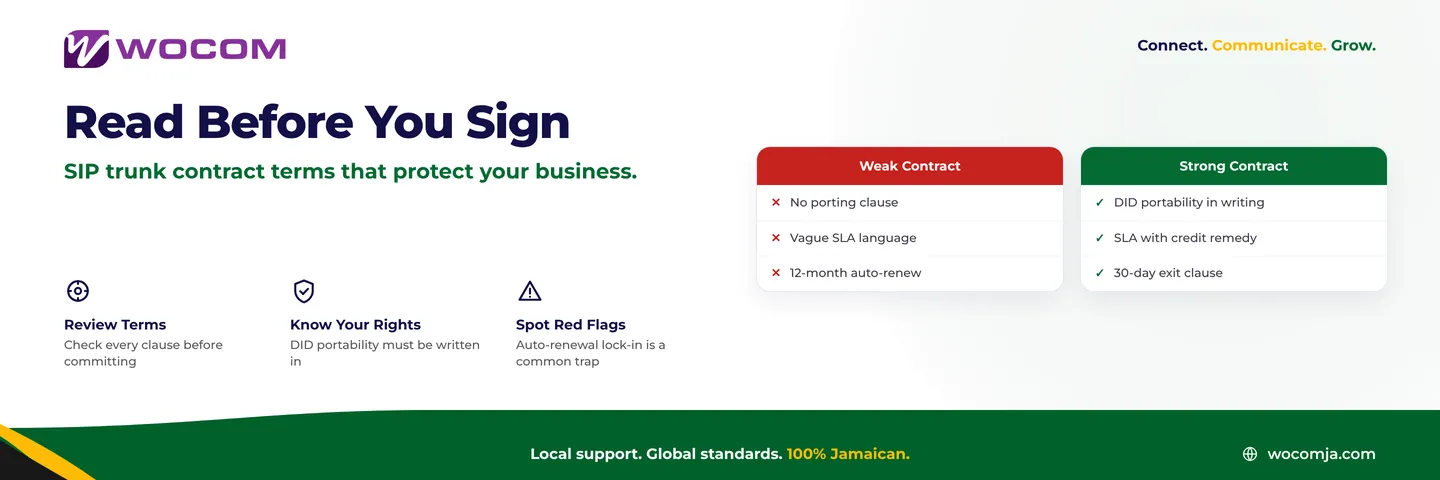
- You retain the right to port your DID numbers to another provider at any time
- Porting will be completed within a defined timeframe (typically five to ten business days)
- No porting fee or early-termination penalty applies to number release
If the contract is silent on portability, treat that as a red flag. A fully licensed carrier in Jamaica — one that holds numbers from its own block on the national numbering plan — can guarantee portability because it controls the routing. A reseller cannot make the same guarantee, because the numbers technically belong to the upstream carrier it depends on.
Clause 2: The SLA — Hours, Not Just Percentages
Every SIP provider will promise "99.9% uptime." What that actually means depends on how the contract defines it, and whether there is a remedy when the guarantee is missed.
Convert the percentage to hours before you agree to anything:
- 99.9% uptime = roughly 8.7 hours of downtime per year
- 99.5% uptime = roughly 43.8 hours of downtime per year
- 99.0% uptime = roughly 87.6 hours of downtime per year
A contact centre or medical clinic in Kingston cannot absorb 43 hours of silent phones each year. Push for the percentage to be expressed as an annual hours cap, and confirm that the SLA includes a credit remedy — a concrete statement of what the provider gives you if the target is missed. An SLA with no credit is a marketing claim, not a contractual commitment.
Also check how outages are measured. Some contracts exclude scheduled maintenance windows, broadly defined "force majeure" events, or faults originating outside their own network. Narrow definitions of "covered outage" can render an impressive headline figure meaningless.
Clause 3: Pricing, Minimums, and Overage Rates
SIP trunk pricing is rarely as simple as the rate card suggests. The headline local-call rate is just one component. The full bill depends on several variables that often go unread:
- Monthly minimum commitment: many contracts include a floor spend expressed as a minimum number of minutes or a fixed dollar amount. Confirm whether unused minutes roll over or expire at month-end.
- International and mobile termination rates: calls to local mobile networks, US and Canada numbers, and other Caribbean destinations are priced on a separate schedule. Get the full rate card as a signed exhibit — not a webpage that can change without notice.
- Concurrent channel cap: if your contract limits you to a set number of simultaneous calls, clarify whether exceeding that cap means calls are rejected outright or billed at an overage rate — and what that rate actually is.
- Billing increments: calls billed in six-second increments cost meaningfully less across a month than calls billed in full one-minute increments, even at the same per-minute headline rate. This detail rarely surfaces during a sales conversation.
Request a sample invoice from a comparable client before you sign. Any provider confident in their pricing will provide one.
Clause 4: Support Response Times and Escalation
Phone system faults rarely happen at 10 am on a Tuesday. The uptime SLA means nothing if a fault reported on a Friday evening is not addressed until Monday morning. Before signing, confirm:
- What is the guaranteed response time for a Priority 1 (total loss of service) fault? One hour? Four hours? Twenty-four hours?
- Is 24/7 support available, or only during standard business hours?
- Is the support team local to Jamaica, or routed to an offshore help desk?
- What is the escalation path when first-line support cannot resolve the issue within the committed window?
A provider whose support is handled abroad may have skilled engineers — but the time zone gap and the extra communication hop can extend your outage window considerably. For businesses in Montego Bay or Kingston handling customer-facing calls seven days a week, local support availability is a practical requirement, not a preference.
Clause 5: Exit Terms and Auto-Renewal
This is the clause that catches most Jamaican businesses off guard. Many SIP trunk contracts include an automatic renewal provision: at the end of the initial term — typically 12 or 24 months — the contract rolls into another full term unless the customer provides written notice within a narrow cancellation window, sometimes as short as 30 days before the renewal date.
Miss that window by a week and you are committed for another year. Look for:
- Whether the contract auto-renews, and on what cycle
- The exact notice period required to exit without penalty
- What early termination fees apply if your circumstances change mid-term
- Whether early termination triggers a clawback of any promotional pricing or equipment subsidies applied at signup
The strongest exit clause gives you 30 days' written notice to terminate at any time, with no financial penalty beyond the current month's charges. A provider who offers that is confident in their service — not in their lock-in provisions.
Red Flags That Should Make You Pause
Beyond the five clauses above, watch for these warning signs in any SIP trunk contract:
- No written rate card attached: pricing referenced as "current published tariff" without a signed schedule can be changed unilaterally at any time
- Liability cap far below your revenue exposure: if a two-hour outage costs your business significant revenue and the contract caps provider liability at a token amount, the SLA is effectively decorative
- Dispute resolution in a foreign jurisdiction: contracts requiring disputes to be resolved abroad effectively put legal remedies out of practical reach for a Jamaican SME
- Undisclosed reseller relationship: ask directly whether the provider owns its own infrastructure and numbering block, or whether it is reselling capacity from a third party — this directly affects your porting rights, SLA coverage, and support chain
Questions to Ask Any SIP Provider Before You Sign
Use these questions in your final conversation with a prospective SIP trunk provider. A confident, transparent provider will answer each one clearly and in writing:
- "Are you a licensed telephone service provider in Jamaica, or are you reselling another carrier's capacity?"
- "Can you provide a sample invoice from a comparable client?"
- "If I need to port my numbers to a different provider in six months, what is the process and what does it cost?"
- "What is your measured uptime over the last 12 months, and can you share a service report?"
- "Who handles a fault report at 9 pm on a Saturday, and where are they located?"
Evasive or vague answers at the sales stage are a reliable signal of how the relationship will feel when you have a real problem.
Talk to a Provider Who Answers Every Question
WOCOM is a fully licensed telephone service provider in Jamaica. We own our network infrastructure and our DID number blocks — which means portability rights are built into every account from day one, not negotiated clause by clause. Our SLA terms are written in plain language, our support team is based locally, and we operate seven days a week.
If you are reviewing an existing SIP trunk contract or evaluating a new provider, our team is happy to walk you through what to look for — no obligation required. Visit wocomja.com/sip-trunking or contact us directly to arrange a conversation before you sign anything.
Continue exploring
Ready to upgrade your communications?
Talk to our team about the right solution for your business.
Book a Demo Contact SalesEverett Kildare is WOCOM's voice and infrastructure specialist, with more than 25 years of experience designing and running carrier-grade voice, SIP and virtualization infrastructure. Holding a BSc in Information Technology, he has built, secured and migrated phone systems for businesses of every size. Everett writes WOCOM's technical coverage of SIP trunking, cloud PBX, contact centres, business continuity and migration.