SIP Trunk Origination vs Termination Explained: What Every Jamaica Business Needs to Know
If you've ever requested a SIP trunk quote and received a document full of technical terms, you're not alone. Two of the most misunderstood words in that quote are origination and termination — and confusing the two can mean your outbound calls fail on day one, or that your business number stops ringing without warning.
This guide explains both concepts plainly, applies them to real Jamaica business scenarios, and gives you the exact questions to ask before signing any SIP trunk agreement.
What Is SIP Trunk Origination?
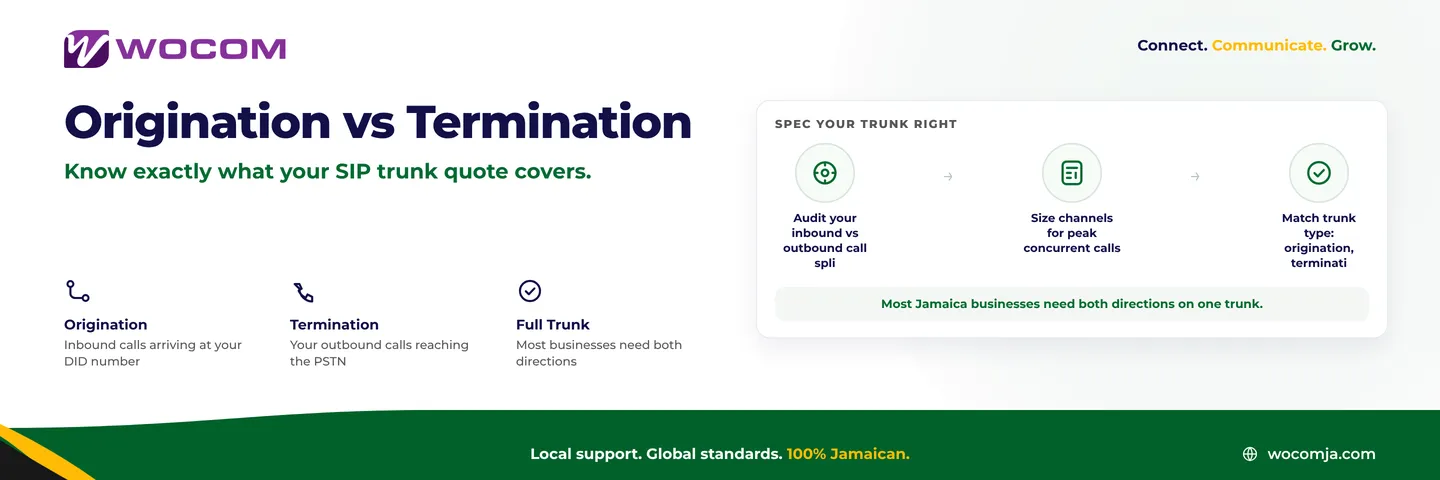
Origination refers to inbound calls arriving at your business. When a customer dials your 876 or 658 number and their call reaches your IP PBX or cloud phone system, that inbound path is handled by an origination service.
Your SIP trunk provider assigns you one or more Direct Inward Dialling (DID) numbers — Jamaican numbers, international numbers for businesses serving the diaspora, or toll-free numbers. When someone dials one of those numbers, the provider routes the call over the internet to your system. That routing is origination.
With origination alone, your system can receive calls on a specific phone number. What it cannot do — if your quote covers nothing else — is place outbound calls through that same provider.
What Is SIP Trunk Termination?
Termination is the reverse: outbound calls leaving your system to reach the public phone network. When a staff member dials a local Kingston number, a Digicel mobile, or an international destination, that call must exit your IP network and connect through a carrier that can deliver it to its final destination. The service that handles that handoff is called termination.
The word is counterintuitive — it sounds like ending something, but in telecoms it means delivering (terminating) a call to a number on the public network. Think of it as your outbound gateway to the world.
Termination is typically priced per minute or per channel, and rates vary by destination. Calls within Jamaica are inexpensive; international termination to the United States, the United Kingdom, or Canada carries a different rate — something worth understanding clearly before you commit.
Why This Distinction Matters When You Read a Quote
Many providers quote origination and termination separately, and some entry-level packages cover only one direction. A business that signs an origination-only agreement discovers the problem quickly: staff can receive calls but cannot dial out. A termination-only agreement creates the mirror problem — outbound calls work, but the business number never rings.
Three scenarios where this split causes real damage:
- Number porting: When you port an existing 876 number to a new provider, you're moving the origination service. If the new provider doesn't also handle termination, you'll need a second provider for outbound — two bills, two support queues, and two sets of SIP credentials to manage.
- International DID numbers: A business that serves the Jamaican diaspora may buy a US +1 number for origination, routing calls back to Jamaica. The origination provider (handling the US number) and the termination provider (handling the Jamaica handoff) may be different companies — and both need to be contractually clear on quality and liability.
- Pilot setups before cutover: Some businesses configure a test trunk before the full go-live. If the test covers only termination, inbound behaviour in the live environment remains untested and a go-live can fail from the first incoming call.
How to Calculate What Your Jamaica Business Actually Needs
Before approaching any provider, spend thirty minutes auditing your call traffic. Three questions to answer:
- What is your inbound-to-outbound split? A customer service team in New Kingston handling mostly inbound enquiries has very different needs from a sales team in Montego Bay dialling outbound leads all day.
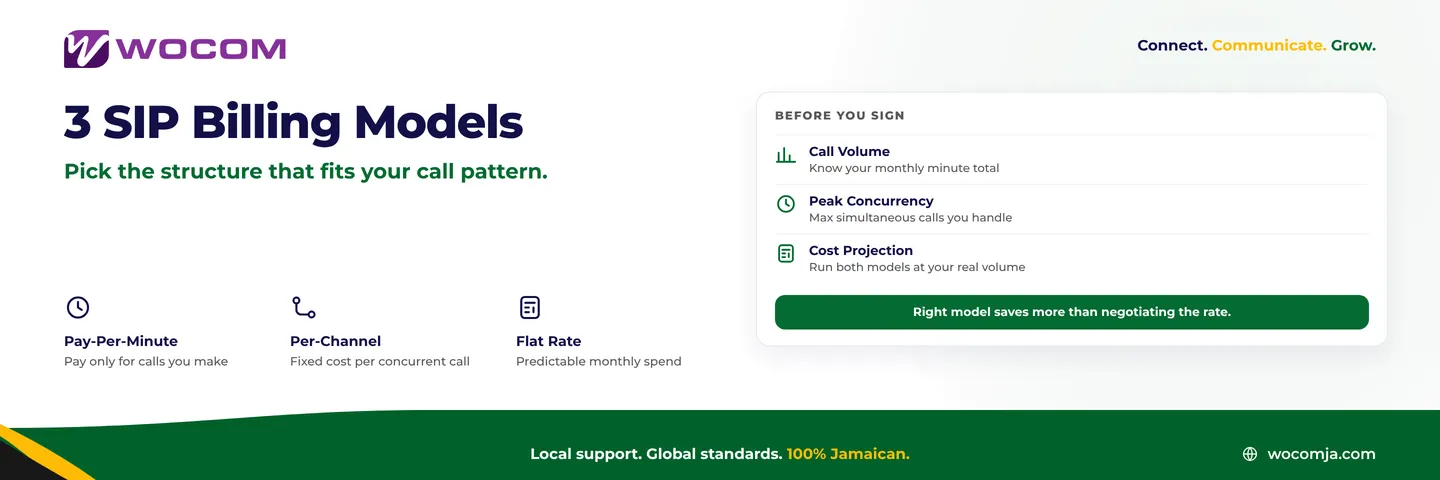
- What is your peak concurrent call count? SIP trunks are priced partly by the number of simultaneous calls they support. A business where three agents could be on calls at once needs at least three channels — with a sensible buffer on top.
- Which destinations do your staff call most? Local Jamaica landlines, Digicel and Flow mobiles, the United States, United Kingdom, and Canada are the most common for Jamaican businesses. Get per-minute rates for each destination before comparing quotes side by side.
With these numbers in hand, you can evaluate quotes properly. A provider offering very low per-channel pricing but high international termination rates may be more expensive overall than one with a bundled monthly fee covering both directions to common destinations.
Bundled Trunks vs Splitting Between Two Providers
Every business faces a practical choice: use one provider for both origination and termination, or split them between specialists to chase the best rate on each.
The argument for splitting is price: some providers have excellent DID rates but poor international termination pricing, while others are the reverse. In theory, you save money by cherry-picking.
In practice, splitting creates support headaches that erode those savings. When a call fails — and calls do fail — each provider will point to the other. Diagnosing whether a problem lives in the origination path, the termination path, or the handoff between them requires technical skill most businesses don't have in-house. Outages during business hours in Kingston or across a multi-parish operation stretch longer because the resolution loop now involves two separate support teams who have no obligation to coordinate.
For most Jamaican SMEs, a single provider handling both directions on one contract is the simpler, lower-risk choice. The slight cost premium over a split arrangement is typically recovered in the first support incident you never have to escalate twice.
Seven Questions to Ask Before You Sign
Whether you're speaking with WOCOM or evaluating any other provider, these questions protect you:
- Does this quote cover origination, termination, or both?
- Are there separate per-minute charges for Jamaican mobiles vs landlines?
- What is the termination rate to the United States, the United Kingdom, and Canada?
- If I need to add channels later, what is the process and lead time?
- Is there a minimum monthly spend that applies to termination, origination, or both separately?
- If a call fails to connect, how is it billed — full minute, partial minute, or not at all?
- Who is the actual carrier, or are you purchasing through a reseller?
Any reputable provider should answer all seven clearly before you commit. Vagueness on any point is a signal worth taking seriously.
Get a Clear SIP Trunk Quote from WOCOM
WOCOM is a licensed telephone provider in Jamaica. Our SIP trunks carry both origination and termination on a single agreement — Jamaican DID numbers in the 876 and 658 area codes, local termination, and international routes to the United States, Canada, the United Kingdom, and beyond. We own the infrastructure, so calls don't pass through a reseller layer before reaching the public network.
If you're unsure whether your current SIP trunk agreement covers what you think it covers, or if you're speccing a new connection for a Kingston head office, a Portmore branch, or a Montego Bay contact centre, our team will walk through your requirements and give you an itemised quote — origination, termination, channel count, and destination rates all clearly separated.
Ready to stop guessing what your SIP trunk covers? Contact WOCOM today. Bring your three audit numbers — inbound/outbound split, peak concurrent calls, and your most-dialled destinations — and we'll turn those into a quote that matches your business, not a template.
Continue exploring
Ready to upgrade your communications?
Talk to our team about the right solution for your business.
Book a Demo Contact SalesEverett Kildare is WOCOM's voice and infrastructure specialist, with more than 25 years of experience designing and running carrier-grade voice, SIP and virtualization infrastructure. Holding a BSc in Information Technology, he has built, secured and migrated phone systems for businesses of every size. Everett writes WOCOM's technical coverage of SIP trunking, cloud PBX, contact centres, business continuity and migration.