SIP Trunk Monitoring Jamaica: Know Before Your Calls Go Down
Every Jamaican business running voice over IP depends on a healthy SIP trunk. When that trunk degrades or drops, callers get busy signals, crackling audio, or a phone that rings with no answer. The frustrating part: most businesses only find out when a client calls to say they could not get through. By then, calls have been missed, deals have been lost, and your reputation has taken a quiet hit that never appears on any report.
Monitoring your SIP trunk proactively changes that equation. You know before your callers do.
What Does SIP Trunk Monitoring Actually Watch?
A SIP trunk is not a single thing to monitor — it is a stack of interrelated states, each of which can fail independently.
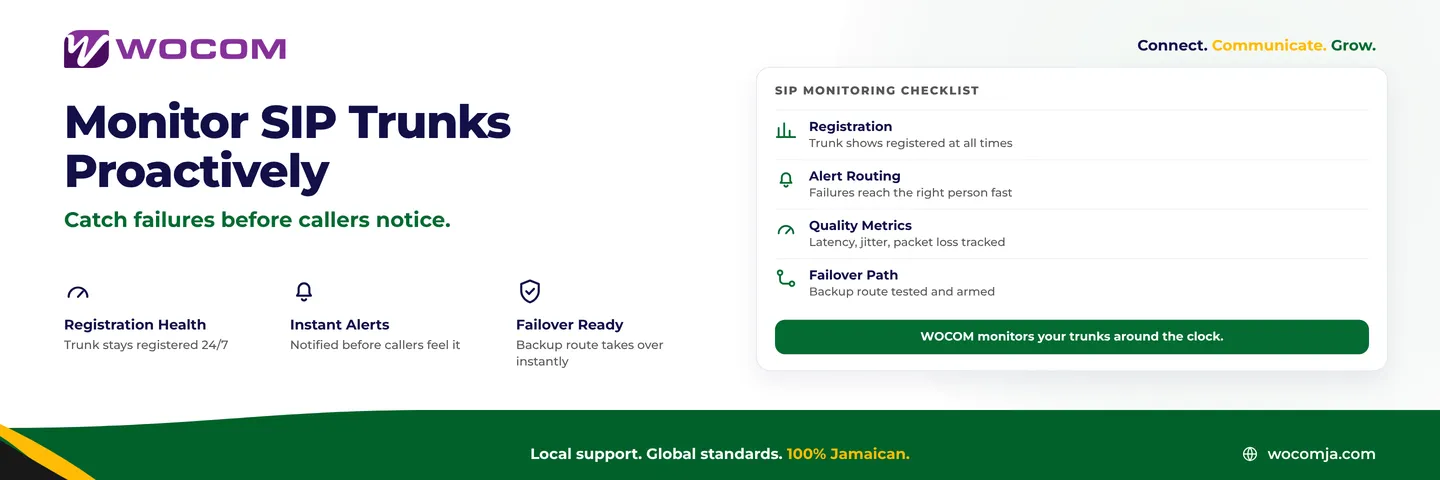
Registration status is the most fundamental. Your PBX or SIP gateway must maintain an active registration with the carrier at all times. If registration drops — due to a network hiccup, a NAT timeout, or a router reboot — inbound calls stop arriving instantly, often without any obvious error on your end. Your phone system still looks "on" even as every incoming call fails silently.
Call completion rate tracks the proportion of outbound call attempts that actually connect. A drop in this rate, even without a full outage, signals congestion, routing problems, or a carrier fault upstream.
Voice quality metrics — latency, jitter, and packet loss — tell you whether calls are connecting but degrading. A call that sounds robotic, choppy, or cuts in and out is arguably worse for your business than no call at all: the customer experiences the frustration firsthand and associates it with your brand.
Concurrent call utilisation shows how many of your licensed channels are active at any moment. If your business hits the channel ceiling, new inbound calls receive a busy signal. Most businesses do not discover they have outgrown their trunk until a Monday-morning complaint wave arrives.
Why Jamaica Adds Extra Risk
Jamaican infrastructure introduces failure modes that businesses in other markets face less often.
- ISP volatility. Even reliable business connections in Kingston and Montego Bay can experience short bursts of packet loss during peak hours or after heavy rain. A 200ms latency spike is barely noticeable in a browser — it is immediately audible on a voice call.
- Power events. When power fluctuates and your router reboots, your SIP trunk loses its registration. The trunk reconnects within seconds, but without monitoring you may not know it happened — or that inbound calls were silently failing while the trunk re-registered.
- Hurricane season load. During active weather systems, network paths across the Caribbean can degrade as regional traffic spikes. International call quality typically suffers first, often without any single link appearing fully down.
- Single-ISP dependency. Many businesses run their voice and data over a single internet feed with no secondary path. When that feed struggles, both internet and calls suffer simultaneously — and there is nothing to fail over to unless one has been pre-configured.
None of these risks are unique to SIP. But SIP makes failures visible — or invisible — in ways that legacy landlines did not. A copper line that goes down is obvious. A SIP registration that silently expires is not.
Setting Alert Thresholds That Actually Help
Monitoring without alerting is just logging. The goal is to know the moment something changes — before it becomes a customer complaint.
Registration failure alerts should fire immediately. There is no acceptable tolerance window for a deregistered trunk during business hours. Configure your alert to notify within 60 seconds of a registration drop so your team can act before the first caller is affected.
Call quality alerts need a threshold that balances sensitivity against noise. Packet loss above 3% consistently degrades voice clarity. One-way latency above 150ms becomes noticeable to callers. Jitter above 30ms creates the choppy, clipped audio that makes calls feel unreliable. Set thresholds slightly below where quality visibly deteriorates, so you have time to act before a caller complains.
Channel utilisation alerts should fire when you consistently reach 80% of your licensed capacity during business hours. At that point you are one heavy calling period away from blocking legitimate inbound calls. The alert is your signal to review trunk capacity — not to panic, but to plan ahead.
Who receives the alert matters as much as the threshold itself. A message sent to an IT inbox that nobody checks at weekends is not an alert in any meaningful sense. Route critical notifications to a mobile number via SMS or a direct call so that whoever is responsible for your communications infrastructure actually gets notified when it counts.
The Difference Between Monitoring and Redundancy
These two capabilities are often confused, but they serve different purposes. Monitoring tells you something is broken. Redundancy keeps you running while it is broken. Both matter, but neither replaces the other.
A business that monitors but has no failover will know their trunk is down and still be helpless — watching calls fail in real time with no alternative path. A business with failover but no monitoring may not realise their primary trunk has been down for days while the secondary quietly absorbs traffic, possibly at higher cost or lower capacity, with nobody aware of the underlying fault.
The right setup pairs both: monitoring that detects the primary failure, and automatic failover routing that moves calls to a secondary path while the primary is resolved. For most Jamaican businesses, that secondary path could be a second SIP trunk over a different ISP, a mobile-based fallback route, or a failover number that redirects inbound calls when the primary does not respond. WOCOM configures failover routing as part of SIP trunk deployment for businesses that need it — and the monitoring layer sits alongside it, alerting your team the moment the failover activates.
What to Review in Your Call Detail Records
Even without a dedicated monitoring dashboard, your call detail records (CDRs) contain the evidence of trunk health problems — if you know what to look for.
Pull your CDR report for the past week and look for:
- Any stretch of time during business hours where inbound call volume drops to zero. A genuine quiet period is possible, but sustained silence during normal hours often signals a registration gap.
- A cluster of outbound calls marked as failed, busy, or not connected within a short window. This pattern points to a routing or congestion fault rather than isolated dialler errors.
- Unusual call attempts originating from unexpected numbers or international prefixes your business does not normally call. This can signal toll fraud activity on a compromised trunk.
- Duration outliers — calls that connected but lasted only one or two seconds. These are typically answered calls where one party immediately hears silence or distortion and hangs up.
Reviewing CDRs once a week takes five minutes and often surfaces problems that automated alerts miss — particularly gradual quality degradation rather than hard failures.
What WOCOM Monitors on Your Behalf
Running your own monitoring stack requires tooling, configured alerts, and someone available to respond. For most Jamaican businesses, that is not a realistic expectation without dedicated IT staff.
WOCOM monitors SIP trunk health at the carrier level — registration state, call success rates, and trunk availability. When a fault originates on the network side, our team is aware before your business calls us. Businesses on managed trunk plans receive proactive outreach when a fault is detected on their account.
For businesses that want direct visibility, WOCOM's portal provides CDRs with per-call outcomes alongside timestamps, durations, and originating numbers. If your team wants to go further, your PBX administrator can enable syslog or SNMP forwarding to a monitoring tool of your choice, and WOCOM can supply the specific metrics needed to build custom dashboards.
The point is that monitoring does not have to be a solo effort. A good carrier partner is part of your monitoring layer — and the first call you receive about a fault should come from them, not from a frustrated customer.
Your SIP trunk carries every business call. Do not wait for a customer complaint to find out it is broken.
Talk to WOCOM today about SIP trunk monitoring, failover routing, and the right channel count for your call volume. We work with businesses across Kingston, Montego Bay, and every parish in Jamaica to keep phone infrastructure reliable — and to make sure the first person who knows about a problem is you, not your clients.
Call us at 876-300-1234 or visit wocomja.com/contact to speak with a SIP trunk specialist.
Continue exploring
Ready to upgrade your communications?
Talk to our team about the right solution for your business.
Book a Demo Contact SalesEverett Kildare is WOCOM's voice and infrastructure specialist, with more than 25 years of experience designing and running carrier-grade voice, SIP and virtualization infrastructure. Holding a BSc in Information Technology, he has built, secured and migrated phone systems for businesses of every size. Everett writes WOCOM's technical coverage of SIP trunking, cloud PBX, contact centres, business continuity and migration.