Returning Caller Recognition: Faster Routes for Loyal Customers in Jamaica
Your best customers — the ones who call every month, pay on time, and have been with you for years — deserve a better experience than a first-time caller who just found your number on Google. But in most Jamaica contact centres, both callers land in the same queue, hear the same greeting, and have to start from scratch every single time.
Returning caller recognition changes that. By identifying whether an inbound call is from a known customer before the agent answers, your contact centre can route that caller faster, give the agent relevant history, and skip the parts of the conversation that waste both sides' time. Here is how it works and how Jamaica businesses can put it in place today.
The Hidden Cost of Treating Every Call the Same
When a returning customer calls your business in Kingston or Montego Bay and immediately has to repeat their account number, explain their situation from scratch, and wait in the same queue as everyone else, that is a small but measurable harm to the relationship. Customers who feel unrecognised are more likely to escalate, more likely to compare alternatives, and less likely to give a positive review.
The damage is rarely a cancelled contract on the spot. More often it is a slightly longer handle time, a slightly lower satisfaction score, and an agent who responds with questions rather than context. Multiply that pattern across hundreds of calls a month and the aggregate effect on your contact centre numbers becomes hard to ignore.
What Returning Caller Recognition Actually Does
When an inbound call arrives at your contact centre, the switching system receives the caller's number — known as the Automatic Number Identification, or ANI. With a Cloud PBX or SIP trunk connected to your CRM or customer database, that number can be queried in real time before routing completes.
The lookup can confirm whether the number belongs to:
- A known customer with an active account
- A caller with a recent open ticket or service case
- A VIP or high-value account flagged for priority handling
- A caller who abandoned a queue within the last 48 hours
- A completely unknown number — a likely first-time caller
Each category triggers a different routing path. The recognition happens in milliseconds. The caller notices none of the mechanics — they simply get through faster and to the right person. That is what a good customer experience feels like from their side.
Four Routing Strategies You Can Apply to Returning Callers
1. Skip the main IVR menu. A returning customer who has called before already knows your business. Sending them through a full self-service menu tree wastes their time. With recognition in place, returning callers can be routed directly to a live agent queue, bypassing the initial menu entirely.
2. Route to the last-handling agent. If a customer's previous call was handled by a specific agent and that agent is available, routing the new call to that same person creates continuity. The customer does not have to re-explain anything. The agent already has context. Average handle time drops.
3. Priority queue placement. High-value or long-tenure accounts can be placed at the front of the standard queue, or into a separate queue with shorter wait-time targets. This does not need to be announced — the customer simply notices they wait less. That is enough.
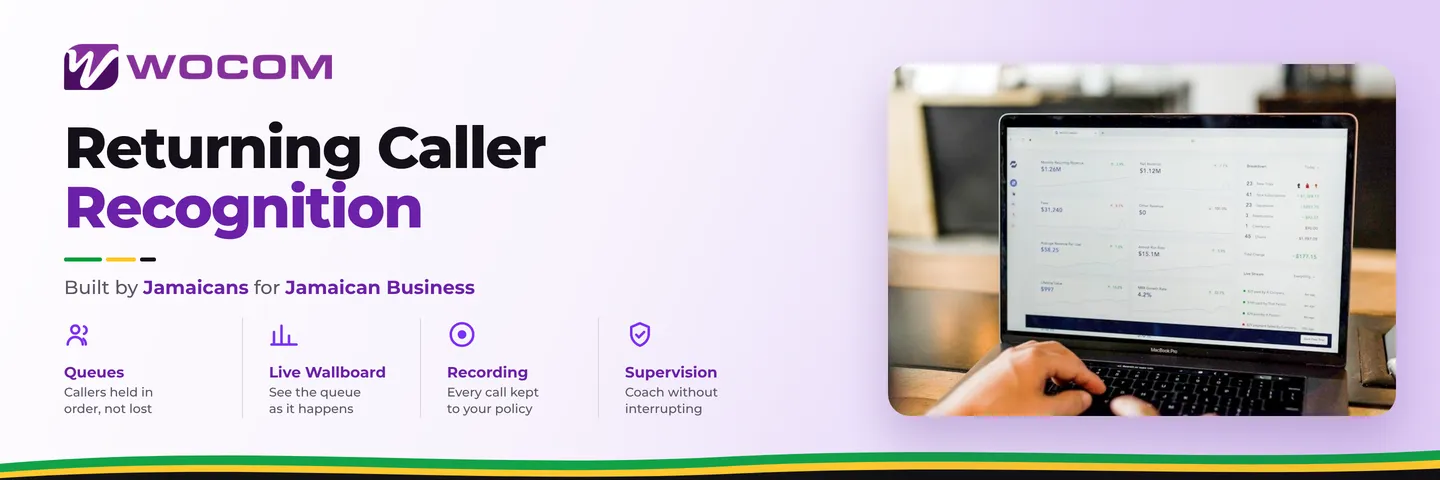
4. Screen pop with account history. When the agent's phone rings, their screen should already show the customer's name, their last interaction, any open tickets, and their account tier. The agent answers with context, not with questions. This alone can shave two to three minutes off average handle time per call.
Connecting Your Contact Centre to Your CRM in Jamaica
The practical question for most Jamaica businesses is how to build this connection without a large technology project. WOCOM's Cloud PBX supports API-level integration with common CRM platforms including Zoho CRM, which is widely used across Jamaican businesses. When a call arrives, the PBX fires a webhook to your CRM with the inbound number and receives a response — customer found, account tier, last case — before routing completes.
For businesses running simpler setups — a customer spreadsheet or an internal database rather than a full CRM — the same pattern applies at a smaller scale. A lightweight lookup sits between your PBX and your data, and the routing logic follows the result.
What matters is that the lookup is fast. If the query takes more than a fraction of a second, callers may hear a brief delay before the queue begins. WOCOM configures these integrations so the lookup completes within the normal call-setup window, invisible to the caller.
How WOCOM AI Handles Returning Callers
WOCOM's AI receptionist — Alex — performs returning caller recognition on every inbound call automatically. When a call arrives, Alex checks whether the caller's number has a known profile associated with the business. If a match is found, the AI can greet the caller by name, skip the basic qualification questions, and move directly to the reason for the call.
For businesses where every call goes to Alex first, this is particularly valuable. A returning customer should not have to identify themselves from scratch each time. Alex draws on the caller record to provide a context-aware experience from the very first second, and passes that context to the agent if a transfer is needed — so the agent picks up an informed call, not a cold one.
This is part of how AI call handling in Jamaica is shifting from a simple answering function to a genuinely relationship-aware system. The AI is not just answering the phone — it is carrying the customer's history alongside the conversation.
The Metrics That Improve When You Personalise Routing
Contact centres that implement returning caller recognition consistently see improvement across several key performance areas:
- Average Handle Time (AHT) falls because agents spend less time gathering information the system already has
- First Call Resolution (FCR) rises because context-aware routing connects callers to the right agent the first time
- Customer Satisfaction (CSAT) improves because loyal customers feel recognised rather than anonymous
- Queue abandonment drops for returning callers who are routed more efficiently
None of these gains require a large capital investment. For most Jamaica contact centres operating on Cloud PBX today, the routing logic and CRM integration can be configured within your existing platform — it is a setup change, not a system replacement.
Start Treating Your Best Callers Like Your Best Customers
If your contact centre routes every inbound call the same way regardless of who is calling, you are leaving loyalty on the table. Returning caller recognition is one of the most practical improvements you can make to your caller experience — and it is available within the Cloud PBX and AI receptionist environments that Jamaica businesses already use.
WOCOM works with businesses across Jamaica to configure caller identification, CRM integration, and intelligent routing as part of a managed Cloud PBX or contact centre setup. Contact the WOCOM team today to find out how quickly your contact centre can be routing returning customers the right way.
Continue exploring
Ready to upgrade your communications?
Talk to our team about the right solution for your business.
Book a Demo Contact SalesEverett Kildare is WOCOM's voice and infrastructure specialist, with more than 25 years of experience designing and running carrier-grade voice, SIP and virtualization infrastructure. Holding a BSc in Information Technology, he has built, secured and migrated phone systems for businesses of every size. Everett writes WOCOM's technical coverage of SIP trunking, cloud PBX, contact centres, business continuity and migration.