Receptionist Capacity Planning: How Many Calls Can One Person Handle in a Jamaica Business?
When "One Person for the Phone" Stops Working
Most Jamaica businesses start with one person answering the phone. That works when you are small. But as call volume grows — more customers, more enquiries, more suppliers, more everything — that single point of contact becomes a bottleneck. The question is not whether one person can eventually get overwhelmed. The question is when, and whether you notice before it starts costing you customers.
Receptionist capacity planning is the practice of matching your call volume to your front-desk resources. Very few Jamaican SMEs do it deliberately. Most wait for a complaint, a missed contract, or an unusually bad week before they act. This guide walks through what to measure, what the warning signs look like, and what your options are when demand exceeds supply.
What Overloaded Reception Looks Like in Practice
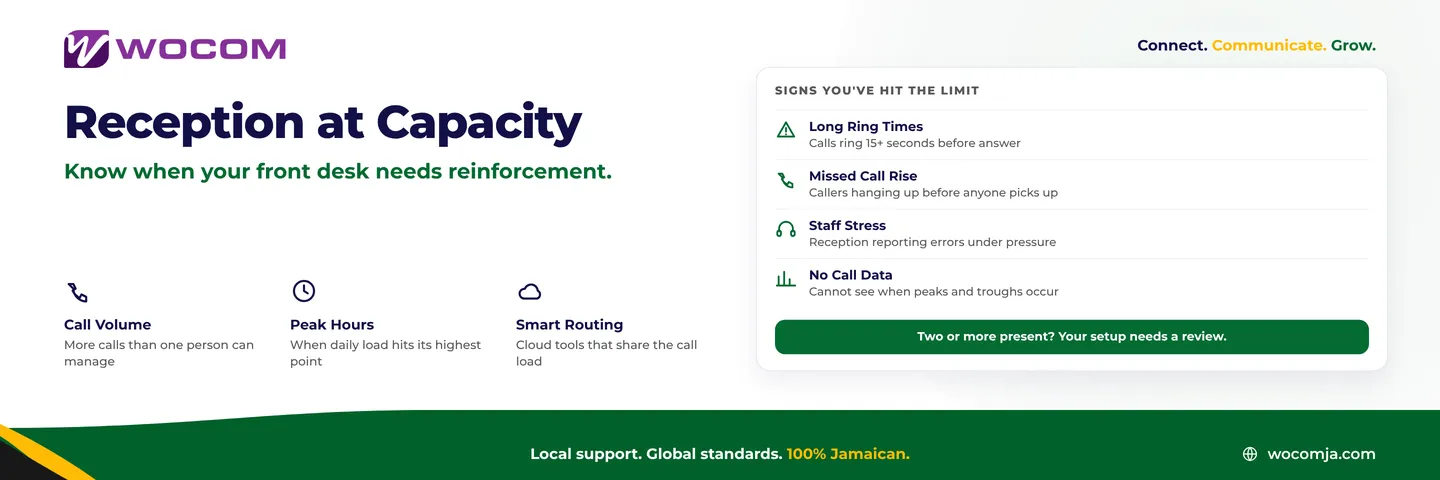
Overloaded reception staff rarely complain outright. Instead, you see the symptoms: calls ringing for fifteen seconds or more before anyone picks up; callers hanging up and not calling back; your receptionist rushing callers off the line to get to the next one; messages that get taken but never passed on correctly. These are not personal failures — they are capacity failures.
A busy business phone in Kingston or Montego Bay might handle forty to sixty inbound calls on a typical weekday. During peak periods — lunch hours, Fridays, or immediately after a promotion — that number can spike sharply. One person, with no call management tools, can realistically give proper attention to around twenty to thirty calls per day while also handling walk-in traffic, internal requests, and administrative work. Beyond that threshold, service quality drops, not because the person is incapable, but because the system has no room to absorb the load.
The receptionist is not failing. The system is failing. When one person carries the full weight of all inbound calls, there is no room for quality — only survival.
How to Measure Your Reception Call Load
Before you can fix the problem, you need to see it clearly. Cloud PBX systems give you reporting tools that traditional phone lines cannot match. Your call logs will show:
- Total inbound calls per day — broken down by hour so you can see exactly when peaks hit
- Ring time before answer — how long each call rang before it was picked up
- Missed call count — calls that were never answered and callers who hung up
- Call duration — how long each conversation lasted, which helps estimate handling time
- Extension-level data — which team members answered calls and how many each handled
If you are still running a traditional PABX or plain landline, you likely cannot access any of this data. That invisibility is itself a risk — you are managing a resource-intensive function with no metrics at all.
Once you have the data, identify your average calls per hour during your three busiest hours of the day. That is your planning number. If a single reception point is absorbing all of that with no overflow path and no queue management, you have a structural problem worth addressing now rather than later.
Cloud PBX Features That Extend a Receptionist's Capacity
Switching to a cloud PBX system does not automatically solve call overload, but it gives you the tools to manage it properly. Here is what makes the most practical difference for Jamaica businesses:
- Ring groups — instead of routing all calls to one extension, ring groups send the call to the first available person in a defined team. Your receptionist no longer carries every call alone.
- Call queuing with hold audio — callers who cannot be answered immediately are held in a queue rather than receiving a busy signal. This alone reduces hang-ups significantly during peak periods.
- Auto-attendant menus — a well-designed IVR routes billing callers to accounts, support callers to technical staff, and new enquiries to sales, before a human even picks up. This reduces the volume that hits your receptionist directly.
- Operator console or busy lamp field (BLF) — a visual dashboard showing which extensions are active, on hold, or free. A skilled receptionist with an operator console handles higher volumes more calmly than one working with a standard handset and no visibility into the queue.
- Call overflow routing — when all agents are busy, overflow calls route to a secondary ring group, a mobile number, or a voicemail box that triggers an email notification. Nothing falls into a void.
None of these require expensive hardware upgrades. A cloud PBX from WOCOM can be configured and adjusted from an online portal, so you can tune your routing as your business grows — without scheduling a technician visit every time something changes.
When AI Becomes the Right First-Line Answer
For some Jamaica businesses, the right response to call overload is not adding more staff — it is deploying an AI receptionist as the first point of contact. This works particularly well when a large proportion of your calls are routine: enquiries about opening hours, pricing, branch locations, service availability, or appointment confirmation.
An AI receptionist handles these calls without occupying a human agent. When a caller has a request that genuinely requires a person, the AI collects the caller's name and the nature of their enquiry, then routes accordingly or takes a message. The practical effect is that your human receptionist — or your sales or support team — only receives calls that actually require human attention.
This is not about replacing your receptionist. It is about removing the category of calls that should never have required a person in the first place. "What time do you open?" does not need a trained employee. "I want to discuss upgrading my service package" does. The AI handles the first; your team focuses on the second.
WOCOM's AI receptionist is deployed across businesses throughout Jamaica, handling calls professionally and in context, without additional staffing overhead for the calls it manages.
Building a Scalable Front-Desk Call Strategy
The right setup depends on your call volume, your team structure, and the nature of your inbound calls. A few practical principles apply regardless of business size:
- Always have an overflow path. If your primary reception point is busy, there must be somewhere the call goes — not a busy signal, not dead air. A secondary ring group, a voicemail-to-email, or an AI handler are all better than the caller simply giving up.
- Review your call data monthly. Volume changes with seasons, marketing campaigns, and business growth. A setup that handled last year's traffic comfortably may already be under strain today.
- Train for capacity, not just courtesy. Reception staff need to understand how to use ring groups, operator consoles, and call transfer features efficiently. A well-trained person with the right tools handles more volume more calmly than an undertrained person with identical equipment.
- Plan for peaks, not averages. Your system needs to cope with your worst day, not your typical day. A promotion, a news mention, or an unexpected referral campaign can triple inbound volume overnight. If your setup has no headroom, you will lose the moment you most need to capitalise on.
Ready to Assess Your Business Call Load?
WOCOM works with Jamaica businesses of all sizes to right-size their phone systems — from one-person operations in Kingston to multi-branch companies spanning the island. If you are not sure whether your current setup is keeping up with your volume, we can help you pull the numbers and identify where the gaps are.
Speak with the WOCOM team today to review your call volume, your routing configuration, and whether a cloud PBX upgrade or AI receptionist makes sense for your front-desk workflow. Reach out at wocomja.com and let us build a setup that keeps up with your business.
Continue exploring
Ready to upgrade your communications?
Talk to our team about the right solution for your business.
Book a Demo Contact SalesEverett Kildare is WOCOM's voice and infrastructure specialist, with more than 25 years of experience designing and running carrier-grade voice, SIP and virtualization infrastructure. Holding a BSc in Information Technology, he has built, secured and migrated phone systems for businesses of every size. Everett writes WOCOM's technical coverage of SIP trunking, cloud PBX, contact centres, business continuity and migration.