Radio and TV Advertising Jamaica: Set Up Your Business Phone System Before the Campaign Airs
When the Ad Airs, the Phones Should Already Be Ready
You spend weeks preparing a radio campaign. The script is polished, the slot on ZIP FM or RJR is booked, and the offer is compelling. The ad airs at 7:30 AM during the morning drive and within twelve minutes your front desk line is constantly engaged. Except it is not ringing constantly — it is ringing busy.
This is the most common and most avoidable waste in Jamaican business advertising. The ad does its job. The phone system does not. Callers hit a busy signal or ring out to voicemail, hang up, and move on to the next result on Google. The revenue opportunity disappears before anyone even picks up.
Preparing your business phone system for an advertising campaign is not complicated. It takes a handful of configuration changes on a modern Cloud PBX. The challenge is knowing what those changes are before the campaign airs — not after.
What Actually Happens When Your Ad Hits the Air
Traditional business phone lines operate on a one-to-one model: one call, one line. If your business has three phone lines and four people call simultaneously, one caller gets a busy tone. That is acceptable when call volume is predictable. It is costly when you have just told 50,000 listeners to call your number right now.
Radio advertising in Jamaica creates a sharply shaped spike. Volume climbs within two to three minutes of the ad airing, peaks during the following fifteen minutes, then drops quickly. TV campaigns generate a similar pattern but with more sustained volume if the ad runs across multiple slots or stations. By the time your team realises the lines are overwhelmed, a significant number of potential customers have already given up.
A Cloud PBX handles this differently. Calls connect over SIP channels, additional capacity is available without adding physical lines, and the system queues callers rather than returning a busy tone. None of that works automatically, though. It has to be configured before the campaign runs.
Five Configuration Changes to Make Before Any Campaign
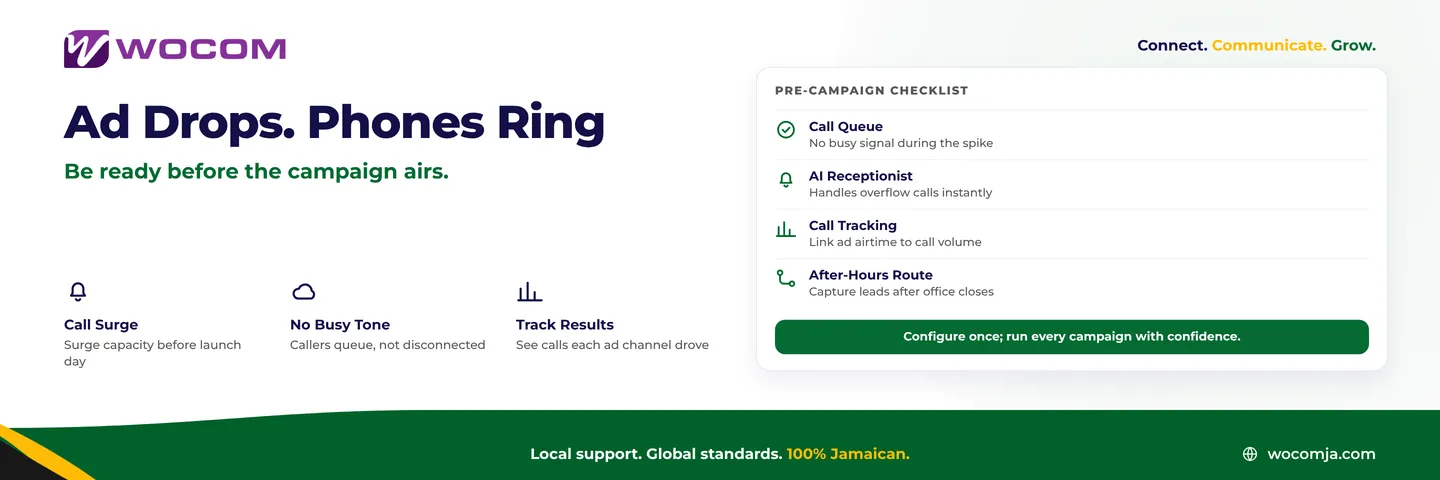
1. Set a Call Queue Depth That Matches Expected Volume
Your Cloud PBX has a call queue — a virtual line of callers waiting to be answered. By default, many businesses leave this at a low number or leave it unconfigured entirely. Before an advertising push, raise your queue depth to accommodate expected volume and configure a queue announcement so callers hear their position and an estimated wait time. A caller who hears "You are second in line; your expected wait is under two minutes" almost always holds. A caller who hears dead air does not.
2. Route Overflow to Your AI Receptionist
If your queue fills or your team is fully occupied, overflow calls should route to an AI receptionist rather than voicemail. The AI greets the caller, captures their name and reason for calling, offers a callback, takes a message, and can answer basic questions about your offer. This keeps the caller engaged and ensures you have a lead record even when your human team is at full capacity. WOCOM's AI receptionist handles this role as a seamless second tier behind your live staff.
3. Add a Campaign-Specific Greeting
When someone calls after hearing your ad, they expect to reach a business that is ready for them. Updating your auto-attendant greeting to reference the campaign — "Thank you for calling. We are running our special promotion this week" — immediately confirms they have reached the right place and reinforces the offer. This takes a few minutes to record and measurably improves the caller's confidence that calling was worth their time.
4. Configure Call Tracking for Each Advertising Channel
If your Cloud PBX supports reporting by DID number, assign a dedicated number to each advertising channel — one number for radio, a different one for social media, a third for print or outdoor. After the campaign, your call log shows exactly how many calls each channel generated, when they peaked, how long callers waited, and how many were answered versus abandoned. This is the data that tells you whether a particular media buy was worth it. Without it, you are guessing.
5. Extend Your After-Hours Coverage
Radio and TV ads often air in early mornings, evenings, or on weekends — times when your office may be closed. Configure your after-hours routing before the campaign launches. This might mean extending queue hours, enabling the AI receptionist during off-hours, or routing evening calls to a designated team mobile. A caller motivated by your ad at 6:30 PM will not reliably call back in the morning. Capture the lead when the interest is fresh.
The Real Cost of Doing Nothing
If a campaign generates a large burst of calls in the first hour and your system can only handle a few simultaneous connections, the remaining callers receive a busy tone or voicemail. If your offer converts at even a modest rate, the calls you fail to answer represent real lost revenue — not theoretical lost revenue. The advertising budget spent to generate that call interest is gone regardless of whether the calls were answered.
Businesses that invest in call infrastructure before advertising consistently report better campaign return on investment, not because the advertising is better but because they capture a higher percentage of the calls it generates. Kingston companies that run frequent radio campaigns have learned this the hard way. Getting the phone system ready is as important as writing the script.
Reading the Data After the Campaign Ends
Your Cloud PBX reporting dashboard gives you a clear picture of what happened once the campaign closes. You can see the call volume curve against your ad airtime schedule, identify the peak window, review how many calls were answered by your team versus the AI, and check the abandoned call rate. High abandonment during a specific time slot signals a need for more queue capacity or staffing on the next campaign. Short, consistent wait times before answer confirm the system was sized correctly.
This data also validates your advertising investment in ways that digital metrics alone cannot. A call from someone who heard your radio ad, waited briefly in a queue, and spoke to your team is a warmer lead than almost any other channel. Knowing how many of those calls each channel drove is the foundation of smarter media decisions going forward — whether your business is in New Kingston, Montego Bay, or anywhere else across the island.
Confirm Your System Is Ready Before the Next Campaign
WOCOM's Cloud PBX gives Jamaica businesses the call queuing, AI receptionist overflow, DID-level campaign reporting, and flexible routing that advertising campaigns demand. If your next radio or TV buy is on the calendar, reviewing your phone configuration now takes far less time than recovering revenue lost to a busy signal.
Speak with the WOCOM team about your advertising schedule and we will confirm your system is configured to handle the volume your campaign will generate. Visit wocomja.com/contact to get started.
Continue exploring
Ready to upgrade your communications?
Talk to our team about the right solution for your business.
Book a Demo Contact SalesEverett Kildare is WOCOM's voice and infrastructure specialist, with more than 25 years of experience designing and running carrier-grade voice, SIP and virtualization infrastructure. Holding a BSc in Information Technology, he has built, secured and migrated phone systems for businesses of every size. Everett writes WOCOM's technical coverage of SIP trunking, cloud PBX, contact centres, business continuity and migration.