Phone System Downtime Cost Jamaica: What One Hour of Outage Is Worth to Your Business
The Hour Your Phones Went Silent
A dentist in New Kingston loses her front desk phone line for three hours on a Monday morning. By the time the line is restored, eleven appointment slots have gone unfilled — patients who called, got no answer, and booked elsewhere. The direct loss: roughly J$110,000 in revenue. The indirect loss: three of those patients never returned.
This is not an extreme scenario. For most Jamaica businesses, the phone is still the primary channel for bookings, enquiries, and sales. When it goes down, revenue stops — and the clock starts ticking immediately.
Before you can protect against downtime, you need to know what it costs. Here is how to calculate it.
Step One: Calculate Your Hourly Phone Revenue
Start with this formula:
Hourly call revenue = (Monthly revenue attributable to inbound calls) ÷ (Business hours per month)
Example: A Kingston hardware store generates J$4.8 million per month. Roughly 60% of sales begin with a customer enquiry call. That is J$2.88 million attributable to phone-initiated sales. Divided across 200 business hours per month, each hour of open phones is worth approximately J$14,400.
That figure only counts direct revenue. It does not include the cost of handling callbacks, the staff time spent managing frustrated repeat callers, or customers who moved on without telling you why.
Run this calculation for your own business. Most owners are surprised by the result.
Direct Costs During a Phone Outage
The most visible damage is straightforward: calls you cannot answer become revenue you cannot capture. But several other direct costs add up fast.
- Emergency backup scrambles — Most businesses rush to set up a temporary mobile number when the main line goes down. Forwarding that number, updating Google Business Profile, and printing new contact details all consume staff time — none of it billable.
- Overtime and recovery surge — The first hour after restoration is spent returning missed calls, catching up on bookings, and managing complaints. That surge costs more in effort than any normal business hour.
- Hardware repair or replacement — If the outage stems from a failed on-premise PBX or a faulty line, the repair invoice arrives on top of the lost revenue.
For a contact centre or outbound sales operation, the math is even more direct. An outbound team with ten agents at J$3,500 per hour in labour costs produces nothing during a phone outage — but the payroll still runs.
Indirect Costs: What the Spreadsheet Misses
The harder costs to measure are the ones that do not appear in the same week.
Customer churn from a single bad experience is well-documented across industries. A caller who reaches a dead line during business hours assigns that frustration to your brand. In a market like Jamaica where word-of-mouth is a primary trust signal, one frustrated customer influences several others before you have any chance to fix the situation.
There is also the question of lost prospects. A buyer comparing options who cannot reach you on the first attempt is very likely to call a competitor next. In competitive Kingston industries — insurance, real estate, car rental, freight — that second call often results in a sale. Just not for you.
Quantifying churn is difficult, but a conservative estimate holds: if a four-hour outage causes even one percent of monthly callers to switch permanently, the long-term revenue impact easily exceeds the immediate missed-call figure by a factor of ten or more.
Jamaica-Specific Risk Factors
Phone downtime risks in Jamaica are not the same as in markets with stable, redundant infrastructure. Businesses here face a specific combination of threats that compound the exposure.
- Power outages — On-premise PBX hardware requires power to operate. A generator may protect your computers while your phone system sits on a separate circuit or a failing UPS — leaving you dark on calls even when the lights are on.
- Hurricane season — Between June and November, the risk of extended outages from wind, flooding, or downed lines rises significantly. Montego Bay, coastal St. Elizabeth, and eastern parishes face the sharpest exposure.
- ISP instability — Businesses dependent on a single internet provider for VoIP experience both data and call outages simultaneously when that provider has a maintenance window or congestion event.
- Single-carrier PSTN lines — Traditional copper or PRI connections offer one path to the public network. If that path fails, there is no automatic fallback — someone has to make a call to report that they cannot make calls.
These risks are not hypothetical. Most Jamaica businesses with five or more years of history can point to at least one significant outage that cost them measurable revenue.
How Cloud PBX Cuts Your Downtime Exposure
The structural advantage of a cloud-hosted phone system is that the core infrastructure is not in your building. If your office loses power, floods, or suffers a hardware failure, your phone numbers, call flows, and voicemail continue to exist on the carrier's network — unaffected.
Failover can be automatic and near-instant:
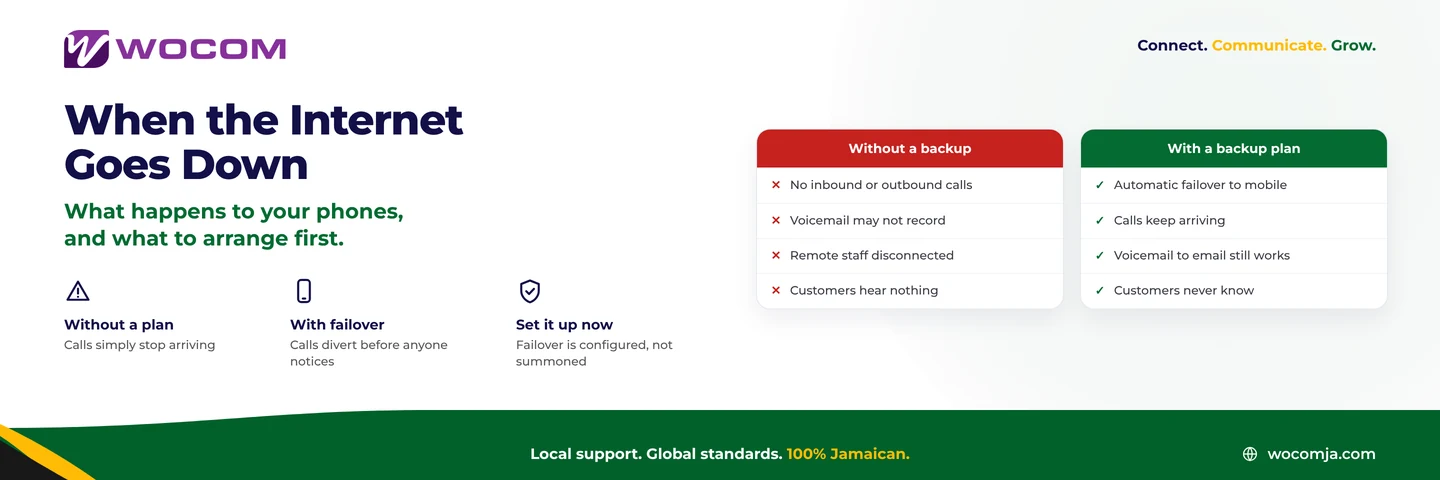
- Calls reroute to mobile numbers if your office internet goes down
- Remote staff can keep answering calls from any location without configuration changes
- Voicemail-to-email captures every message even when no one is available
- A secondary SIP trunk or backup internet path means a single ISP issue does not take your phones offline
WOCOM's Cloud PBX platform runs on infrastructure owned and operated by WOCOM directly — not resold from a third-party provider with no footprint in Jamaica. That matters when something goes wrong and you need someone who actually controls the network to fix it.
Businesses on WOCOM's platform can also pair their Cloud PBX with a Starlink backup connection, which has proven particularly resilient during hurricane conditions when terrestrial internet routes fail.
A Quick Business Continuity Review for Your Phone System
If you have not reviewed your communications resilience recently, work through this checklist:
- What happens to incoming calls if your office internet goes down right now?
- What happens if your on-premise phone hardware fails at 9 a.m. on a Monday?
- How long does full service restoration take — and who initiates it?
- Do you have a documented fallback number that staff and customers know about?
- When did you last test your failover under a simulated outage — not just assume it works?
If any of those questions produce an uncertain answer, your business is currently carrying downtime risk without fully knowing its value. The calculation you ran in step one is the floor — the real number is higher once indirect costs are included.
Talk to WOCOM About Closing the Gap
WOCOM works with Jamaica businesses to replace single-point-of-failure phone setups with cloud-based systems designed to keep calls flowing regardless of what happens at your office. Whether you are currently on copper PSTN lines, an ageing on-premise PBX, or a resold VoIP service with no local support, there is a migration path that reduces your downtime exposure without disrupting operations while the transition happens.
Visit wocomja.com/contact or reach our team directly to request a free communications review. We will walk through your current setup, identify the single points of failure, and show you exactly what a resilient cloud alternative looks like — and what it costs compared to the risk you are already carrying.
The cost of downtime is something you can calculate. The cost of prevention is almost always less.
Continue exploring
Ready to upgrade your communications?
Talk to our team about the right solution for your business.
Book a Demo Contact SalesEverett Kildare is WOCOM's voice and infrastructure specialist, with more than 25 years of experience designing and running carrier-grade voice, SIP and virtualization infrastructure. Holding a BSc in Information Technology, he has built, secured and migrated phone systems for businesses of every size. Everett writes WOCOM's technical coverage of SIP trunking, cloud PBX, contact centres, business continuity and migration.