How Much of the Market Has Actually Moved? PBX to Cloud Migration by the Numbers, 2026
Ask how far the migration from traditional PBX to cloud phone platforms has gone and you will get three different answers from three credible sources — 37%, 67% and 73% — all published within the last two years, all measuring what sounds like the same thing.
They are not measuring the same thing. This note sets out what each figure actually counts, which one to use when you are planning, and what the numbers look like for Jamaica specifically.
The headline number depends entirely on what you count
Three published measures, three very different pictures of the same shift:
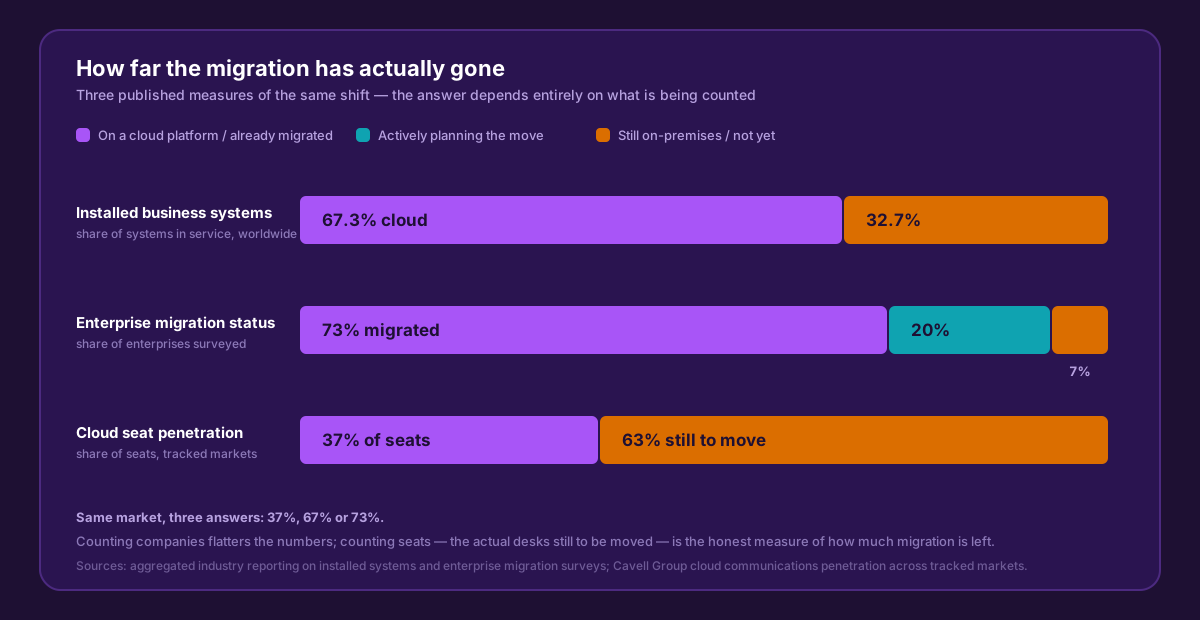
Counting companies gives you 67–73%. Counting seats — the actual desks left to move — gives you 37%. Both are true; only one tells you how much work is left.
- 67.3% of installed business phone systems are cloud-based, leaving 32.7% on-premises. This counts systems, so a five-person office and a 400-seat contact centre carry identical weight.
- 73% of enterprises say they have already migrated to cloud telephony, with a further 20% actively planning the move. This counts organisations, and an organisation qualifies as migrated the moment any meaningful part of it runs in the cloud.
- 37% of business phone seats are on cloud platforms across the markets Cavell Group tracks — with the United States, United Kingdom and Netherlands ahead of that average and Germany and France well behind it.
The gap between 73% and 37% is the whole story. A company that put its sales team of eight on a cloud platform while a 200-extension PBX still runs the rest of the building appears in the "migrated" column of a survey — and leaves 200 seats sitting in the "not yet" column of a seat count.
If you are sizing the remaining opportunity or planning your own project, use the seat number. Roughly six in ten business phone seats worldwide are still attached to hardware that has to be replaced eventually. The migration is not nearly finished; it is closer to half done.
What the forecasts say happens next
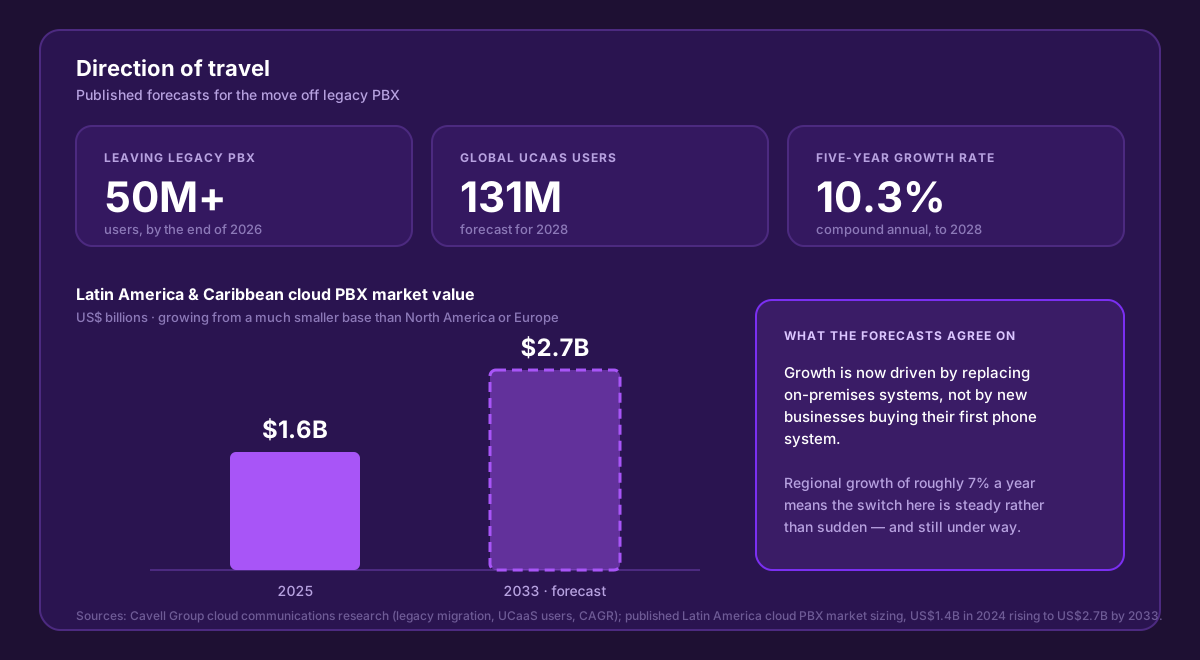
The forecasts differ on pace but agree on direction: growth now comes from replacing on-premises systems rather than from businesses buying their first phone system.
- Over 50 million users are forecast to migrate from legacy PBX solutions to cloud communications by the end of 2026.
- The global UCaaS market reaches more than 131 million users by 2028, growing at a compound annual rate of 10.3%.
- The Latin America and Caribbean cloud PBX market was valued at about US$1.4 billion in 2024, US$1.6 billion in 2025, and is forecast to reach US$2.7 billion by 2033 — roughly 7% compound annual growth.
There is an important nuance in the analyst commentary. In mature markets, providers are running out of on-premises systems to convert; growth there is shifting from seat expansion to value-added services and AI. That is a description of the United States and Western Europe. It is emphatically not a description of the Caribbean, where a smaller base and a longer runway mean the straightforward hardware-to-cloud conversion still has years left in it.
Where Jamaica sits
There is no published, Jamaica-specific migration percentage — no local body tracks cloud PBX seats the way Cavell tracks European ones, and anyone quoting you a precise national figure is estimating. What is published is the set of conditions that decide whether migration is even possible, and on that measure Jamaica is ready.
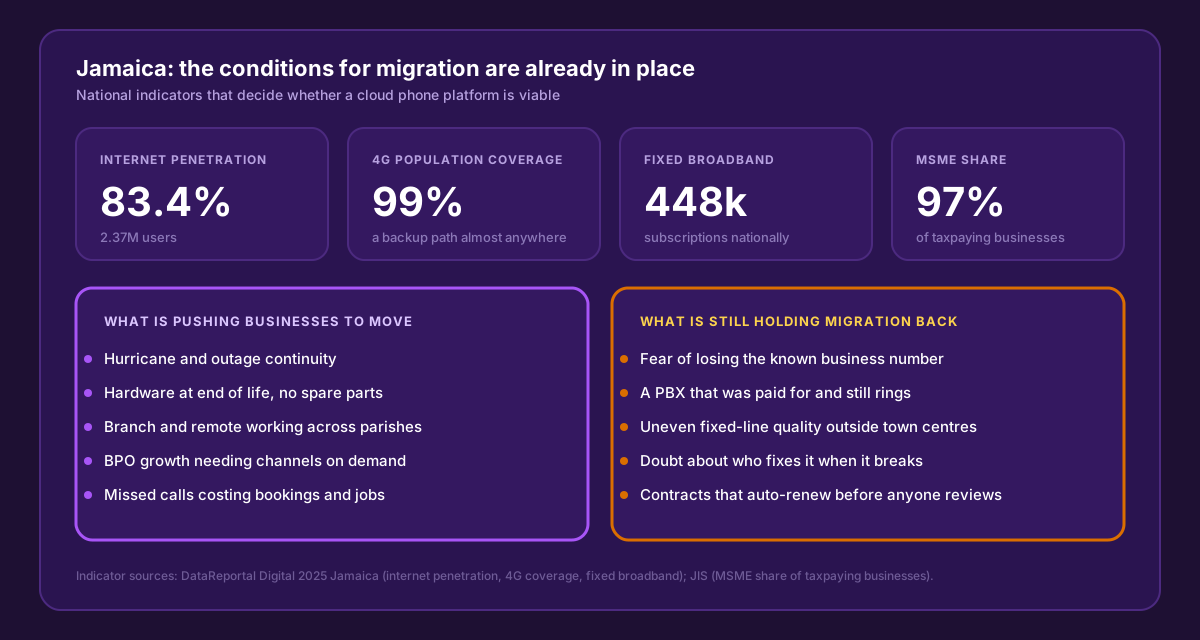
The infrastructure question is settled. What remains is a set of commercial and confidence barriers — which is a very different problem to solve.
Internet penetration of 83.4% — about 2.37 million users — means the transport exists for the overwhelming majority of businesses. 4G coverage of roughly 99% of the population means a backup path exists almost everywhere, which matters more here than in most markets. And with MSMEs making up over 97% of taxpaying businesses, the bulk of the remaining on-premises estate is not in large enterprises at all — it is in the long tail of small firms running a box on the wall that still works.
That shapes what migration looks like locally. Large organisations — government bodies, BPOs, financial institutions, multi-site retailers — have largely moved or are mid-project, because their business cases are driven by continuity, compliance and multi-site management. The remaining volume sits with owner-led businesses whose systems are old but functional, and for whom the trigger is rarely strategy. It is an event.
The events that actually trigger a migration
- The hardware fails and parts are no longer made. Still the single most common trigger, and the worst possible moment to plan a phone system.
- A storm or a prolonged outage. Businesses that lost calls for days rarely renew the same setup — see our guide on failover and redundancy.
- Contract renewal. The one predictable moment to review everything; our renewal checklist covers what to look at.
- An office move or a new branch. Nobody wants to pay to install legacy line infrastructure twice.
- Remote and hybrid staffing. A PBX cannot follow an employee home; a cloud extension can.
What still holds businesses back — and what answers each objection
- "We will lose our number." Number portability is a regulated right in Jamaica, and the rules require minimal service interruption. Our porting guide walks through the process.
- "The PBX is paid for and still works." Fair — which is why the first step does not have to be replacing it. A SIP trunk into the existing PBX cuts line costs and adds redundancy while the hardware lives out its remaining years.
- "Our internet is not good enough." A voice call needs about 100 kbps. The relevant question is consistency, not speed, and the platform runs over whatever connection is available — see why a cloud phone system is connectivity agnostic.
- "Who fixes it when it breaks?" The genuine risk is buying from a reseller with no infrastructure and no restoration path. Ask whether your provider is licensed in Jamaica and owns the network your calls run on.
The practical read for a business still on a PBX
Three conclusions follow from the data:
- You are not late, but you are no longer early. With roughly six in ten seats still to move globally, plenty of businesses are where you are — but the direction is settled and the vendors' investment is going one way.
- Migration is now the normal path, not the risky one. The forecast of 50 million-plus users leaving legacy PBX by the end of 2026 describes a well-worn route with mature tooling, not an experiment.
- Choose the moment rather than letting it choose you. Migrating on a planned date with numbers ported cleanly costs a fraction of migrating in a panic after a hardware failure or a storm.
Methodology and sources
Figures in this note are drawn from published industry research and national statistics, not from WOCOM customer data. Where measures disagree we have shown all of them rather than picking the most flattering. The Jamaica section reports national connectivity and business-structure indicators; it does not claim a national migration percentage, because none is published.
- Cloud communications penetration, legacy migration volumes and UCaaS forecasts: Cavell Group cloud communications research.
- Installed-base split and enterprise migration status: aggregated industry reporting on business telephony deployments, 2025–2026.
- Regional market sizing: published Latin America and Caribbean cloud PBX market forecasts, 2024–2033.
- Jamaica connectivity indicators: DataReportal — Digital 2025 Jamaica.
- MSME share of taxpaying businesses: Jamaica Information Service.
Migration research FAQs
Plan the move on your own timetable
WOCOM is a licensed Jamaican carrier that owns its own voice network, and we migrate businesses off legacy PBX systems every week — including phased projects that start with a SIP trunk into the hardware you already own. Call 876-906-7240 or book a consultation and we will map your current system, your numbers and a realistic switchover date before you commit to anything.
Continue exploring
Ready to upgrade your communications?
Talk to our team about the right solution for your business.
Book a Demo Contact SalesMichelle Goss is a data and AI analyst at WOCOM, where she studies how Jamaican businesses use voice, messaging and AI to win and keep customers. With a BSc in Data Science & Analytics, she turns call data, customer trends and AI receptionist performance into practical guidance owners can act on. Michelle writes WOCOM's coverage of AI call handling, call analytics, customer growth and industry trends.