How Many Business Phone Numbers Do You Have? The Case for One Main Number
Answer without looking: how many phone numbers does your business pay for?
Most owners get it wrong, and they get it wrong in the same direction. There is the main line. The second line that was added when the main one kept engaging. The fax number nobody has faxed since 2019. The one printed on the side of a van that has since been sold. The line the alarm company asked for. The branch number that still bills after the branch moved. Somewhere in there is a number a customer is dialling right now and getting nothing.
Every one of those is a rental. In Jamaica a business line typically runs around J$2,200 a month — so four of them is J$8,800 a month, or J$105,600 a year, for four numbers that mostly cannot help each other.
The bill is not the problem. What the bill buys is.
Here is the comparison most businesses have never actually run: four separate lines against a single SIP trunk carrying four simultaneous calls.
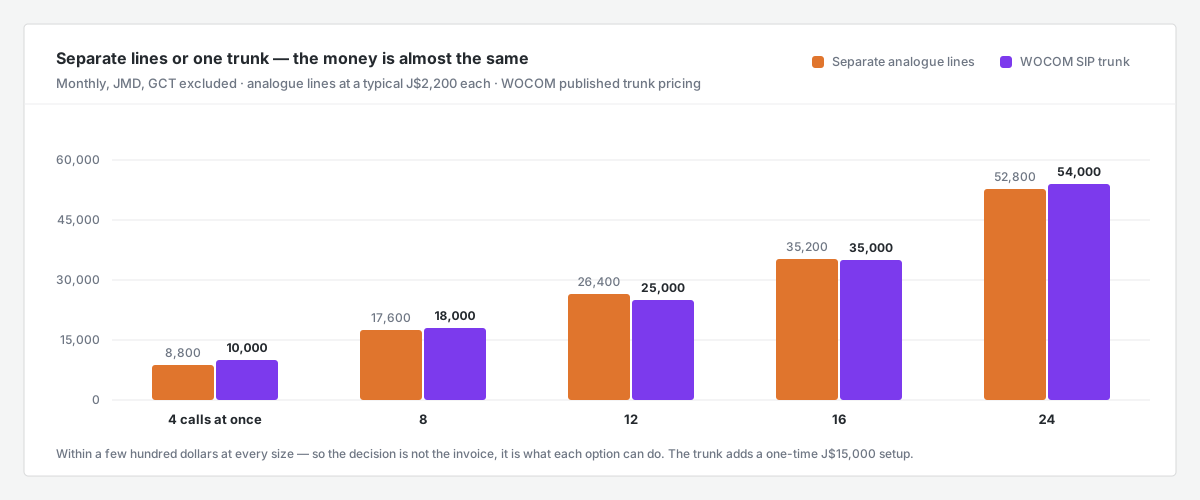
Within a few hundred dollars of each other at every size — which means price is not the deciding factor.
Four lines: J$8,800. A four-channel trunk: J$10,000. At twelve calls the trunk is already the cheaper of the two. Across the whole range the difference is small enough to ignore, and that is the useful finding — you are not choosing between an expensive option and a cheap one. You are choosing between two things that cost the same and behave completely differently.
(Both figures exclude GCT. A trunk adds a one-time J$15,000 setup that covers installation, provisioning and porting your existing numbers.)
What separate numbers do to the person calling you
A line is a number and a number is a line — that is the part worth unlearning. Because they are welded together, every problem with a line becomes a problem the caller has to solve.
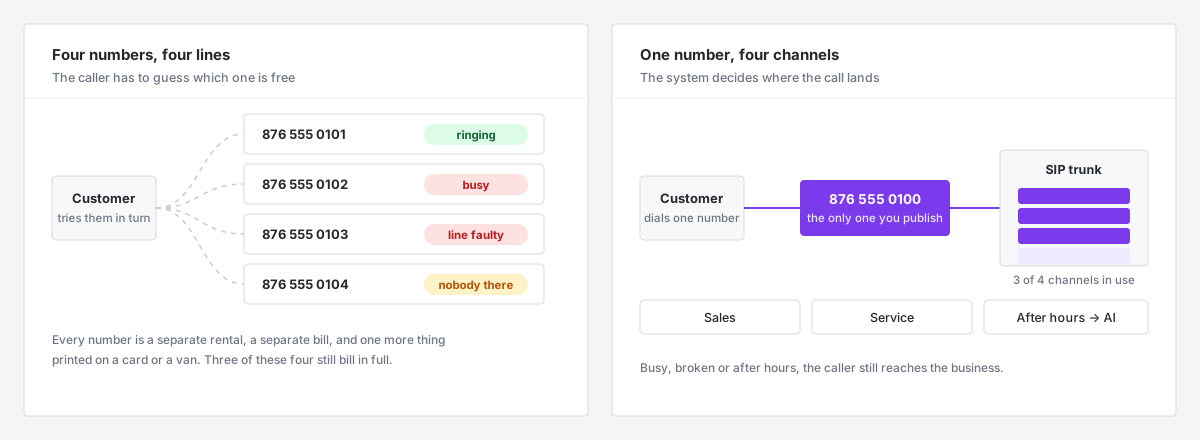
The difference is who does the work: the caller, or the system.
When line one is busy, the caller hears a busy tone and has to know that line two exists. When line three is damaged, that number is simply dead until a technician arrives — and it keeps billing in the meantime. When the number on the old signage rings in an empty room, nobody hears anything at all.
Meanwhile you are paying full price for all four. The two that are broken or unattended cost exactly the same this month as the one that is working.
On a trunk, numbers and capacity stop being the same thing
This is the change that makes consolidation possible, and it is genuinely different from how copper works.
A SIP trunk gives you channels — how many calls can be in progress at once — and numbers (DIDs) separately. Ten numbers can sit on a four-channel trunk. They all share the same capacity, so you can give sales a direct number, accounts a direct number and the branch its own number without renting a line for each one. Add a number: no new line, no site visit. Add capacity: more channels, same numbers, usually the same day.
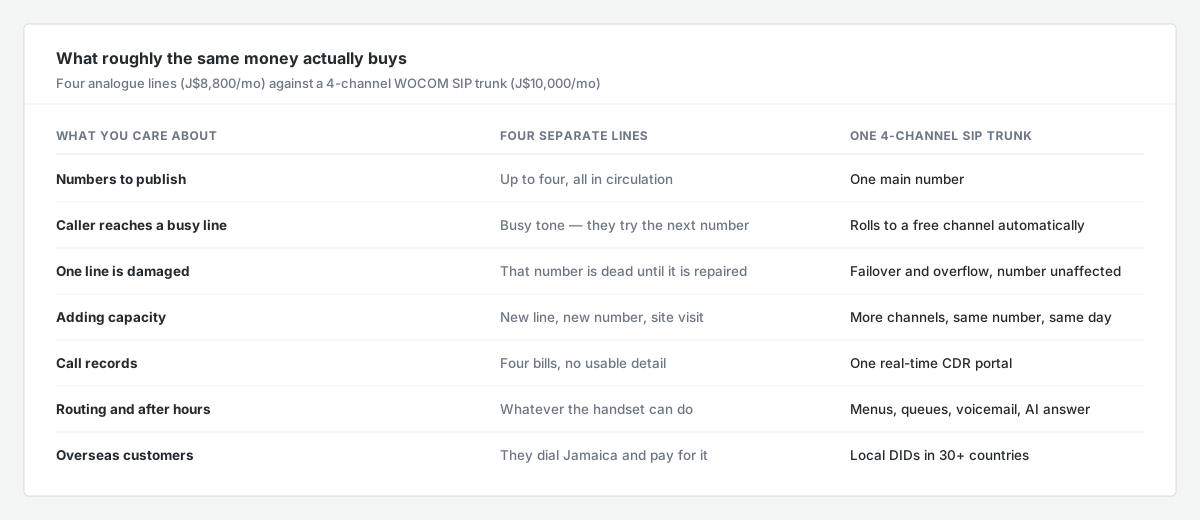
Same money, two very different sets of capabilities.
So the consolidation looks like this: keep the number your customers actually know, publish that one, and let everything else become either a DID on the same trunk or a line you stop paying for. Your best-known number is not at risk in this — porting it is a regulated right, and it moves with you, as covered in how long the switch actually takes.
How many channels, though?
Fewer than most people guess. Channels are about simultaneous calls, not total calls — a business handling 200 calls a day rarely has more than a handful in progress at the same moment.
The rough starting point: count the people who answer the phone as part of their job, then check your busiest hour. Four channels covers a great many small businesses; twelve covers a busy one. If you are between sizes, start lower — channels can be added, and a trunk can burst above its allocation when a spike arrives. The longer version of this is in how many concurrent lines your business actually needs, and the cost breakdown is in SIP trunk pricing for 2026.
The audit, which takes about an hour
- List every number you pay for. Bills, not memory. Most businesses find at least one they had forgotten.
- Ring each one from a mobile. Note what happens: answered, engaged, rings out, dead. Do it twice, once inside hours and once after.
- Mark which numbers are printed on something you cannot recall. Vehicles, signage, an old directory entry, the Google listing, a supplier's records. Those are the ones to keep and consolidate onto, not the ones on your letterhead.
- Count the simultaneous calls in your busiest hour, not the total.
- Add up the monthly rentals. That number, next to what a trunk costs for the same or better capacity, is the whole decision.
Businesses that run this exercise usually find the same shape of answer: several numbers, most of them idle, none of them helping each other, all of them billing.
Frequently Asked Questions
How many phone numbers should a business have?
One that everybody knows, plus as many direct numbers as are genuinely useful — sales, accounts, a branch. The mistake is not having several numbers; it is renting a separate line for each one, when numbers on a SIP trunk share the same pool of channels.
Is a SIP trunk cheaper than separate phone lines?
At four calls at once it is roughly the same: about J$8,800 a month for four analogue lines at typical rates against J$10,000 for a four-channel WOCOM trunk, GCT excluded. From around twelve simultaneous calls upward the trunk is cheaper, and at every size it does considerably more.
Can I keep my existing business number?
Yes. Number portability is a regulated right in Jamaica, and porting is included in the trunk's one-time setup. The number your customers already dial stays the number they dial.
What happens when all the channels are in use?
The call queues, overflows to another destination, or goes to voicemail or an AI receptionist — whatever you configure. It does not simply return a busy tone the way a full analogue line does, and a trunk can burst above its channel count when demand spikes.
Do I need to replace my phone system to do this?
Usually not. A SIP trunk connects to most existing PBX hardware, which is the point of it — you change the lines, not the phones. If your system is genuinely at end of life, a cloud phone system is the alternative, compared in SIP trunk vs Cloud PBX.
What happens to the numbers I no longer need?
Either bring them across as DIDs on the trunk, so anything printed on an old van still reaches you at no extra line cost, or stop paying for them deliberately — after checking where they are published. The costly version is cancelling a number that turns out to be on someone's records.
Count them, then call us
The audit above is worth doing whoever you buy from. If it turns up what it usually turns up — four or five rentals doing the work of one — a WOCOM Flexi-SIP Trunk consolidates them onto one number with 4 to 128 channels, international DIDs in 20+ countries, failover and a real-time call record portal. See the channel pricing, or talk to our team and read your numbers off the bill — we will tell you what the same money buys.
Continue exploring
Ready to upgrade your communications?
Talk to our team about the right solution for your business.
Book a Demo Contact SalesEverett Kildare is WOCOM's voice and infrastructure specialist, with more than 25 years of experience designing and running carrier-grade voice, SIP and virtualization infrastructure. Holding a BSc in Information Technology, he has built, secured and migrated phone systems for businesses of every size. Everett writes WOCOM's technical coverage of SIP trunking, cloud PBX, contact centres, business continuity and migration.