Peak Call Volume Jamaica: How to Handle Call Spikes Without Hiring More Staff
The Call Surge That Catches Jamaica Businesses Off Guard
It happens fast. A promotion goes out, a news story mentions your business, the Christmas rush arrives, or a service disruption triggers a wave of enquiries. Suddenly your phone lines are backed up, callers are waiting three and four minutes, and the team is scrambling. The instinct is to hire — but by the time you recruit, train, and onboard new agents, the surge is likely over.
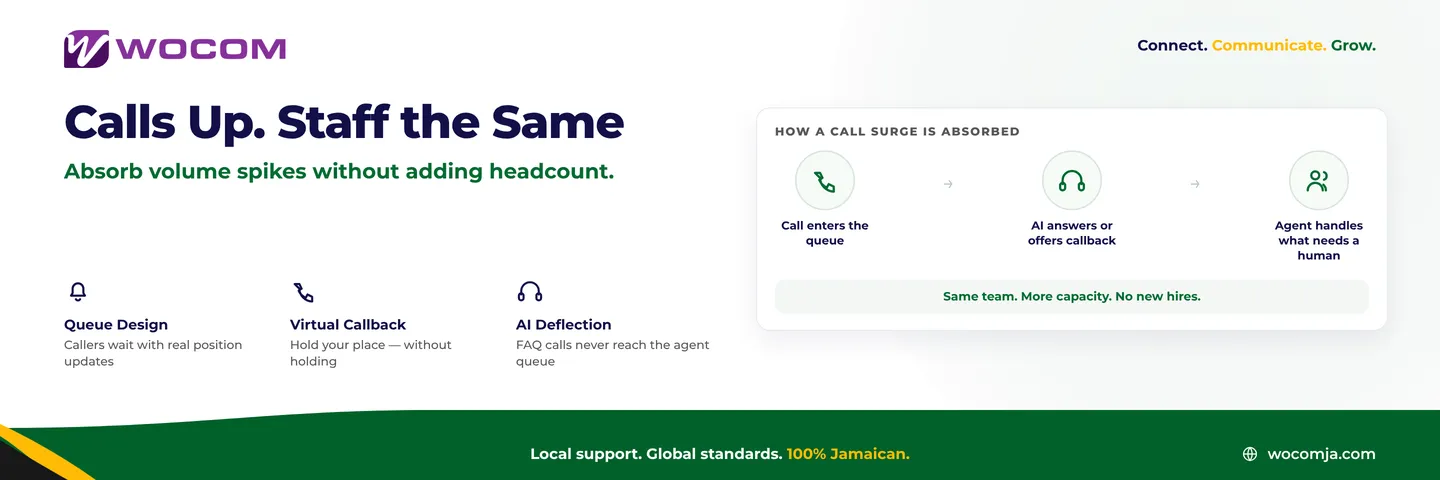
Jamaica businesses with the right phone system architecture absorb volume spikes without adding headcount. The tools are already built into Cloud PBX and contact centre platforms: intelligent queuing, virtual callbacks, AI deflection, and real-time overflow routing. The question is whether your setup is actually configured to use them before volume climbs.
Queue Design: The Foundation Everything Else Builds On
A poorly designed queue makes a busy day feel catastrophic. Callers hit silence, have no idea how long the wait will be, and hang up — often for good. A well-designed queue does the opposite: it sets expectations, keeps callers engaged, and holds more of them until an agent is free.
- Position announcements: Telling a caller they are second in the queue changes the decision to hang up. "You're number two in the queue" is reassurance. Silence is not.
- Estimated wait time: Cloud PBX platforms calculate average handle time and project wait duration. A realistic estimate — even if it is four minutes — reduces abandoned calls because callers can make an informed decision to stay.
- On-hold audio: Silence feels longer than it is. A loop of relevant information — your hours, your website, a current promotion — adds perceived value to the wait and reduces the psychological pressure of holding.
- Queue thresholds: Set a maximum queue depth. When the queue fills beyond that point, offer the caller a callback rather than forcing them to wait indefinitely. Callers who receive a callback option and take it almost never abandon the interaction entirely.
These settings take minutes to configure and can be the difference between a caller who waits and one who never calls back.
Virtual Callback: Let Callers Hang Up Without Losing Their Place
The single highest-impact feature for peak call management is virtual callback — also called a callback queue or virtual hold. When a caller has been waiting beyond a set threshold (say, ninety seconds), the system offers a choice: press a key to keep your place in the queue and receive a call back when an agent is available.
The caller hangs up. Their position in the queue is preserved. When an agent would have answered them, the system dials out automatically and connects the call. From the caller's side, they never had to wait on hold. From your side, abandonment rates drop and agents work through volume at their natural pace — no emergency hiring required.
This is especially relevant for Jamaica businesses with predictable daily peaks: pharmacies around lunchtime, financial institutions on paydays, courier companies when tracking enquiries flood in after scheduled deliveries, or insurance offices after a major weather event. The pattern is known in advance. The callback configuration should be in place before it arrives.
AI Deflection: Remove FAQ Calls from the Queue Entirely
A significant share of calls during any volume surge are not complex. They are questions your system can answer without touching an agent at all: business hours, office location, whether a product or service is available, appointment availability, or basic account status. When these calls enter an agent queue during peak periods, they consume capacity that should be reserved for callers who genuinely need a person.
WOCOM's AI receptionist, Alex, handles these calls before they reach the queue. Alex answers the line, understands the caller's question, and responds — closing the call without routing it anywhere. Calls involving complaints, billing disputes, account access issues, or nuanced technical problems are passed through to a human agent. Everything else is resolved at the first point of contact.
AI deflection is not a replacement for agents. It is a filter. The callers who reach your team arrive with problems that actually require a person — and they reach that person faster because the queue is shorter.
During high-volume periods, this matters enormously. A Kingston business receiving two hundred calls in a day might find that thirty to fifty of them are routine enquiries handled entirely by AI — freeing agents for the hundred and fifty that genuinely need them.
Skills-Based Routing: Stop Calls from Landing on the Wrong Desk
During peak volume, misrouted calls are expensive. A call that reaches the wrong department, gets transferred, re-enters a queue, and finally reaches the right agent has consumed twice the hold time and twice the agent effort — while the caller's patience has been halved.
Skills-based routing assigns calls based on what the caller needs. If the IVR or AI determines a caller is asking about billing, that call enters the billing queue directly. A technical support enquiry routes to a technical agent. In smaller businesses where one team handles everything, priority routing ensures the most urgent calls — escalations, active fault reports, high-value accounts — jump ahead of routine enquiries during a surge.
The practical effect is that each agent handles calls they are equipped to resolve on the first attempt. Handle time drops. Queue depth clears faster. The same number of agents can process more calls per hour without the confusion of misrouted volume cycling through the wrong hands first.
Real-Time Monitoring: Know When to Activate Overflow
Even the best-configured system needs a supervisor watching it during peak periods. WOCOM's contact centre dashboard shows live queue depth, average wait times, agent availability status, and abandoned call counts in real time. When metrics cross a threshold — average wait time exceeds three minutes, abandonment rate spikes, queue depth doubles — a supervisor can act immediately.
Overflow options include routing excess calls to a secondary team, opening additional agent seats, or triggering an outbound callback sweep for callers who abandoned within a short window. Businesses with multiple Jamaica locations — Kingston headquarters and a Montego Bay branch, for example — can use overflow to balance load across sites when one location is hit harder than the other. The caller experiences seamless service. The business uses existing capacity rather than scrambling for emergency cover.
Reviewing past call data also matters. Which hours generated the most volume last quarter? Which weeks? That data lives in your Cloud PBX call reports. Using it to adjust staffing rosters before a predictable surge is simpler and cheaper than reacting to one in progress.
Configure This Before the Next Busy Period Arrives
Every Jamaica business has a peak. Whether it is the Q4 retail rush, a hurricane season information surge, the response to a marketing campaign, or predictable monthly spikes around billing cycles, the time to configure your call handling is before volume climbs — not during it.
WOCOM's Cloud PBX and contact centre platforms include queue management, virtual callback, AI reception via Alex, skills-based routing, and real-time supervisor tools as part of the standard platform. If these features are not yet active on your lines, or if your current configuration has not been reviewed recently, the WOCOM team can complete a queue audit and implement the right settings for your business.
Contact WOCOM at wocomja.com or reach out directly to schedule a configuration review. With the end-of-year period approaching, there is no better time to make sure your phone system handles the volume your business is about to receive.
Continue exploring
Ready to upgrade your communications?
Talk to our team about the right solution for your business.
Book a Demo Contact SalesEverett Kildare is WOCOM's voice and infrastructure specialist, with more than 25 years of experience designing and running carrier-grade voice, SIP and virtualization infrastructure. Holding a BSc in Information Technology, he has built, secured and migrated phone systems for businesses of every size. Everett writes WOCOM's technical coverage of SIP trunking, cloud PBX, contact centres, business continuity and migration.