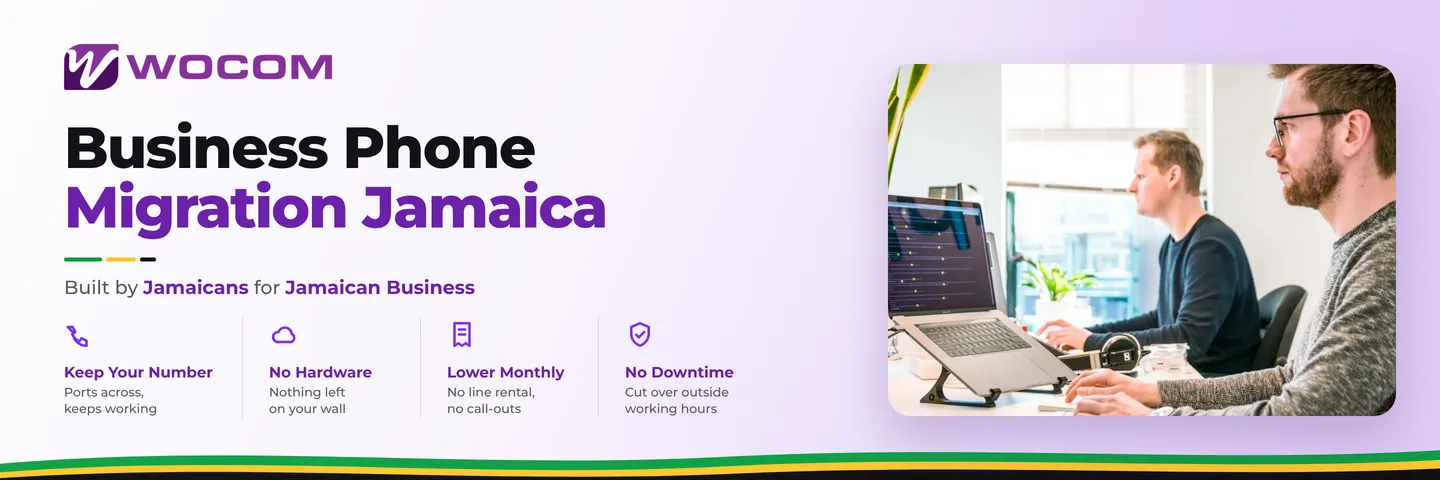
Business Phone Migration Jamaica: Keeping Your Customers Informed During the Switch
Why the Customer Side of a Phone Migration Gets Forgotten
When a Jamaica business decides to switch phone providers, the to-do list fills up fast: porting documents, hardware setup, staff briefings, SIP configuration. What rarely makes the list is a plan for the people who are still calling in.
That oversight is costly. A customer who dials your number and hears a disconnected tone, an unfamiliar greeting, or nothing at all does not know whether to wait, call back, or move on. In a competitive market — whether you run a medical clinic in New Kingston or a distribution company in Spanish Town — a customer who cannot reach you once may not try a second time.
This guide covers the communication layer most migration checklists skip: what to tell your customers, when to tell them, and how to configure your phone system so callers feel continuity even when everything behind the scenes is changing.
What Callers Experience During a Poorly Managed Switch
The technical cut-over window for a well-executed phone migration is usually measured in hours, not days. But the customer-perception window is much wider. Here is what commonly goes wrong:
- Unexpected voicemail. During the porting window, some inbound calls land in voicemail without ringing. If the greeting has not been updated, the caller hears a stale message that does not acknowledge anything unusual.
- Unfamiliar auto-attendant prompts. If the new system has different menu options, regular callers who know "press 2 for billing" are pressing the wrong keys and reaching the wrong department.
- Missed updates to stored contacts. Suppliers, partners, and clients who have a direct extension or forwarding number saved may not realise the routing has changed.
- Staff uncertainty bleeding into calls. A team still learning the new system sounds unsure to callers, which erodes confidence in the business regardless of the quality of the technology underneath.
None of these are individually catastrophic. Together, in the same week, they signal to your customers that something is wrong — even when everything is actually going to plan.
A Customer Communication Timeline That Works
Planning communication around a phone migration does not require a marketing campaign. It requires a clear sequence and a little discipline across three windows.
Two weeks before go-live. Identify your highest-value callers — regular clients, key suppliers, and contacts who have your number saved in their directory. For businesses in professional services, financial services, or logistics, this list may be short but critical. A brief message — a call, an email, or even a WhatsApp — that says "We are upgrading our phone system on [date]. Your calls will continue as normal" is enough. The purpose is to set an expectation, not to explain the technology.
This is also the time to update your Google Business Profile, your website contact page, and your email footer if the number is changing. Search engines take time to re-index; starting early means the correct number appears before cut-over day.
One week before. Record and load a transitional greeting for your auto-attendant: "You have reached [Company Name]. We are making improvements to our phone service — please stay on the line or leave a message and we will return your call promptly." This runs alongside your normal menu and takes two minutes to record. It prevents the spike in confusion calls that follows a silent switch.
If your business uses an AI receptionist such as WOCOM Alex, brief the knowledge base on the migration. When a caller asks "Has your number changed?" or "I am having trouble reaching you," Alex answers accurately instead of deflecting or leaving the caller unsure.
Go-live day. Before 8 a.m. — before your first inbound call — test every route. Dial the main number from a Flow mobile, from a Digicel mobile, and from a local landline. Confirm the auto-attendant answers, the right departments ring, and voicemail captures cleanly. This ten-minute exercise catches most routing issues before they affect a single customer.
The first week after. Pull a missed-call report at the end of each day for the first five working days. Any number that called and was not answered should receive a callback. Clients who reached voicemail during a brief routing hiccup deserve a personal follow-up — a short call from a relationship manager prevents weeks of eroded trust.
The Number-Porting Advantage
One of the most effective ways to reduce the customer communication burden is to keep your existing number. WOCOM's number porting service transfers your existing Jamaica business number — 876, 658, or toll-free — to the new system. Your customers dial the same number they always have. Your staff give out the same contact. Your marketing materials, business cards, and Google listing require no changes.
Number portability requires a formal authorisation process and is not guaranteed on a tight deadline, which is one more reason to begin the migration conversation early. When porting is confirmed, your entire customer communication plan simplifies to a single line: same number, better service.
Businesses that skip the porting conversation and accept a new number face a much longer customer communication burden — updating directories, notifying every regular contact, and watching for months as old calls land nowhere. The administrative cost alone often exceeds any short-term savings from a rushed switch.
Three Details Jamaica Businesses Consistently Overlook
Most migration problems do not happen at the configuration level. They happen at the edges — in the directories, the footers, and the staff habits that the project team never thought to update.
- Internal directories. Staff who have department extensions saved in their personal phones need those updated on day one. A salesperson who dials a stored extension and reaches the wrong department looks unprofessional in front of a client on a live call.
- Third-party listings. Online directories, industry associations, and local chamber listings often carry old numbers for months. A manual update request to the five or six most-visited directories is worth the hour it takes.
- Cross-carrier testing. Call quality and routing can behave differently when calling from a mobile network versus a fixed line. Testing only from one carrier type before go-live leaves gaps that surface on your most important accounts in the first week of live calls.
Businesses that build a short checklist around these three points before cut-over day consistently report smoother first weeks than those that treat the migration as complete the moment the technical team signs off.
Ready to Switch? WOCOM Handles the Hard Part
WOCOM handles number porting for Jamaica businesses migrating from legacy PABX systems, existing SIP trunks, and traditional landline services. The WOCOM team helps you plan the cut-over window, pre-test all inbound routes, and configure your auto-attendant and AI receptionist so that callers never know a thing changed — only that reaching you just got easier.
Whether you are a growing company in Montego Bay ready to move off an old on-site switchboard, or a Kingston professional services firm consolidating multiple lines onto a single cloud platform, the migration process is the same: careful planning, clear customer communication, and a provider who stays engaged beyond the go-live date.
If your business is planning a phone system change in the coming months, start the conversation before you commit to a date. A thirty-minute consultation at the planning stage prevents most of the issues that create customer-facing disruption at the switch.
Contact WOCOM today at wocomja.com/contact to talk through your migration timeline and build a clear plan before the first number is ported.
Continue exploring
Ready to upgrade your communications?
Talk to our team about the right solution for your business.
Book a Demo Contact SalesEverett Kildare is WOCOM's voice and infrastructure specialist, with more than 25 years of experience designing and running carrier-grade voice, SIP and virtualization infrastructure. Holding a BSc in Information Technology, he has built, secured and migrated phone systems for businesses of every size. Everett writes WOCOM's technical coverage of SIP trunking, cloud PBX, contact centres, business continuity and migration.