Contact Centre Workforce Management Jamaica: Schedule Agents, Forecast Call Volume, and Cut Overtime
Why Jamaican Contact Centres Keep Over- and Under-Staffing at the Same Time
Most contact centres in Kingston and Montego Bay schedule agents one of two ways: copy last month's rota, or add bodies until the queue clears. Neither is workforce management — it is hope. The result is predictable: Monday mornings collapse into chaos, Thursday afternoons three agents sit idle, and overtime bills climb every quarter without a corresponding improvement in service levels.
Workforce management (WFM) is the discipline of matching agent availability to call demand before the week starts. It is not a software platform — it is a repeatable process. Software helps, but the logic matters more. And for the 10–60 seat contact centres that make up most of Jamaica's market, you already have everything you need to begin.
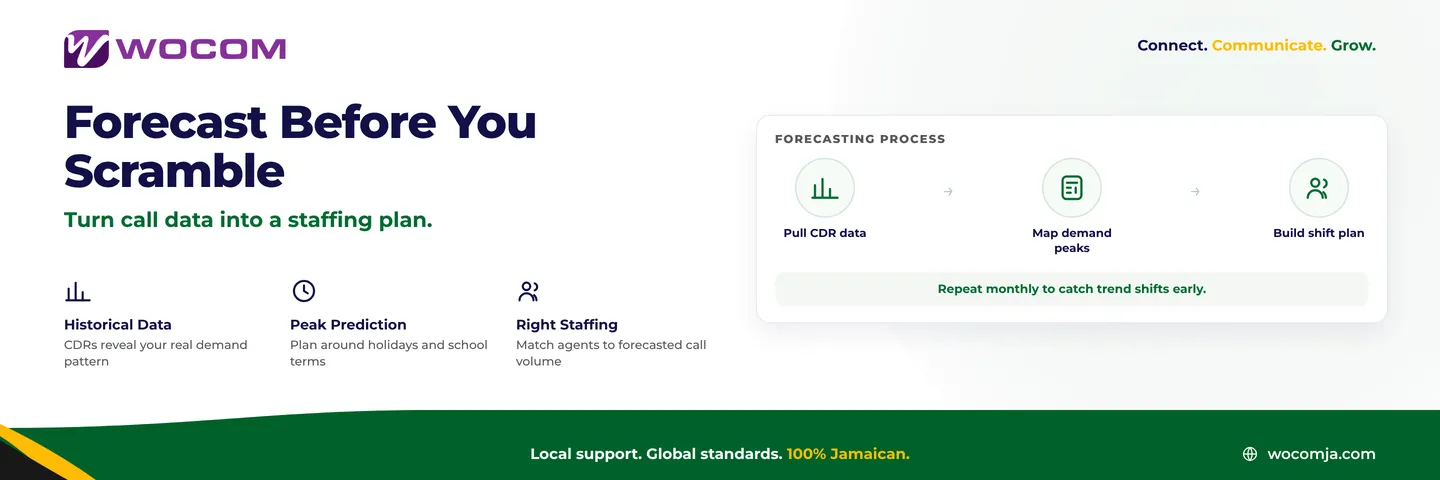
Step 1 — Forecast Call Volume With Data You Already Have
Every call that touches your Cloud PBX is logged with a timestamp. Before you can schedule correctly, answer three questions from that data:
- When do calls arrive? Pull hourly call counts for the past 90 days. You will almost certainly see peaks at 9–11 a.m. and 1–3 p.m., with a dip after 4 p.m. — but your specific business may differ significantly. Government-adjacent contact centres in Jamaica typically spike on Fridays; retail and insurance peaks differ again.
- How long do calls last? Average Handle Time (AHT) drives how many agents you need per hour. A team with a 6-minute AHT needs roughly twice the agents of one handling 3-minute calls at the same inbound volume.
- What day-of-week pattern do you see? Bill payment centres often spike at month-end. Logistics and courier operations spike Monday mornings. Your 90-day export will show you exactly when your operation is stressed.
Once you have hourly volume data, calculating required agents per interval uses a formula called Erlang C — designed specifically for queuing systems. Free online Erlang calculators are easy to find; plug in volume, AHT, and your target answer speed, and the output tells you the minimum agent count needed for each half-hour block to hit that target.
Step 2 — Build a Schedule Around Real Patterns, Not Assumptions
With a forecast in hand, scheduling becomes a matching exercise. A few principles hold for most Jamaican operations:
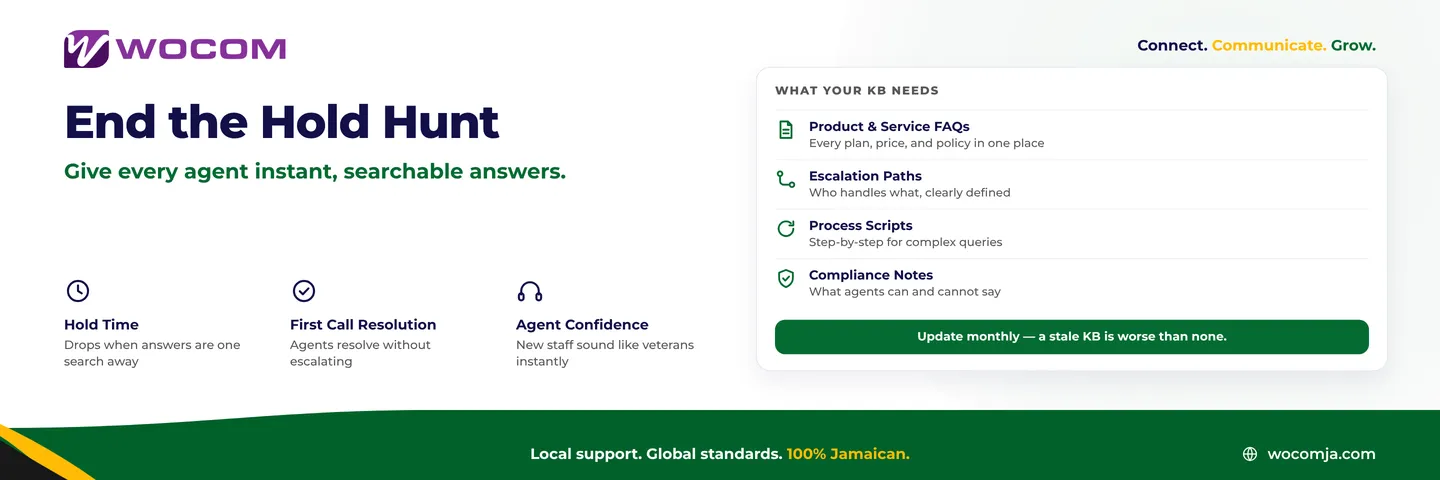
Stagger start times. If your peak is 9:30 a.m., a team that all start at 8:00 a.m. is fully staffed two hours before they need to be — and hitting the end of their shift precisely as the midday surge arrives. Starting one cohort at 7:30 a.m. and another at 10:00 a.m. covers the peak with fresh agents rather than tired ones.
Plan breaks explicitly. A 10-agent team where three are on break simultaneously is a 7-agent team. Many supervisors know this but do not reflect it in the schedule. Mark break windows in the rota and stagger them deliberately.
Account for shrinkage. Shrinkage is the percentage of scheduled time agents are unavailable — training, team meetings, systems downtime, late arrivals. Industry average runs 25–35 %. If you need 10 productive agents logged in, schedule 13–14 to absorb shrinkage. Ignoring it means you are understaffed by design, every single week.
Keep a float pool. Even one cross-trained agent who can jump between queues when a specific line spikes will save you from scrambling for coverage on abnormal days — public holidays, end-of-month billing surges, or when a storm warning sends call volume up 40 % in an hour.
Step 3 — Monitor in Real Time and Adjust Before the Queue Builds
Forecasting and scheduling happen before the week starts. Real-time monitoring is what you do during it. A supervisor who sees the queue at 12 callers and climbing has a 90-second window to act — move an agent off after-call work early, stagger a break, or let the AI receptionist handle initial greetings and intent capture while human agents catch up.
A contact centre that reacts to queue build-up in two minutes recovers in five. One that notices at the end of the hour absorbs the damage for the rest of the day.
WOCOM's live call management portal shows active calls, queued callers, and agent status in real time. Combined with wallboard metrics — queue depth, oldest caller waiting, current answer speed — supervisors have enough information to make micro-adjustments without waiting for end-of-day reports. That visibility is the difference between managing your operation and reacting to it.
Three WFM Metrics Every Jamaican Contact Centre Should Track Weekly
Workforce management produces numbers you can act on. Track these three above all others:
- Schedule Adherence — the percentage of time agents are logged in and available during their scheduled window. Anything below 85 % signals a scheduling or culture problem. High adherence is the single strongest predictor of consistent service levels across your floor.
- Shrinkage — calculated as (non-productive hours ÷ total scheduled hours) × 100. If your actual shrinkage is 40 % but your schedule assumed 25 %, every week is understaffed by design regardless of how well you forecast volume.
- Agent Occupancy — how much of logged-in time agents spend on calls or after-call work versus waiting for the next contact. Below 75 % means overstaffing; above 90 % means agents have no recovery time and burnout accelerates. The sweet spot for most Jamaican operations is 80–88 %.
These three metrics create a feedback loop: forecast → schedule → measure → adjust → better forecast. Within two to three scheduling cycles you will have tighter numbers, lower overtime, and a team that is not exhausted by Wednesday.
Where Your Cloud PBX Platform Fits Into WFM
WOCOM's Cloud PBX is not a dedicated WFM suite — it will not replace Calabrio or NICE if you are running a large BPO operation. But for the mid-market contact centres across Jamaica, the built-in reporting covers the essentials: call volume by hour, AHT by queue, abandon rate, and answer speed. Export these from your WOCOM dashboard weekly and your forecast data is ready to go.
Where WOCOM adds specific value in a WFM workflow:
- Skills-based routing — queue callers to the right agent group automatically, so your WFM schedule maps cleanly to actual call types rather than depending on whoever picks up first.
- AI overflow handling — when live agents are at capacity, WOCOM Alex handles the greeting, collects caller intent, and holds position in queue rather than playing silence or abandoning the call.
- Detailed call logs — every call exports with start time, duration, queue wait time, and agent. Your Erlang calculation runs on real data, not rough estimates from memory.
- Real-time supervisor portal — live agent status and queue depth without a separate wallboard subscription.
Start This Week: A Simple WFM Starter Checklist
You do not need to buy software before you can start managing workforce properly. This week:
- Pull 90 days of hourly call logs from your Cloud PBX dashboard
- Calculate your real AHT per queue, not an estimate
- Run an Erlang C calculation for your three busiest half-hour blocks
- Compare the output to your current schedule and note where you are genuinely under- or over-covered
- Adjust next week's rota based on what the data shows, not what feels right
That five-step cycle, repeated every two weeks, is workforce management. It is not glamorous — but it is why some Jamaican contact centres hit their service levels consistently while others miss every week and blame the call volume.
Ready to give your contact centre the foundation it needs? Talk to the WOCOM team about skills-based routing, real-time reporting, and how WOCOM Alex can absorb overflow intelligently so your agents handle the calls that need a human touch. Visit wocomja.com/contact or reach us directly — let's build the setup your team and your customers deserve.
Continue exploring
Ready to upgrade your communications?
Talk to our team about the right solution for your business.
Book a Demo Contact SalesEverett Kildare is WOCOM's voice and infrastructure specialist, with more than 25 years of experience designing and running carrier-grade voice, SIP and virtualization infrastructure. Holding a BSc in Information Technology, he has built, secured and migrated phone systems for businesses of every size. Everett writes WOCOM's technical coverage of SIP trunking, cloud PBX, contact centres, business continuity and migration.