Contact Centre Service Level Jamaica: What 80/20 Means and How to Hit It
What Service Level Actually Measures
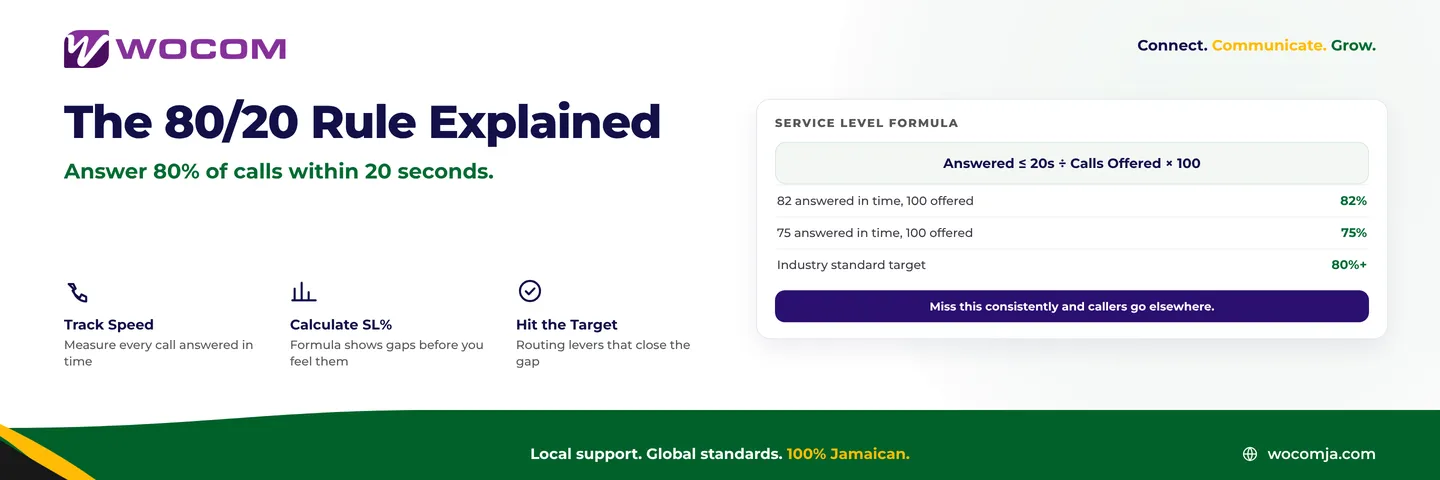
Service level is one number: the percentage of incoming calls your agents answer within a defined time window. The most widely used standard in contact centres — from Kingston BPOs to Montego Bay insurance desks — is 80/20: 80% of calls answered within 20 seconds.
It sounds straightforward. In practice it is the single metric that ties together your staffing, your call routing, your queue design, and the experience every caller has from the moment they dial. When service level falls, callers abandon. When callers abandon, they either call back later (adding to tomorrow's volume) or they call a competitor today.
The metric is simple. Ignoring it is expensive.
How to Calculate Your Service Level Right Now
Pull your call data for any period — a day, a week, a shift — and apply this formula:
Service Level % = (Calls answered within threshold ÷ Total calls offered) × 100
If your team answered 82 of 100 calls within 20 seconds, your service level is 82%. If 75 were answered in time, it is 75%.
Two things trip up most Jamaican operations when they first run this:
- Abandoned calls count against you. A caller who hung up after 22 seconds was offered to the queue but not answered in time. Most centres exclude very short abandons — under five seconds, likely accidental dials — but everything beyond that belongs in your denominator. Excluding longer abandons inflates your number and hides a real problem.
- Your threshold might not be 20 seconds. 80/20 is the global standard, but some sectors use 80/30 for complex queries or 90/10 for urgent services. Know what your callers and regulators expect before locking in a target.
Four Reasons Jamaican Contact Centres Miss 80/20
Most operations that miss their target consistently have one or more of these root causes. None of them require a complete rebuild to fix.
- Schedules built on average volume, not peak volume. Call demand in Jamaica spikes on Monday mornings, Friday afternoons, and the days following public holidays. A schedule designed around daily averages leaves peak hours badly understaffed. Your Monday 9am service level is not your weekly service level — it is your reputation.
- No overflow routing. When a queue fills and there is nowhere for the call to go, it either rings out or presents a busy signal. This is a routing configuration issue, not a headcount issue. On a modern cloud platform, adding an overflow destination takes minutes.
- Handle time running over plan. If your agents take seven minutes on calls budgeted at four, they are unavailable far longer than your staffing model assumed. Long handle time is the most common hidden driver of a missed service level — and it rarely shows up in daily reports unless you look for it specifically.
- Single-site dependency. Every agent in one location means any local event — a power cut, a neighbourhood internet outage, an unplanned training pull — drops your service level across every caller simultaneously. Multi-site or remote-agent routing removes this single point of failure.
The Staffing Model Behind the Number
Erlang C is the mathematical model used to translate call volume and handle time into a staffing requirement for a given service level target. You do not need to run the equations manually — every workforce management platform does it — but you do need to understand the four inputs:
- Calls per hour — actual inbound volume by time of day, not a daily average
- Average handle time (AHT) — talk time plus after-call work combined
- Target service level — 80% within 20 seconds in this case
- Shrinkage — the share of paid time when agents are unavailable: breaks, training, late arrivals, admin
Jamaican operations consistently underestimate shrinkage. They build plans assuming 15% and run at 25% or more once real-world patterns are measured. The fix is not stricter attendance enforcement on its own — it is building honest shrinkage figures into the staffing model from the start, so you are never pretending you have more capacity than you actually do.
Routing Changes That Lift Service Level Without More Staff
Before hiring, check whether your routing configuration is making full use of the agents already on shift:
- Simultaneous ring groups. If your hunt group rings agents one at a time (sequential), every agent who does not answer adds delay before the next one rings. Switch to simultaneous ring and the first available agent answers immediately. This single change meaningfully reduces average speed of answer in most operations.
- Skills-based overflow. When your primary queue is at capacity, route overflow to a secondary group with broader skills rather than letting it queue indefinitely. A slightly less specialised agent answering promptly beats a specialist answering five minutes late.
- Callback virtual queue. Let callers hold their place without staying on the line. They receive a callback when an agent is free. This removes long-wait abandons from your service level denominator and reduces the perception of wait time dramatically. It is now standard practice in competitive Jamaican contact centres.
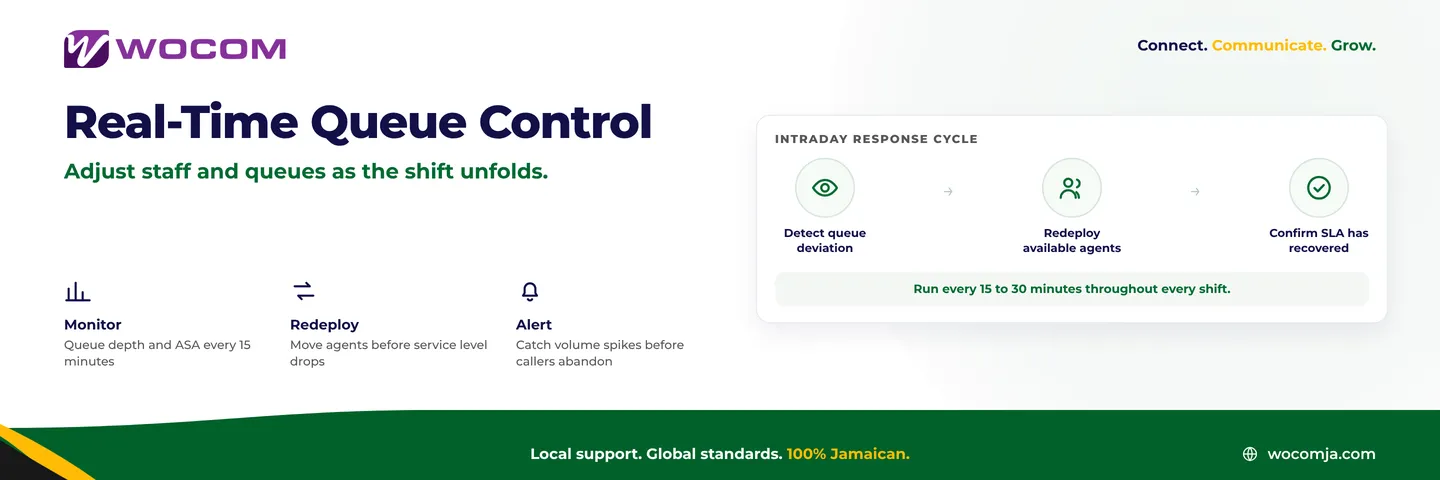
- Time-based queue thresholds. If a caller has been waiting longer than your service level target already, route them to a priority agent group or trigger a supervisor alert. Catching a missed-target call in real time is always better than discovering it in yesterday's report.
Setting a Target That Fits Your Operation
80/20 is the standard, not the ceiling. Set your target based on what your callers genuinely need:
- Retail and general services: 80/20 is appropriate. Most queries are routine and callers expect a quick response.
- Financial services and credit unions: Consider 80/15. A caller managing a time-sensitive transaction feels the wait more acutely than someone asking about business hours.
- Technical support: 80/30 is defensible if your resolution quality is high. Callers will wait a little longer when they are confident they will get a real answer.
- Health-adjacent or urgent services: 90/10 or better. No tolerance for queuing when the reason for calling is urgent.
Whatever you set, publish it to the team on a live wallboard. A target nobody can see is a target nobody will manage in real time.
Take the Guesswork Out of Your Service Level
If your contact centre in Jamaica does not have a live service level dashboard today, every hour below target is an hour your team cannot see the problem forming. By the time the end-of-day report lands, the callers who abandoned have already made a decision.
WOCOM's contact centre platform gives you real-time service level tracking, overflow routing you can adjust from the admin portal, and reporting that surfaces handle time and abandonment patterns before they drag your number down. Whether you are running a five-seat team in Kingston or a fifty-seat operation in Montego Bay, knowing your number in real time changes how you manage every shift.
Ready to see where your service level actually stands? Visit wocomenterprise.com or speak with the WOCOM team to get a contact centre review and find out what it would take to hit 80/20 — consistently, not occasionally.
Continue exploring
Ready to upgrade your communications?
Talk to our team about the right solution for your business.
Book a Demo Contact SalesEverett Kildare is WOCOM's voice and infrastructure specialist, with more than 25 years of experience designing and running carrier-grade voice, SIP and virtualization infrastructure. Holding a BSc in Information Technology, he has built, secured and migrated phone systems for businesses of every size. Everett writes WOCOM's technical coverage of SIP trunking, cloud PBX, contact centres, business continuity and migration.