Contact Centre Agent Multiskilling Jamaica: How to Train Your Team for Multiple Queues
It is 10 a.m. on a Monday. Your billing queue has seven callers waiting. Estimated hold time: six minutes. Meanwhile, three agents on your sales queue are watching an empty dashboard. They are ready. They just cannot help — because no one ever trained them to handle billing.
This is the single-skill trap, and it is one of the most common structural problems in Jamaican contact centres that grew organically, adding queues as the business expanded without rethinking how agents are deployed. Multiskilling is the fix. It turns a fixed headcount into a flexible pool that routes to wherever it is needed most.
Why Single-Skill Pools Create Preventable Backlogs
When agents are locked to one queue, your service levels depend entirely on whether call volume matches staffing on that specific queue on that specific day. Forecast slightly wrong and you get a pile-up on one side and idle agents on the other — both simultaneously.
In Kingston and Montego Bay contact centres where staffing margins are tight, this dynamic is especially costly. You might have twelve agents covering three queues, which looks adequate on a headcount sheet. But if four agents on the quieter product-enquiry queue cannot take billing calls, the billing queue suffers and callers abandon while capacity sits unused. The problem is not headcount. It is distribution.
Multiskilling — cross-training agents to handle more than one queue type — lets your routing platform assign the same twelve agents wherever demand is highest. The total staffing cost does not change. The service level outcome does.
What Multiskilling Actually Looks Like in Practice
Effective multiskilling is not about making every agent do everything. That model collapses quality. Most contact centres implement a tiered structure instead:
- Primary skill: The queue an agent handles most of the time, where they have full product knowledge and comfortable AHT (average handle time).
- Secondary skill: A related queue they are trained to handle at full quality, but only receive calls on when their primary queue is below a defined threshold.
- Tertiary skill (optional): A third queue for senior or long-tenure agents, typically lower-complexity call types such as general account lookups or inbound FAQs.
Skills-based routing enforces this hierarchy automatically. An agent with billing as their primary skill and sales as secondary will always take billing calls first. Sales calls only land on their desk when the sales queue is building up and they are not already on a billing interaction. The supervisor does not need to manually move anyone — the system handles the distribution in real time.
Building Your Multiskilling Matrix: A Four-Phase Approach
Rushed multiskilling creates quality problems that erode trust in the programme. The right approach is structured and phased.
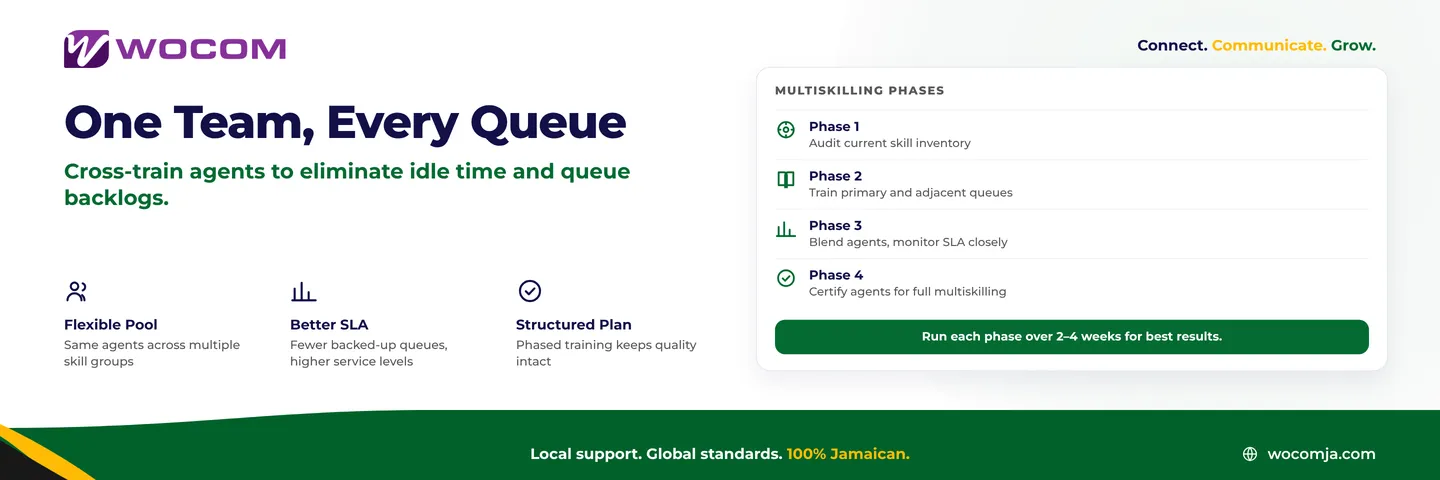
Phase 1 — Skills inventory. Before training anyone, document what your current agents already know. Review call recordings, talk to supervisors, and check handle times per queue. You may find that several agents already informally assist on adjacent queues during overflow — those are your first multiskilling candidates. Also identify which queue pairs share the most knowledge. Billing and account enquiries overlap heavily. Sales and product FAQs overlap. Technical support and provisioning share the same systems. Start with the highest-overlap pairs.
Phase 2 — Primary plus adjacent training. Pair each candidate agent with their most natural secondary queue. Training should include a listen-in period on live calls, a supervised handling phase where a team leader is available to assist, and a short knowledge assessment before the agent takes calls independently. Budget ten to fifteen hours of training time per queue transition. Do not compress this to cover a short-term staffing gap — it will cost more than it saves.
Phase 3 — Controlled blending. Once agents pass their secondary queue assessment, update their routing profile in your contact centre platform to activate the secondary skill. For the first two weeks, monitor their AHT and quality scores on the new queue closely. An agent whose AHT on secondary calls runs 40 percent above the team average needs additional coaching before they receive more volume on that queue.
Phase 4 — Certification and expansion. For agents who have demonstrated sustained quality across both their primary and secondary queue, open a path to tertiary skills. In contact centres handling financial or insurance clients, for example, a billing-primary agent who also handles verifications and general product FAQs becomes significantly more resilient to volume spikes across all three queues.
Which Metrics Tell You Whether Multiskilling Is Working
Do not assume multiskilling is delivering results — measure it with metrics that are sensitive to pool flexibility.
- Abandonment rate per queue: If your billing queue ran at 18 percent abandonment before multiskilling and drops to 8 percent after secondary-skilled agents are routing to it, the training investment is working.
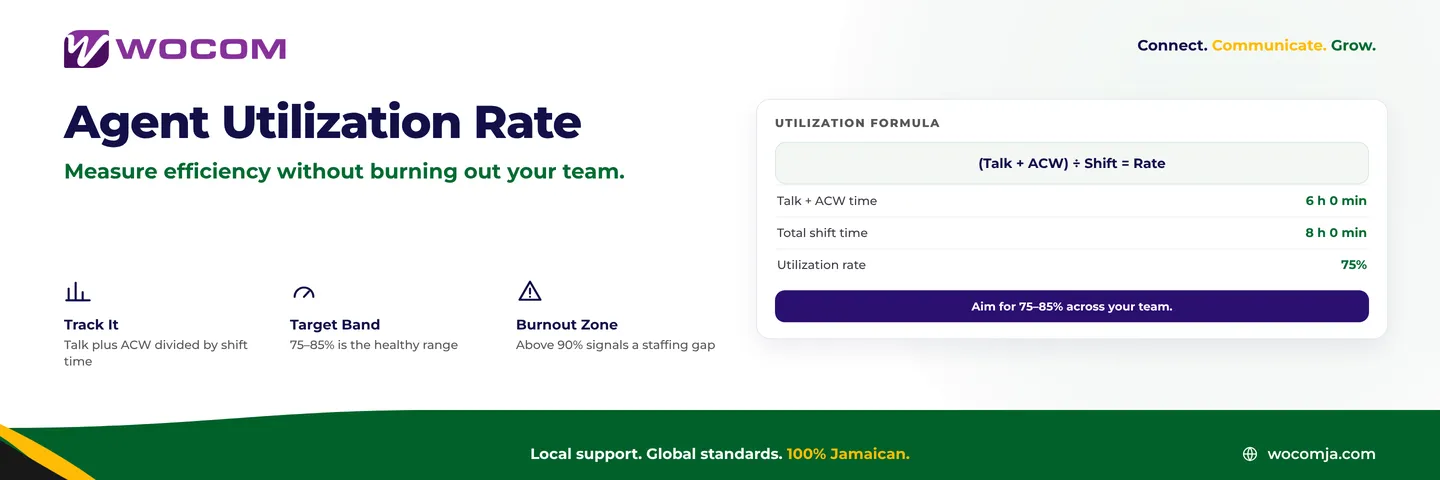
- Occupancy rate balance: Are utilisation rates evening out across queues? If some agents are at 90 percent occupancy while others sit at 55 percent, either the routing rules are not blending correctly or your skill assignments need adjusting.
- AHT per agent per queue: This is your quality canary. When an agent's handle time on a secondary queue is significantly higher than the team average on that queue, they need more support — and their allocation to that queue should be temporarily reduced until proficiency improves.
- Service level by queue over time: Track your 80/20 service level target per queue for four weeks before and four weeks after introducing multiskilling. Improvement across previously underserved queues confirms you have fixed a distribution problem, not just shuffled the bottleneck.
If your overall contact centre occupancy is above 85 percent while one or more queues regularly miss service level, you almost certainly have a single-skill distribution problem — not a headcount problem. Adding agents to the struggling queue without addressing the distribution will not hold the improvement once another queue spikes.
Mistakes Jamaican Contact Centres Make When Multiskilling
Training too fast. Compressing a two-week programme into two days to patch a staffing gap produces agents who cannot handle calls confidently on the new queue. Callers notice. Quality scores fall. Agents become reluctant to accept those calls — and quietly route out of them when they can.
Skipping the routing configuration update. Cross-training without updating the skills-based routing profile in your contact centre platform means calls still pile up on the primary queue regardless. The training investment does not translate into actual load distribution until the routing engine knows each agent's full skill set.
Forgetting knowledge base access. If the secondary queue uses a different product FAQ, CRM record type, or escalation path, agents need that access granted and time to become familiar with it before they take live calls. Sending them into calls without the right reference material accelerates errors and erodes confidence.
Treating all agents as interchangeable. Some agents are genuinely unsuited to specific queue types regardless of training hours. A strong technical support agent may perform poorly on outbound sales calls. A skilled billing agent may find product education calls difficult to pace. Your skill matrix should reflect aptitude and communication style, not just tenure.
Make Your Contact Centre More Flexible Without Adding Headcount
WOCOM's contact centre platform supports full skills-based routing with per-agent skill profiles, queue priority weighting, and real-time supervisor visibility into queue depth across every skill group. Whether your operation handles inbound customer service in Kingston, runs a blended programme in Montego Bay, or manages a distributed team across multiple parishes, the routing configuration can be built to reflect your exact multiskilling structure.
We work with Jamaican contact centres at every stage — from operations still running on a single undifferentiated queue through to blended inbound and outbound programmes with six or more skill groups. If your service levels are inconsistent despite what looks like adequate staffing, a queue structure and routing review is usually the fastest way to find the fix.
Contact WOCOM Jamaica today to talk through your contact centre setup. Visit wocomja.com to reach our team and schedule a review of your current queue structure and routing configuration.
Continue exploring
Ready to upgrade your communications?
Talk to our team about the right solution for your business.
Book a Demo Contact SalesEverett Kildare is WOCOM's voice and infrastructure specialist, with more than 25 years of experience designing and running carrier-grade voice, SIP and virtualization infrastructure. Holding a BSc in Information Technology, he has built, secured and migrated phone systems for businesses of every size. Everett writes WOCOM's technical coverage of SIP trunking, cloud PBX, contact centres, business continuity and migration.