Contact Centre Agent Knowledge Base Jamaica: Cut Hold Time and Reach First Call Resolution Faster
The Hidden Cost Sitting Inside Every "Hold Please"
It happens dozens of times a day in Jamaican contact centres: a caller asks a question, the agent isn't sure of the answer, and the caller gets parked on hold while the agent hunts through email threads, WhatsApp group chats, or calls across the room to a senior colleague. Thirty seconds becomes two minutes. The caller's patience runs thin. Your average handle time climbs. And if the agent returns with the wrong answer anyway, you've lost twice.
An agent knowledge base — a centralised, searchable library of the information your team needs to resolve calls — is the most direct fix for this pattern. It doesn't require new headcount. It doesn't require expensive software. It requires structure, discipline, and a commitment to keeping the content current.
What a Contact Centre Knowledge Base Actually Is
An agent knowledge base is not the same as a customer-facing FAQ page. Where a public FAQ is written to be scanned by someone with no training, an agent KB is written to be used by staff under time pressure on a live call. The standard is different: it needs to be faster to read, more precise in its language, and more complete at the edge cases your public FAQ page glosses over.
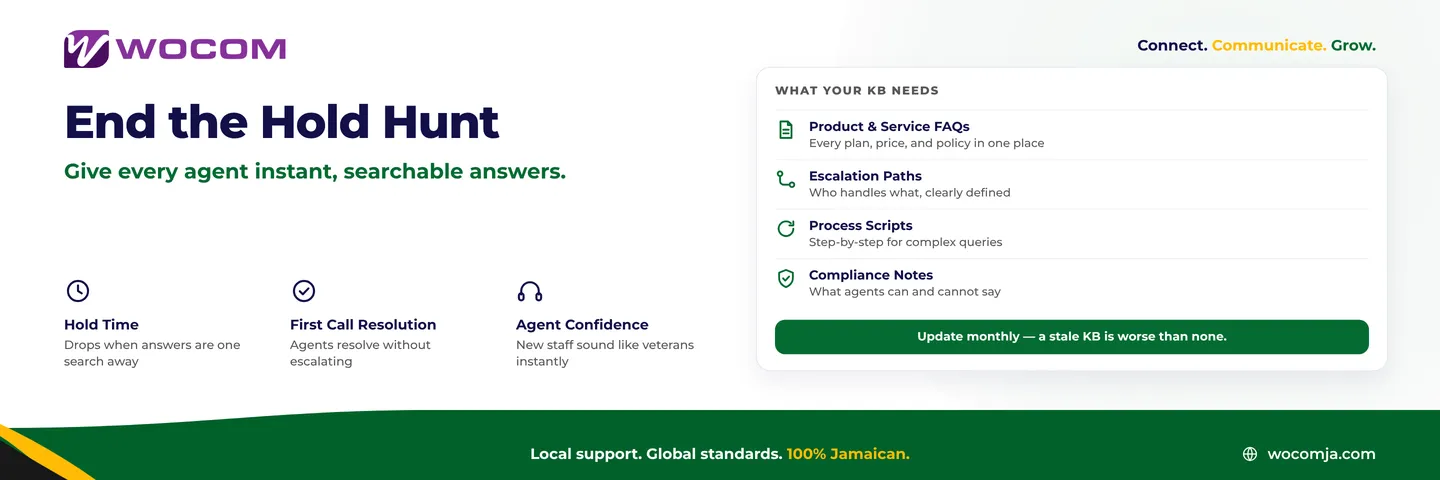
A functional agent KB typically contains:
- Product and service details — plans, pricing tiers, feature limitations, and exactly what is included at each level
- Policy summaries — billing cycles, refund windows, and contractual terms that affect what an agent can commit to
- Escalation logic — a clear map of which complaint types go to which department or supervisor, so agents are never guessing
- Process scripts for complex transactions — step-by-step handling for account changes, service migrations, or complaints that require a specific sequence
- Compliance boundaries — what agents are authorised to say, promise, or offer, and where they must stop and escalate
Most Jamaican contact centres that lack a formal KB are running one anyway — it is just scattered across email threads, WhatsApp groups, and the institutional memory of the two or three senior agents everyone turns to when a difficult question comes in. Formalising that scattered knowledge is what a KB project actually is.
What "Let Me Check on That" Is Actually Costing You
Hold time is the most visible cost. Every second a caller spends waiting while an agent searches for an answer erodes patience and inflates your average handle time (AHT). When AHT rises, you either need more agents to maintain the same service level, or your queue times lengthen and callers abandon.
The less visible cost is consistency. Without a single source of truth, different agents give different answers. One agent tells a Kingston customer that a plan includes a feature it doesn't. Another tells a Montego Bay caller the opposite. The customer who received the wrong information calls back — now you are handling the same query twice, plus a complaint on top of it.
A well-maintained knowledge base attacks both problems simultaneously: it brings the answer to the agent in seconds, and it ensures every agent gives the same answer regardless of their tenure or shift.
When every agent can surface the right answer in under ten seconds, hold time drops, escalations drop, and callbacks for the same unresolved issue all but disappear.
Building a KB That Agents Will Actually Use
The most common failure mode for knowledge base projects is not content — it is findability. If an agent must click through four menus to reach a policy page during a live call, they will stop using the KB within a week and go back to asking a colleague. The structure must match how agents think under pressure, not how management categorises the business internally.
Start by mapping the top 20 query types your team handles. Pull your call logs and wrap-up codes. Those 20 topics should become the top-level navigation of your KB — not your product line hierarchy, not your organisational chart.
Within each topic, use a consistent template: a one-sentence answer or policy summary, then the supporting detail, then the escalation path when the standard answer does not apply. Write for a team member who is mid-call and needs the answer in ten seconds, not a manager reading a compliance document at their desk.
Assign a single named owner for each section. That person is responsible for flagging updates when pricing changes, a policy is revised, or a new product launches. A knowledge base with even one stale entry is actively harmful — an agent who confidently quotes an incorrect price because the KB said so creates a complaint, a refund request, and a trust deficit with that customer.
Connecting Your Knowledge Base to Your Contact Centre Platform
The most effective KBs are embedded directly into the agent desktop — accessible without switching applications or browser tabs. When your contact centre is built on WOCOM's platform, agents can keep a searchable reference panel open alongside their call screen, without losing sight of the active call or the caller's account details.
You do not need a sophisticated custom integration on day one. A well-structured internal web page that opens instantly is far more useful than a purpose-built system that takes 30 seconds to load. Start simple. The discipline is in maintaining the content, not in the platform you host it on.
What the setup must support is zero context switching. The moment an agent has to leave their call interface to find an answer, the friction becomes too high and the behaviour reverts. Design your KB so the answer appears in the same workspace — a side panel, a pinned browser tab, a searchable overlay — without the agent losing focus on the caller.
Measuring Whether It Is Working
Three metrics tell you whether your knowledge base is doing its job — and all three are available in your WOCOM contact centre reporting dashboard:
- Average hold time per call — if the KB is working, agents spend less time parking callers while they search. Measure this by agent group in the four weeks before and after KB deployment.
- First call resolution rate — the share of calls resolved without a callback or escalation. A well-adopted KB typically moves this number upward within four to six weeks of consistent use.
- Repeat call rate for the same query type — if callers are ringing back about the same issue, either the KB answer is wrong or agents are not following it. Both are diagnosable from your wrap-up code data.
Review these numbers monthly alongside a short agent survey: which KB sections are missing, which are confusing, and which save the most time. That feedback loop is what keeps the KB alive rather than turning it into a document that no one opens after the first month.
Ready to Build a Contact Centre That Resolves More and Holds Less?
WOCOM's contact centre solutions give Jamaican businesses the platform, call analytics, and reporting to build a team that consistently delivers first-call resolution. Whether you are running a three-agent team in Spanish Town or a 40-seat operation in New Kingston, the tools are sized to fit your operation — and our team can walk you through wrap-up code configuration, call categorisation, and KB integration from day one.
Call us at 876-300-2900, visit wocomja.com, or reach out to an account manager to discuss contact centre setup, reporting configuration, and how to get your agents to faster, more consistent answers on every call.
Continue exploring
Ready to upgrade your communications?
Talk to our team about the right solution for your business.
Book a Demo Contact SalesEverett Kildare is WOCOM's voice and infrastructure specialist, with more than 25 years of experience designing and running carrier-grade voice, SIP and virtualization infrastructure. Holding a BSc in Information Technology, he has built, secured and migrated phone systems for businesses of every size. Everett writes WOCOM's technical coverage of SIP trunking, cloud PBX, contact centres, business continuity and migration.