Contact Centre Intraday Management Jamaica: Real-Time Staffing Moves That Protect Your Service Level
Your workforce management team spent hours building this week's schedule. Agent counts were right, break times were staggered, and the forecast looked solid. Then Monday arrived, and by 9:15 a.m. the queue was sitting at forty-seven waiting callers with four agents available.
That gap — between the plan and what is actually happening on the floor — is where intraday management lives. It is the discipline of reading live call data and making fast, deliberate staffing moves during the shift, not after it. For contact centres in Kingston, Montego Bay, and across Jamaica, it is often the difference between finishing a day at 91% service level and explaining to management why you hit 64%.
Intraday Management vs Workforce Management: Not the Same Thing
Workforce management (WFM) is about the future — scheduling the right number of agents for forecast demand, managing shift patterns, and optimising rosters days or weeks in advance. Intraday management is about right now. It answers one question: given what is happening on the floor at this exact moment, what do I change to keep the service level on track?
The two disciplines depend on each other but operate on different timescales. WFM sets the plan; intraday management defends it. In larger contact centres, a dedicated real-time analyst or intraday coordinator owns this role. In smaller Jamaican operations — a team of eight to fifteen agents — a senior supervisor typically carries both hats. Either way, the job is the same: watch the numbers, spot the deviation, and act before the problem compounds.
The Metrics That Drive Intraday Decisions
You cannot manage what you cannot see. Intraday decisions depend on a short list of live metrics, reviewed on a consistent cycle:
- Queue depth — how many callers are waiting right now. A queue climbing faster than agents are completing calls is the earliest available warning.
- Average speed of answer (ASA) — the average wait before connection. Watch the trend over the last five minutes, not just the point-in-time figure.
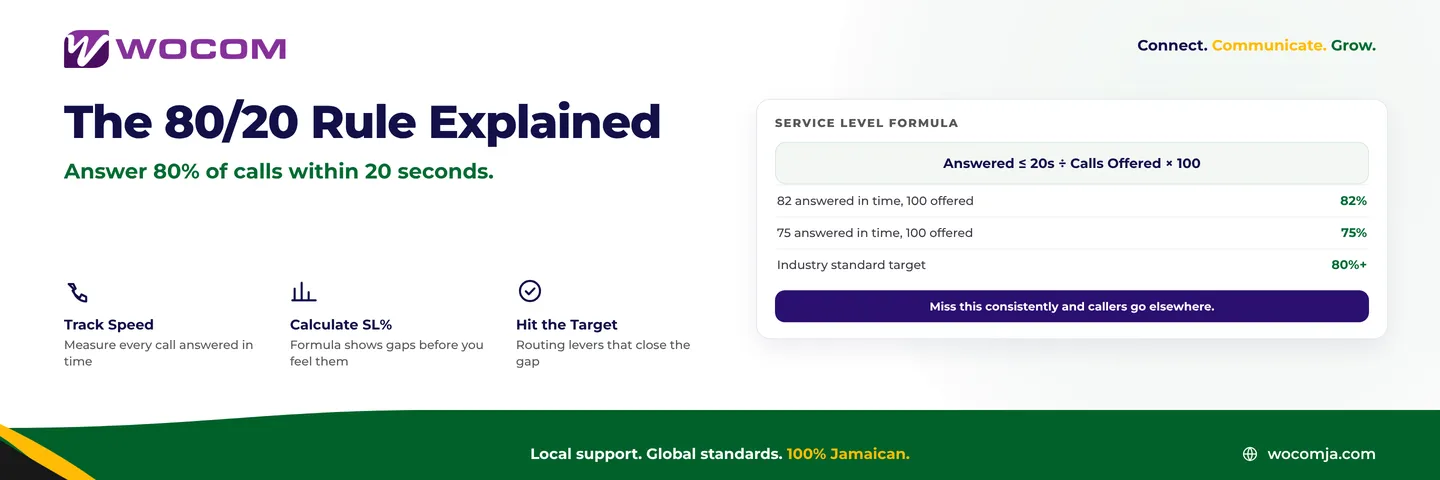
- Abandonment rate — the share of callers who hang up before an agent answers. Abandonment climbing above 5–8% signals a service level problem already under way.
- Occupancy — the percentage of time agents are actively handling calls versus sitting available. Occupancy above 85% means there is no buffer: the next spike hits the queue immediately.
- Agents in adherence — how many scheduled agents are actually logged in and ready, versus on break, in after-call work, or marked unavailable. An unexpected drop here explains the majority of intraday queue spikes.
Your cloud contact centre platform should surface all of these in real time on a supervisor wallboard or dashboard. If your floor manager is pulling up a spreadsheet to check these figures, the operation is working blind.
Common Intraday Triggers in Jamaican Contact Centres
Some intraday events are universal. Others are specific to the Jamaican market, and planning for them explicitly gives local centres an edge.
Unexpected volume spikes are the most common trigger — a promotion goes live, a monthly statement drops, or a news item drives enquiries. In Jamaica, a JPS or NWC service disruption can push call volume into a utility-adjacent contact centre well above any forecast within minutes, with no advance warning.
Unexpected agent unavailability is the second most common cause. A call-out, a transportation delay from a flooding roadway, or an agent who simply does not show creates an immediate gap. The intraday coordinator's first move is always to count who is actually on the floor versus who the system says should be there.
After-call work creep is subtler but just as damaging. If agents are spending far longer than expected wrapping up calls — updating CRM records, processing orders, drafting follow-up emails — their availability collapses without any change to queue volume. Occupancy climbs, the queue builds, and from the outside it looks like a demand spike when it is actually a handle-time problem.
Break overlap catches many smaller operations off-guard. Staggered breaks look good on paper, but when two agents swap simultaneously and a third takes an extended break, the actual staffed count can drop below the service level minimum for twenty minutes — precisely when a lunch-hour rush arrives.
The Intraday Response Playbook
When live metrics show a deviation, the response should be fast and pre-planned. Improvised decisions under pressure are rarely good ones. A simple playbook, agreed in advance with centre management, removes the guesswork at the worst possible moment:
- Flex breaks — delay non-urgent breaks by fifteen to thirty minutes to maintain agent count through a peak. A standing rule should exist: scheduled break times are guidelines, not fixed rights, when the queue is above a defined threshold.
- Pull from training or project work — if agents are in a training session or completing a back-office task, a qualified intraday coordinator can return them to the floor temporarily. This requires prior agreement with the training team about which sessions are interruptible and under what conditions.
- Supervisor coverage — supervisors who maintain an active call-handling certification can log in and take calls during severe spikes. This is a last resort, not a first response, but it is a meaningful lever for small teams facing sudden absences.
- Redirect overflow — if your platform supports call overflow routing, intraday is the moment to activate it. Route excess calls to a secondary queue, a backup team in another location, or an AI receptionist that can handle initial enquiries and capture call-back details without tying up your human agents.
- Update hold messaging — if the queue is unavoidably long, updating the hold announcement with an honest wait time estimate and a call-back option actively reduces abandonment. Callers who know what to expect are more likely to stay or accept a call-back rather than hanging up and calling back to join the queue again.
Building an Intraday Routine That Sticks
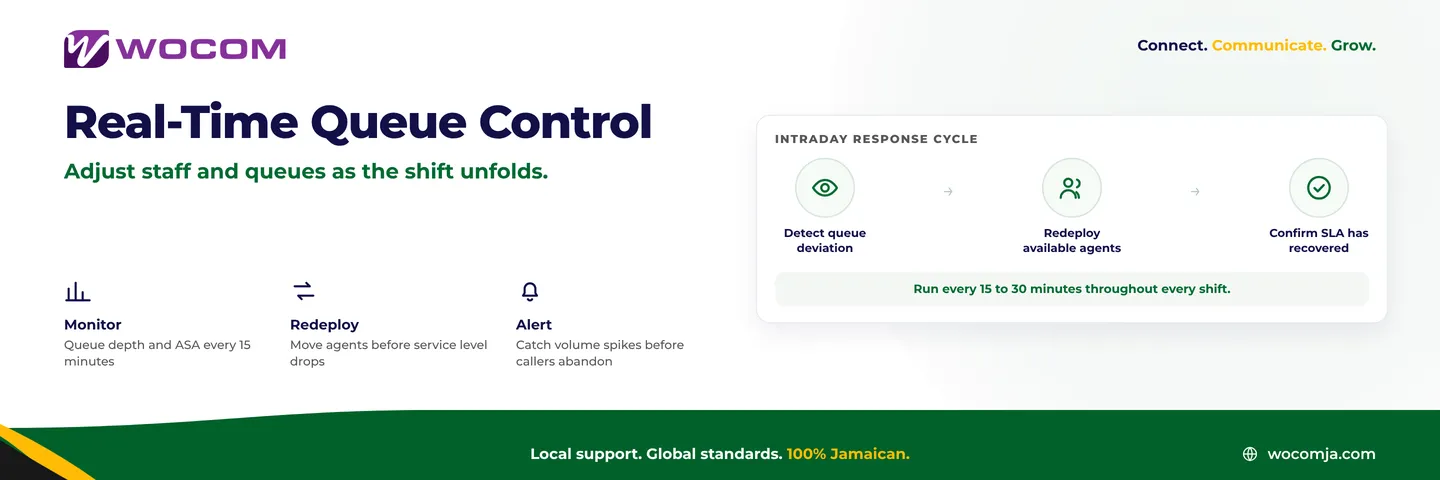
The most effective intraday management is routine, not reactive. Set a fixed review cycle — every fifteen minutes is standard for most operations, every thirty is workable for smaller teams — and run the same check at every interval:
- Verify actual staffed count against scheduled count.
- Check queue depth and ASA against the service level target.
- Identify any deviation above your defined action threshold.
- Execute the appropriate response from the pre-agreed playbook.
- Log the action taken and the outcome for end-of-day review.
That final step — logging — is what turns intraday management from a daily firefight into a continuous improvement process. Patterns in your intraday logs feed directly back into better forecasts and smarter schedules. A spike that surprises you in August should not surprise you again the following August.
How WOCOM's Platform Supports Intraday Decisions
WOCOM's Cloud PBX and contact centre platform gives supervisors the live visibility intraday management depends on. Queue depths, agent states, and call metrics update in real time so coordinators are working from current data, not a lagging hourly report.
Call overflow routing is configurable at the queue level, meaning supervisors can activate overflow independently without waiting on a system administrator to make the change. And where WOCOM AI is part of your setup, Alex can absorb routine inbound enquiries during peaks — capturing caller details, answering common questions, and booking call-backs — so human agents are reserved for interactions that genuinely need them.
For contact centres looking to move beyond gut-feel staffing decisions toward a structured intraday discipline, WOCOM's team can help identify the right platform configuration, wallboard layout, and alert thresholds for your specific operation size and call mix.
Ready to give your supervisors the real-time tools they need to protect your service level? Contact WOCOM at 876-300-1000 or visit wocomja.com to speak with our business communications team about contact centre platform options in Jamaica.
Continue exploring
Ready to upgrade your communications?
Talk to our team about the right solution for your business.
Book a Demo Contact SalesEverett Kildare is WOCOM's voice and infrastructure specialist, with more than 25 years of experience designing and running carrier-grade voice, SIP and virtualization infrastructure. Holding a BSc in Information Technology, he has built, secured and migrated phone systems for businesses of every size. Everett writes WOCOM's technical coverage of SIP trunking, cloud PBX, contact centres, business continuity and migration.