Contact Centre AI Agent Assist Jamaica: Real-Time Tools That Improve Every Call
The phrase "AI for contact centres" often calls to mind automated bots that answer calls instead of people. But in 2026, some of the most impactful AI tools in a contact centre do not replace agents — they work alongside them in real time, making every human interaction sharper and more consistent.
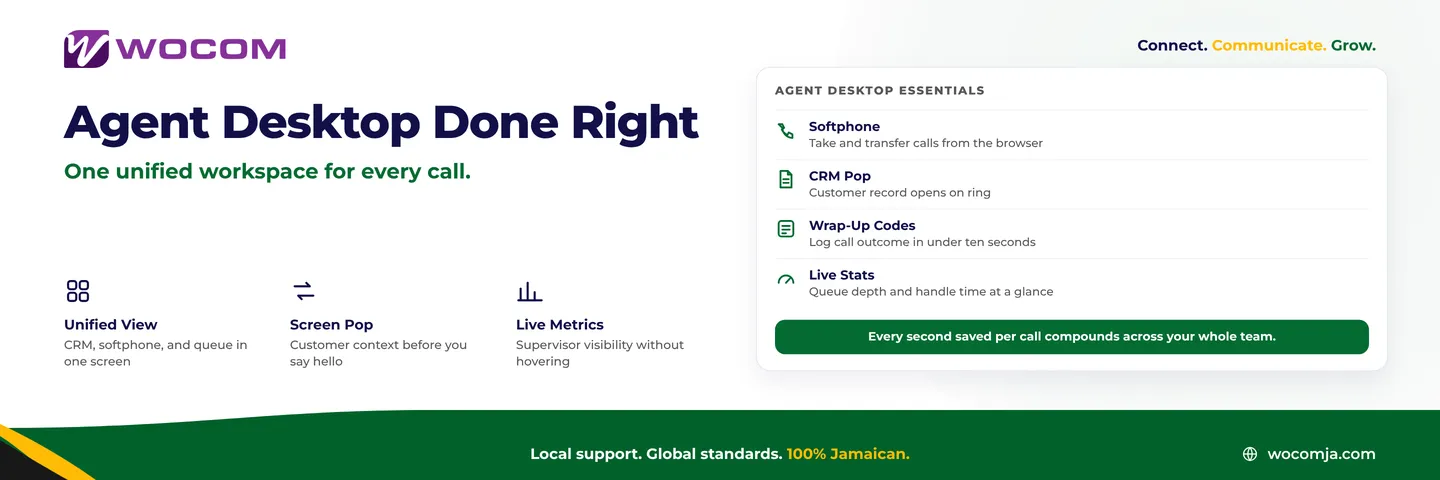
Real-time AI agent assist refers to a layer of intelligence that listens to a live call as it happens and surfaces information, alerts, and suggestions directly to the agent's screen. The caller hears a human. The agent sees AI-powered prompts that help them respond faster, more accurately, and more professionally — call after call, without burnout.
For Jamaica's growing contact centre sector — from Kingston BPOs to in-house customer service teams at financial institutions, utilities, and multi-branch retail chains — these tools are becoming a genuine competitive differentiator.
What Real-Time AI Agent Assist Actually Does
Unlike an AI receptionist that handles calls autonomously, agent assist operates in the background of a conversation between a human agent and a caller. It processes the live audio stream, matches conversational context to your knowledge base, monitors tone and sentiment, and posts suggestions and alerts to the agent's screen — all within seconds of each exchange.
The five capabilities that matter most for Jamaica contact centres are:
- Live call transcription: Every spoken word is converted to text in near-real time. Agents can scroll back through the transcript without asking the caller to repeat themselves — critical when capturing addresses, account numbers, or complaint details accurately.
- Knowledge base pop-ups: When a caller mentions a product, policy, or issue, the AI matches context to your internal knowledge base and surfaces the most relevant article or procedure automatically — no tab-switching or typing required.
- Next best action prompts: Contextual suggestions appear based on what the caller says and where the conversation is heading — escalate to a supervisor, offer a callback, apply a discount, or confirm an appointment.
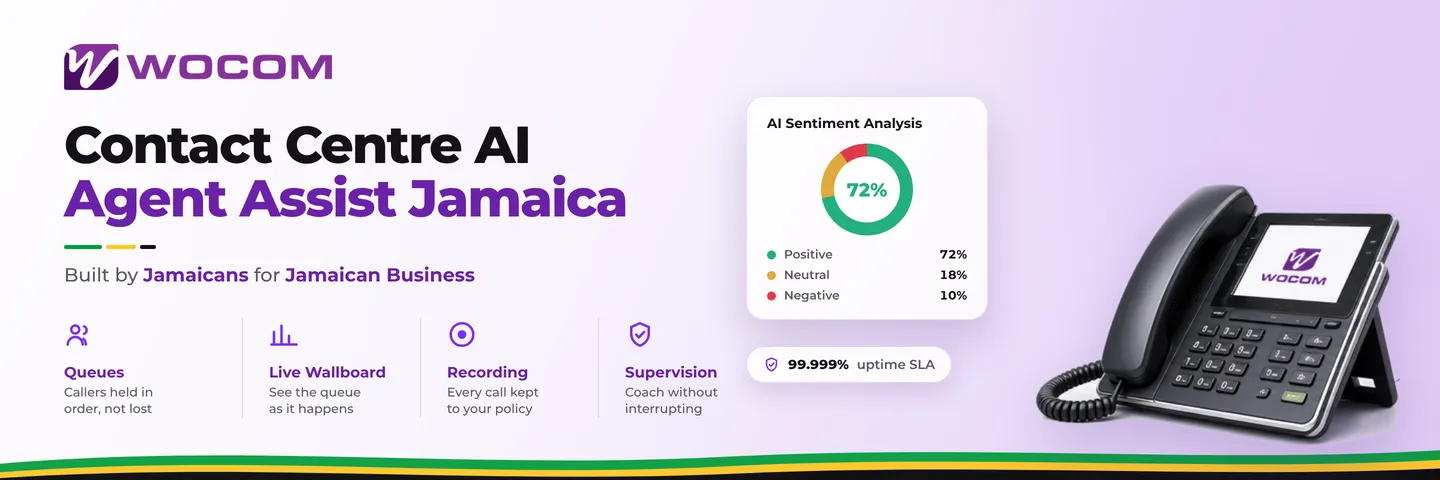
- Sentiment detection and supervisor alerts: The system monitors tone, word choice, and speech patterns to detect rising frustration. When a call crosses a configurable threshold, the relevant supervisor is automatically notified.
- Automatic post-call summaries: After the call ends, a structured summary — key points, outcome, recommended follow-up — is generated and ready to push into your CRM or ticketing system.
The After-Call Work Problem — and Why It Matters in Jamaica
After-call work (ACW) is one of the most expensive time drains in any contact centre. Agents are required to log notes, update records, and classify outcomes before they are ready for the next call — typically taking three to five minutes per interaction.
Consider a mid-size contact centre in New Kingston running 20 agents and handling 400 calls per day:
- 400 calls × 4 minutes average ACW = 1,600 minutes of post-call admin daily
- That is nearly 27 agent-hours lost to note-taking every single shift
AI-assisted summaries can reduce ACW to under 90 seconds for straightforward calls. The recovered capacity represents either more calls handled per agent per shift — or a real reduction in the headcount required to meet service-level targets.
For Jamaica contact centres competing on both cost and service quality, that productivity gain can be the difference between a profitable operation and one that is perpetually under-resourced.
Sentiment Detection in the Jamaican Context
Sentiment analysis tools trained on North American or British English voice samples do not always interpret Jamaican speech patterns correctly. An expression that sounds direct or assertive in a local context might register as "negative" to an unsophisticated model. Conversely, a caller speaking softly but using frustrated language might not trigger any alert at all.
This calibration gap is a real issue when evaluating off-the-shelf AI platforms built for US or UK markets. The solution is not to abandon sentiment detection — it is to use systems that have been exposed to real Jamaican caller audio, or to combine automated scoring with configurable thresholds that supervisors tune during the first few weeks of deployment.
WOCOM's AI platform has processed thousands of real calls from Jamaican businesses across Kingston, Montego Bay, and beyond. The patterns it recognises reflect how local callers actually communicate — not a generic English-language baseline applied without adjustment.
Integration with Supervisor and Monitoring Tools
AI agent assist delivers its full value when it is connected to your existing supervisor toolset. In a well-integrated cloud contact centre, the same platform powering agent assist also handles:
- Silent monitoring: A supervisor listens to a live call without the agent or caller knowing.
- Whisper coaching: The supervisor speaks directly to the agent in real time; the caller hears nothing.
- Barge-in: The supervisor joins the call directly when immediate escalation is needed.
- Wallboard alerts: Sentiment scores, queue depth, and flagged calls appear on the supervisor's real-time dashboard.
This integration means supervisors can shift from random monitoring to AI-triage monitoring — letting the system surface the calls that genuinely need attention, rather than sampling at random and hoping to catch problems. For contact centre managers overseeing both on-site and remote agents across Jamaica, that kind of structured visibility is particularly valuable.
Is Your Contact Centre Ready for AI Agent Assist?
Real-time AI agent assist requires a few baseline conditions before it can deliver its full benefit. Checking these before you start an evaluation saves time on both sides:
- A cloud or SIP-connected phone system: AI assist tools require access to the live audio stream. Legacy analogue or TDM PBX systems cannot integrate with these capabilities. If you are still on older hardware, the move to a cloud platform is the prerequisite.
- A structured knowledge base: The AI can only surface answers that exist somewhere. If your agents are working from memory or printed sheets, building a KB is step one — and most platforms make this straightforward.
- Agent onboarding: A brief session explaining how suggestions are generated — and that they are recommendations, not mandates — significantly reduces resistance and improves adoption rates.
- A supervisor willing to tune thresholds: Sentiment alerts and escalation rules improve substantially over the first few weeks as supervisors calibrate them to the specific call types your centre handles.
WOCOM's contact centre platform is built on cloud infrastructure that supports these integrations natively. The team works with clients to configure AI assist tools around actual workflows — not a generic template that needs months of adjustment.
Ready to Put AI to Work for Your Contact Centre Team?
Whether you run a five-seat customer service desk in Montego Bay or a fifty-agent BPO operation in Kingston, AI agent assist can raise your team's performance without replacing anyone on it. Faster responses, fewer unnecessary escalations, and cleaner call records are measurable outcomes from the first weeks of deployment.
Contact WOCOM today to see how real-time AI agent assist fits into your existing contact centre setup. Call 876-926-6000 or visit wocomja.com to book a walkthrough with our contact centre solutions team.
Continue exploring
Ready to upgrade your communications?
Talk to our team about the right solution for your business.
Book a Demo Contact SalesEverett Kildare is WOCOM's voice and infrastructure specialist, with more than 25 years of experience designing and running carrier-grade voice, SIP and virtualization infrastructure. Holding a BSc in Information Technology, he has built, secured and migrated phone systems for businesses of every size. Everett writes WOCOM's technical coverage of SIP trunking, cloud PBX, contact centres, business continuity and migration.