Contact Centre Agent Onboarding Jamaica: A 5-Day Plan to Get New Hires Live-Call Ready
Why the First Five Days Define the Next Ninety
Agent turnover is one of the costliest and most persistent problems in Jamaican contact centres. The agents who leave earliest are rarely the ones who were wrong for the role — they are the ones who were thrown into live calls before they were ready, made to feel incompetent, and given no clear picture of what success was supposed to look like. The resignation that follows is predictable, expensive, and almost entirely preventable.
A structured five-day onboarding plan does two things simultaneously. It compresses the ramp-up window — the gap between Day 1 and the point where an agent reliably meets your service level targets. And it signals to new hires that the operation is professional, that management invests in preparation, and that they are joining something worth staying for. Both outcomes directly affect your contact centre's bottom line.
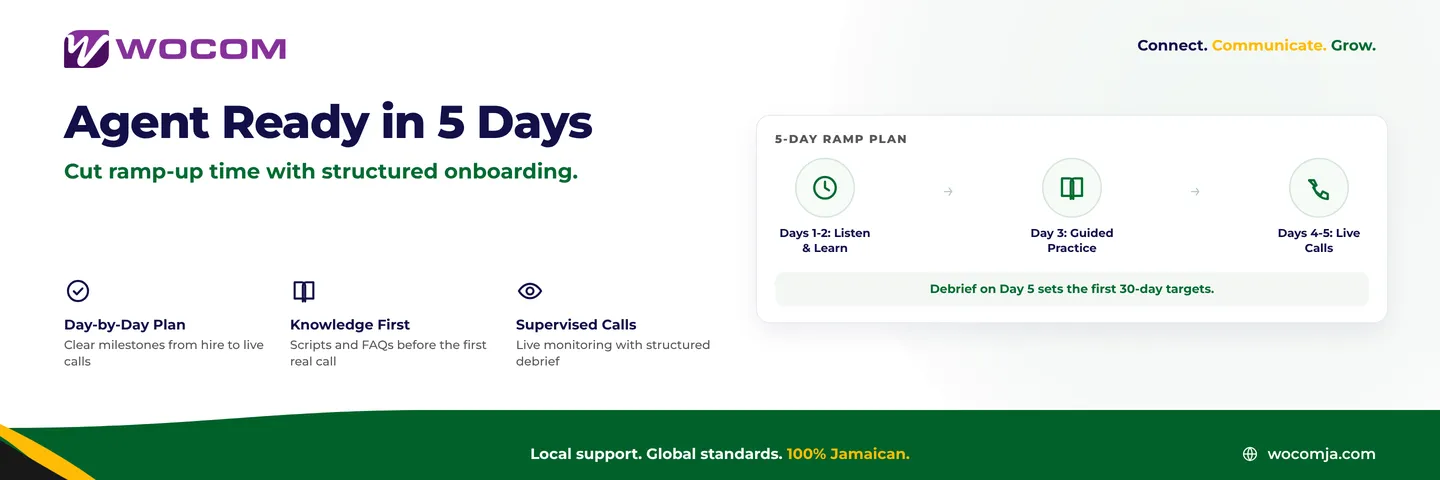
Day 1–2: Orientation, System Access, and Shadow Listening
The first two days are about immersion, not information overload. New hires need to understand how the operation runs before they are asked to run any part of it.
- System provisioning on Day 1. Every new agent should have a working extension, verified login credentials, and a tested headset before they leave Day 1. An agent who arrives on Day 2 still chasing IT access is already a day behind — and already forming opinions about how the operation is run.
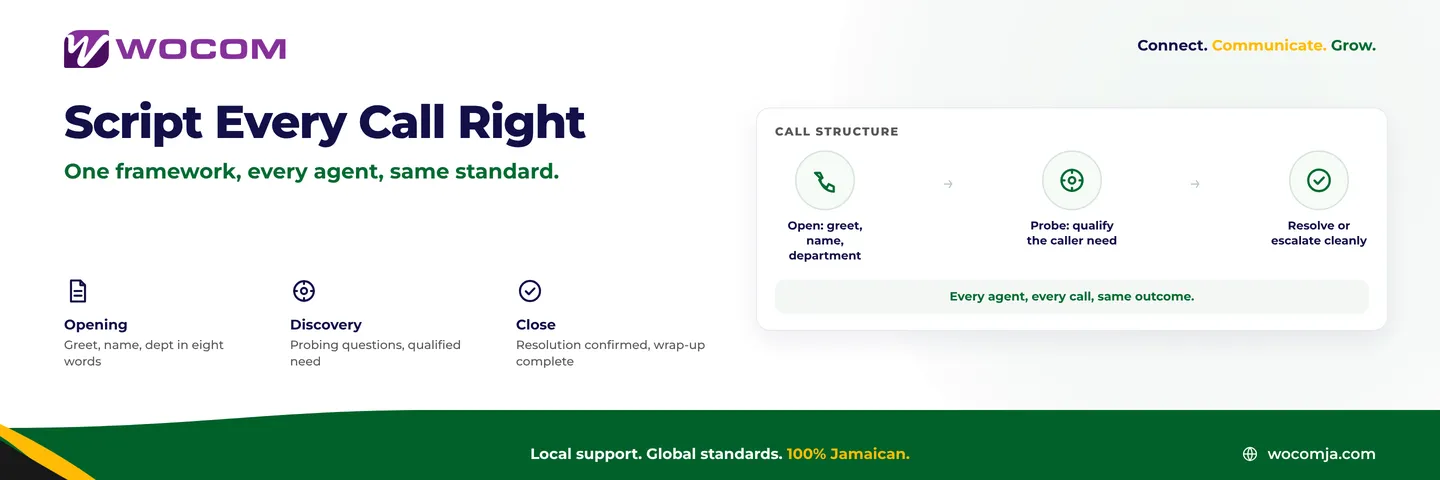
- Shadow listening. Pair each new hire with a top-performing agent and have them listen silently to real calls for at least two hours each day. This is the fastest path to absorbing the natural rhythm of your queue — how agents open a call, how they manage hold requests, how they escalate without alarming the caller, and how they close cleanly. No training deck replicates it.
- Knowledge base orientation. Walk through your call scripts, FAQ documents, and escalation matrix. The goal is not memorisation — it is familiarity. Agents who know where to find the answer perform far better under live call pressure than agents who were asked to memorise answers they cannot reliably locate under stress.
- Team introductions. Brief, structured introductions to supervisors, team leads, and the QA process. Make it explicit who to approach when something is uncertain — so new agents ask rather than guess through a live customer interaction.
Day 3: Guided Practice With Real Scenarios
Day 3 is the bridge between watching and doing. Role-played calls drawn from your actual call logs let agents build confidence and muscle memory in a controlled environment where mistakes carry no cost for the customer.
Run four to six simulated call sessions of five to eight minutes each. Pull the scenarios from your most common inbound request types: billing queries, product or service questions, complaints, and requests to speak with a manager. Rotate supervisors and senior agents through the role of the caller so new hires experience different pacing, different levels of emotion, and different communication styles before they encounter them on a live queue.
Keep every debrief to three points: one thing the agent handled well, one adjustment for the next scenario, and one specific thing to watch for. Long post-mortems overwhelm new hires and generate anxiety rather than confidence. The goal on Day 3 is a positive feedback loop, not a comprehensive critique.
End Day 3 with a short checkpoint — verbal or written — covering the core escalation paths, key product FAQs, and the system shortcuts already practised. This is not a gatekeeping exercise. It is a diagnostic. Agents who are unclear on escalation paths need a targeted coaching hour before Day 4; agents who are solid should be praised and moved forward with confidence.
Day 4–5: Supervised Live Calls With Real Customers
New agents should be on a live queue by Day 4. Not Day 8. Not after another week of observation. Prolonged watching without doing creates anxiety, not competence — and agents who shadow for too long begin to catastrophise the moment they have to handle a call themselves.
What makes Day 4 safe is the support structure around it. Assign a dedicated floor supervisor per four to five new agents. Use your contact centre platform's call whisper function so supervisors can coach in the agent's ear without the customer hearing a word. If a situation requires intervention, a warm transfer to a senior agent must take under thirty seconds — agents should know the exact keystrokes to initiate it before their first call of the day.
Set realistic call volume targets: twelve to fifteen handled interactions on Day 4, scaling to twenty or more on Day 5 as confidence grows. Track first-call resolution and average handle time separately for new agents during this period. These two numbers tell you immediately whether an agent is struggling with product knowledge, system navigation, or communication style — and that diagnosis makes coaching specific rather than generic.
End Day 5 with a formal thirty-minute review. Pull two recordings from the previous two days — one call the agent handled well and one that required recovery — and work through both together. Then set the first thirty-day targets: an acceptable handle time range, a quality score threshold, and a first-call resolution rate to aim for. Agents who leave their first week knowing exactly what the target looks like are far more likely to reach it.
Five Onboarding Mistakes Jamaican Contact Centres Keep Making
- Delaying system access until Day 2 or 3. Every hour a new agent spends without a working extension is a wasted training hour and a quiet signal that the operation is disorganised.
- Filling Day 1 with policy documents. Compliance packs, HR handbooks, and code-of-conduct forms do not build call-handling skill. Keep policy review concise and link every document in the knowledge base so agents can find it when they actually need it.
- No dedicated floor support on Days 4–5. Placing new agents on a live queue without a reachable supervisor is the fastest way to embed bad habits — and the hardest habits to correct once they are formed.
- Skipping the knowledge base during practice. If agents are not actively using the knowledge base during simulated calls on Day 3, they will not use it under live queue pressure on Day 4. Build the habit in practice, not under fire.
- No formal Day 5 debrief. A five-minute chat by the coffee machine is not a debrief. Agents who finish their first week without clear, recorded performance targets drift — and drifting agents are attrition risks within sixty days.
How WOCOM Tools Remove the Friction From Agent Onboarding
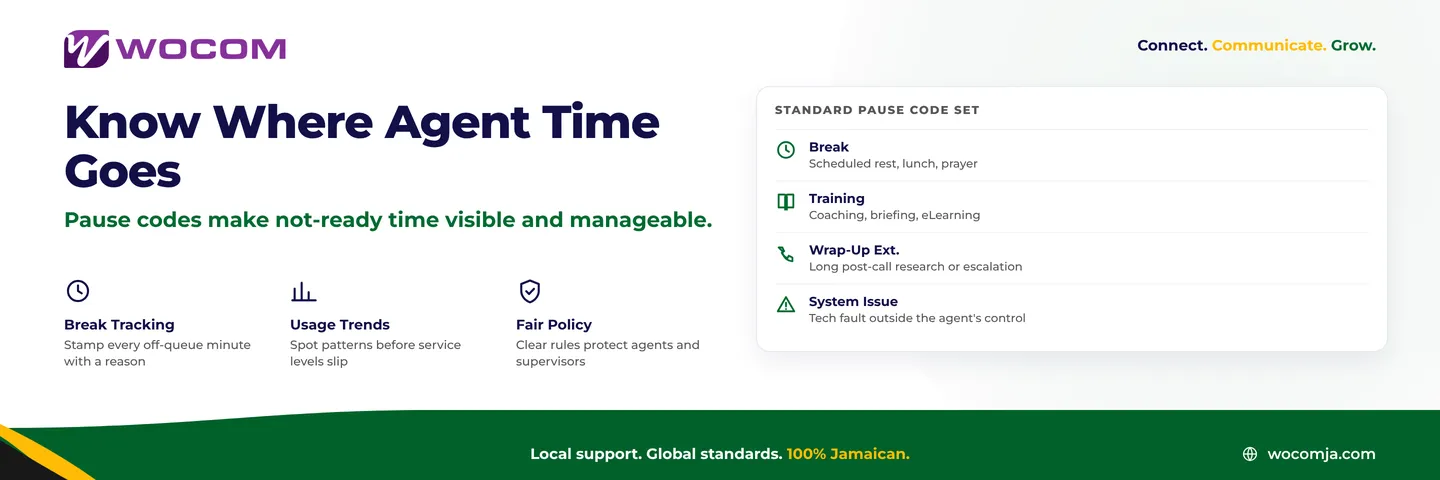
The plan above works on any platform, but the right tools eliminate the logistical delays that make great onboarding hard to sustain consistently. WOCOM's Cloud PBX provisions new extensions from the admin panel in minutes — no site visit, no hardware order, no waiting on a third party. Supervisors can assign whisper, listen, and barge-in permissions per agent before Day 4 begins, so there is nothing to configure on the morning of the first live call.
Call recordings on WOCOM are searchable by agent, date, duration, and queue — which means the Day 5 review pulls the right calls in seconds rather than hunting through a flat log. For contact centres running multiple sites across Kingston, Montego Bay, or Spanish Town, this matters even more: a supervisor reviewing a new agent remotely needs the same call access as one sitting on the same floor.
Contact centres that have also deployed WOCOM AI report an additional benefit during ramp-up. WOCOM's AI receptionist handles high-volume routine queries — balance inquiries, location and hours questions, common FAQs — reducing the pressure on a live queue during the days when new agents need the most support. Senior agents who would otherwise be stretched across queue management and new-hire monitoring have meaningful bandwidth freed up for coaching.
Build a Contact Centre Team That Stays
The five-day plan in this guide is not a magic fix for turnover. But it is the difference between new agents who feel set up to succeed and new agents who spend their first week feeling like a liability. In a market where experienced contact centre agents are genuinely hard to find and harder to replace, that difference compounds fast.
WOCOM works with Jamaican contact centres of every size — from focused teams in New Kingston to multi-site operations across the island. If you want to see how our Cloud PBX, call monitoring, and WOCOM AI platform can support your onboarding and quality assurance programme, visit wocomja.com or email info@wocomja.com to book a consultation with our contact centre specialists.
Continue exploring
Ready to upgrade your communications?
Talk to our team about the right solution for your business.
Book a Demo Contact SalesEverett Kildare is WOCOM's voice and infrastructure specialist, with more than 25 years of experience designing and running carrier-grade voice, SIP and virtualization infrastructure. Holding a BSc in Information Technology, he has built, secured and migrated phone systems for businesses of every size. Everett writes WOCOM's technical coverage of SIP trunking, cloud PBX, contact centres, business continuity and migration.