Contact Centre Agent Burnout Jamaica: How to Spot It Early and Protect Your Team
Why Burnout Costs More Than Turnover
Most contact centre managers in Jamaica track agent burnout in replacement terms — recruiting cost, onboarding weeks, and the performance dip while a new hire ramps. The real cost sits higher. A burned-out agent who stays is often more expensive than one who leaves. They drag down the callers they handle, the metrics the team posts, and the morale of the agents sitting beside them. In a 20-seat contact centre, three disengaged agents can move your CSAT down by several percentage points while appearing to show up and hit attendance targets. The problem is invisible to dashboards that only aggregate across the whole floor.
Early Warning Signs Supervisors Miss
Burnout rarely announces itself. It surfaces in patterns that look like small operational noise until they are read together:
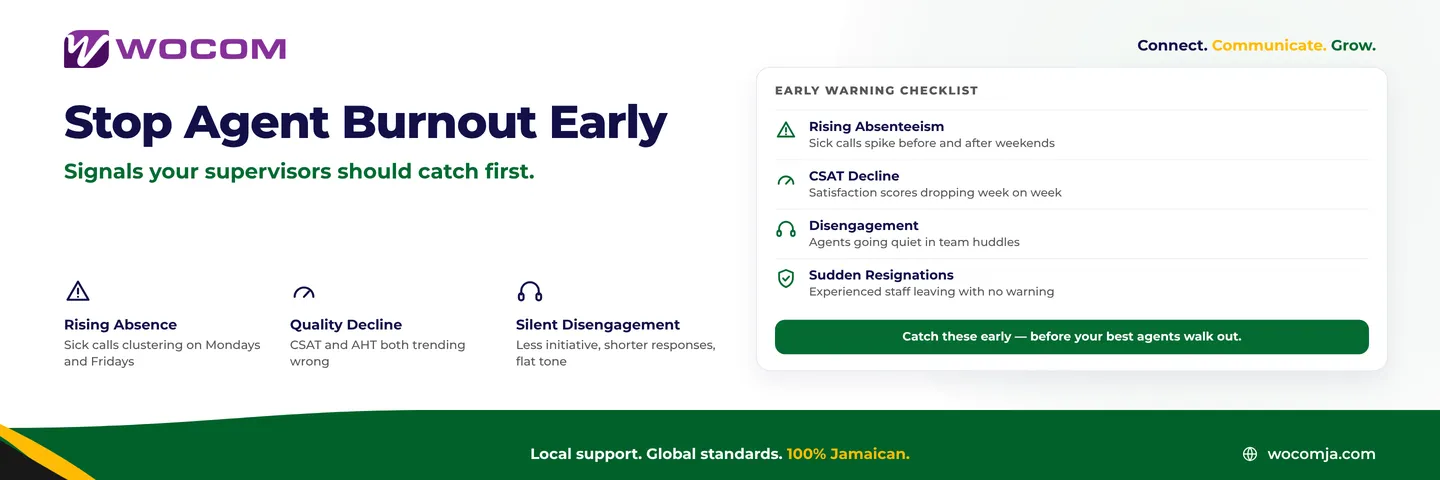
- Absenteeism that clusters on Mondays and Fridays. One sick call is one sick call. A repeating pattern of short-notice absences bookending the weekend signals something different — an agent who needs the buffer days just to function.
- Average Handle Time drift with no obvious cause. An agent whose AHT is creeping upward may be pacing deliberately — creating breathing room between calls as a coping response, not falling behind on technique.
- Silence in team huddles. Agents who once asked questions or flagged issues go quiet before their output does. Engagement drops first; quality drops second.
- Increased mute and hold frequency. Agents under emotional strain mute callers more often. This is a small but measurable sign of distance that your reporting platform can surface if you look for it.
- Sudden resignation with no competing offer. When your most experienced agent leaves without an obvious destination, the decision was made weeks earlier. The resignation letter is not spontaneous — it is the last step in a long exit process.
Track these signals per agent, not for the team in aggregate. Individual trend lines catch burnout earlier than any top-level dashboard.
The Operational Triggers Specific to Jamaica
Some burnout causes are universal. Others are more pronounced in the Jamaican contact centre environment:
- Unpredictable roster structures. Many Kingston and Montego Bay contact centres publish one-week schedules based on volume forecasts that are never shared with agents. When agents cannot plan their personal lives around their work schedule, they carry higher baseline stress regardless of how busy the queues actually are.
- No clean escalation path. When an agent cannot resolve a caller's problem and the only option is "someone will get back to you," the agent absorbs the caller's frustration with no resolution and no closure. Repeated across a shift, this is exhausting. Repeated across weeks, it becomes a reason to leave.
- Sustained high-intensity queues. Debt collection desks, billing dispute lines, and complaint queues carry emotional weight that routine enquiry queues do not. Without deliberate spacing between peak segments, the residue of one difficult caller bleeds into the next.
- No visible career path. Agents who see no route from their current seat into team lead, quality assurance, or training roles stop investing in the job. Disengagement follows — reliably and quickly.
Where Your Phone System Either Helps or Hurts
The contact centre platform your agents use daily either reduces friction or adds to it. Configuration decisions your operations team makes in the system have a more direct effect on daily stress levels than most managers realise:
- Skills-based routing cuts the proportion of mismatched calls agents handle — callers arriving in the wrong queue because the IVR menu was ambiguous. Every mismatched call is a small withdrawal from an agent's goodwill that was never earned back.
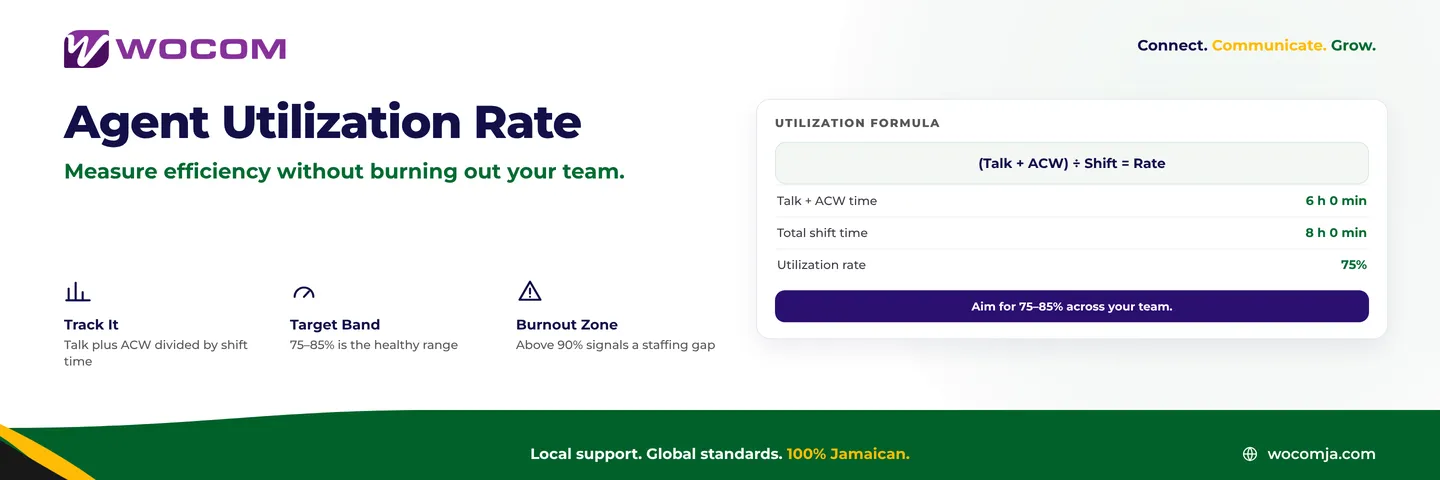
- After-call work (ACW) time controls let you build mandatory recovery windows by queue type. A high-intensity complaints desk can carry a 60-second ACW between calls — enough time to breathe, finish logging, and reset — while a simple enquiry queue runs shorter. If every queue in your system returns agents to ready-state immediately after wrap-up, you are engineering a burnout environment whether you intend to or not.
- Real-time supervisor dashboards that surface hold frequency, mute rate, and transfer rate per agent give team leaders early signals before overall statistics deteriorate. Noticing that an agent has put every caller on hold three or more times in the last hour is actionable. Waiting for CSAT to drop is not.
- Whisper coaching and silent monitoring let supervisors support agents on difficult live calls without the agent feeling exposed. Knowing help is available on a hard call is a stress reducer in itself — agents who feel they are handling everything alone burn out faster.
- Voicemail-to-email routing removes the friction of agents having to chase missed messages between calls — a small but real source of irritation that accumulates across a working week.
Changes You Can Make Starting This Week
You do not need a full contact centre redesign to begin reducing burnout. These five steps can be implemented without a technology upgrade:
- Publish two-week rosters. Agents with predictable schedules carry lower baseline stress. Two weeks of advance notice is achievable in most forecasting cycles and costs you nothing.
- Audit your escalation process by timer. From the moment an agent flags a call as unresolvable, how long before an action is taken? If the honest answer is "a few days," agents are carrying open loops that belong in someone else's queue — and they know it.
- Rotate queue assignments monthly. The complaints desk should not be the same three people every week. Rotation distributes the emotional load and prevents permanent identity lock-in with the hardest calls in your operation.
- Hold a 15-minute team check-in at the start of each week. Not a performance review. A structured space where agents can flag what is difficult before it becomes a pattern. Supervisors who run these consistently retain their teams longer — this is well-documented across the contact centre industry globally.
- Review your ACW configuration by queue today. Pull up your platform settings and check whether your after-call work time reflects the actual emotional weight of each queue. A blanket zero-second ACW is rarely a deliberate choice — it is usually a default nobody changed.
How WOCOM Supports Contact Centre Teams Across Jamaica
WOCOM's cloud PBX and contact centre platform gives Jamaican operations managers the queue controls, supervisor tools, and real-time reporting they need to run an environment that does not grind through its own agents. Skills-based routing, configurable ACW by queue type, per-agent supervisor dashboards, and whisper coaching come standard — not as premium add-ons billed separately.
If you are running a contact centre in Kingston, Montego Bay, or anywhere across Jamaica on a platform that does not give your supervisors early-warning signals at the agent level, a conversation about configuration is worth your time before your next experienced agent walks out.
Agent retention is a contact centre metric. The technology you choose either supports it or actively works against it.
Talk to WOCOM about how your contact centre platform is configured and where it may be adding friction your agents are quietly absorbing. Call us at 876-926-4400 or visit wocomenterprise.com. Our team works with Jamaican contact centres of all sizes — from five-seat internal teams to multi-site operations — and can help you identify the configuration changes that reduce daily stress before it becomes a resignation.
Continue exploring
Ready to upgrade your communications?
Talk to our team about the right solution for your business.
Book a Demo Contact SalesEverett Kildare is WOCOM's voice and infrastructure specialist, with more than 25 years of experience designing and running carrier-grade voice, SIP and virtualization infrastructure. Holding a BSc in Information Technology, he has built, secured and migrated phone systems for businesses of every size. Everett writes WOCOM's technical coverage of SIP trunking, cloud PBX, contact centres, business continuity and migration.