Contact Centre Absenteeism Jamaica: Measure, Benchmark, and Reduce Agent No-Shows
Contact centres run on headcount. When an agent calls in sick — or simply doesn't show up — there is no buffer. Every absent seat means longer queue times, more abandoned calls, and higher occupancy for the agents who did arrive. One missing agent on a ten-person shift can push occupancy from 80% to 90%, wiping out the recovery margin your schedule built in. Multiply that by a Jamaican public holiday that caught your roster off guard, and service levels are collapsing before 9 a.m.
Absenteeism is often treated as an HR problem. In a contact centre it is an operational problem with a measurable cost — and it is fixable once you start tracking the right numbers.
How to Calculate Your Absenteeism Rate
The standard formula is straightforward:
Absenteeism Rate (%) = (Scheduled Hours Lost to Unplanned Absence ÷ Total Scheduled Hours) × 100
If you scheduled 1,000 agent-hours in a month and lost 85 to unplanned no-shows and sick calls, your rate is 8.5%. Track two variants separately:
- Unplanned absenteeism — sick days, no-shows, last-minute personal leave. This is the figure that signals a culture or wellbeing problem.
- Planned absenteeism — approved leave, training days, public holidays. This belongs in your shrinkage calculation but does not indicate a structural issue.
Most cloud contact centre platforms log agent login and logout times against their scheduled shift. Pull the data weekly, not at month end — a monthly report is too slow to catch an emerging pattern before it becomes chronic.
What Is a Healthy Benchmark for a Jamaican Contact Centre?
Industry benchmarks for unplanned contact centre absenteeism typically fall between 5% and 9%. Centres running consistently above 10% are carrying a structural problem — usually a scheduling, culture, or compensation issue — not just a run of bad luck.
Jamaican operations face some specific pressures that push the number higher: public transport reliability across Kingston and Montego Bay, early-morning and overnight shift constraints, and childcare availability on weekends. These are real factors, not excuses — and they point toward specific solutions.
The aggregate monthly rate matters, but the figure that reveals the most is your day-of-week and shift-time breakdown. If Monday absences are consistently 40% higher than mid-week, your agents are building three-day weekends into their attendance pattern. If 5 a.m. shift starts see twice the no-shows of 8 a.m. starts, transport is the root cause, not attitude.
The Common Root Causes
Before investing in incentive programmes or disciplinary procedures, identify what is actually driving absences. The most consistent drivers in Jamaican contact centre environments include:
- Scheduling rigidity — agents with no control over their shift window build informal workarounds. A parent who needs to drop children at school cannot reliably make a 6 a.m. start.
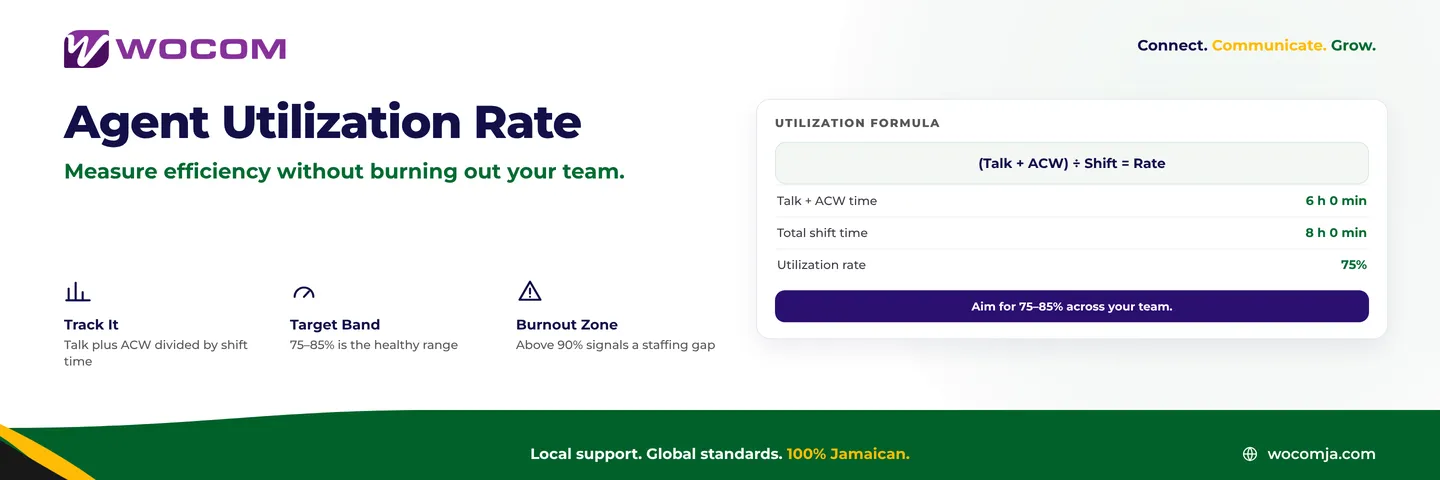
- Sustained high occupancy — when agents spend 85% or more of every shift in active talk time with no breathing room, physical and mental fatigue accumulates fast. Absence is often the first warning sign before full attrition.
- Unrecognised effort — when every call feels the same and results go unacknowledged, motivation erodes. Agents start finding reasons not to come in before they formally resign.
- Commute and transport barriers — one missed bus at 5 a.m. in Kingston has no fallback. Remote or hybrid arrangements eliminate this category of absence entirely for suitable roles.
- Poor tooling and call quality — agents navigating slow systems, broken integrations, or choppy audio burn out faster than those on a well-configured platform. When handling calls is technically hard, every shift feels longer than it is.
Five Operational Fixes That Measurably Reduce No-Shows
1. Introduce shift flexibility where your volumes allow. Offering two or three start-time windows — rather than a single fixed clock-in — dramatically reduces transport-related late arrivals and no-shows. Even a 30-minute window makes a material difference.
2. Keep sustained occupancy below 85%. An occupancy rate of 80–85% is sustainable for a full shift. Anything above that consistently should trigger a staffing review, not a performance conversation. Overworked agents vote with their attendance records.
3. Put real-time queue data in front of every agent. When agents can see queue depth and current service level on a wallboard, they understand the impact of an empty seat. Shared visibility creates shared accountability in a way that policy documents cannot.
4. Pilot remote arrangements for suitable roles. Back-office callbacks, email queues, outbound follow-ups, and overflow coverage can often be handled from home. Agents who can log in remotely when transport or a minor illness makes commuting impractical will call in far less frequently. A cloud contact centre platform makes this possible without hardware investment.
5. Review absence patterns weekly, at the team level. A month-end report is a post-mortem. Weekly reviews by team lead let you spot the spike before it compounds — and intervene with a conversation rather than a formal process.
How Your Contact Centre Platform Affects Absenteeism
The phone system your agents use every day is not a passive tool. A modern cloud contact centre platform gives supervisors capabilities that directly reduce the operational impact of absences — and address some of the root causes:
- Real-time agent status visibility — know exactly who is logged in, on a call, in wrap-up, or absent the moment a shift starts, not 20 minutes later when the queue is already backing up.
- Remote login from any internet-connected device — an agent at home with reliable connectivity can take calls without any hardware change. A sick day that would otherwise be a full absence becomes a partial remote shift for agents who are willing and able.
- Skills-based routing under reduced headcount — when staffing is short, route only priority queues to agents present and temporarily suspend lower-urgency inbound lines rather than letting them drain available capacity across the board.
- Call quality monitoring — identifying agents whose calls are consistently more difficult or unresolved than average lets you spot coaching opportunities before occupancy stress and frustration push them toward chronic absence.
WOCOM's cloud contact centre solution gives operations in Kingston, Montego Bay, and across Jamaica real-time agent visibility, remote-agent capability, skills-based routing, and the reporting tools to track absence patterns alongside call volume and service level data. When a seat goes empty at 8 a.m., your supervisor can re-route within minutes — not hours.
Ready to Get Your Contact Centre Running Tighter?
If unplanned absences are hitting your service levels and you are still managing it with a spreadsheet, it is time to put the right platform under your operation. WOCOM works with Jamaican contact centres to configure cloud systems that give supervisors real-time control, support remote agents, and surface the data that makes workforce decisions evidence-based.
Contact WOCOM today to speak with a contact centre specialist. Call 876-300-WOCOM or visit wocomja.com/contact to schedule a no-obligation consultation.
Continue exploring
Ready to upgrade your communications?
Talk to our team about the right solution for your business.
Book a Demo Contact SalesEverett Kildare is WOCOM's voice and infrastructure specialist, with more than 25 years of experience designing and running carrier-grade voice, SIP and virtualization infrastructure. Holding a BSc in Information Technology, he has built, secured and migrated phone systems for businesses of every size. Everett writes WOCOM's technical coverage of SIP trunking, cloud PBX, contact centres, business continuity and migration.