Call Centre Wallboard Jamaica: The Six Live Numbers Supervisors Should Watch All Day
A Wallboard Is a Set of Triggers, Not a Screensaver
Plenty of Jamaican contact centres have a screen on the wall showing numbers. Far fewer have agreed, in advance, what each number means and what happens when it moves. That is the difference between a dashboard and a wallboard: a dashboard informs, a wallboard triggers action.
This is a practical guide to the six live counters worth watching, what each one really measures, the threshold that should make you act, and the action itself.

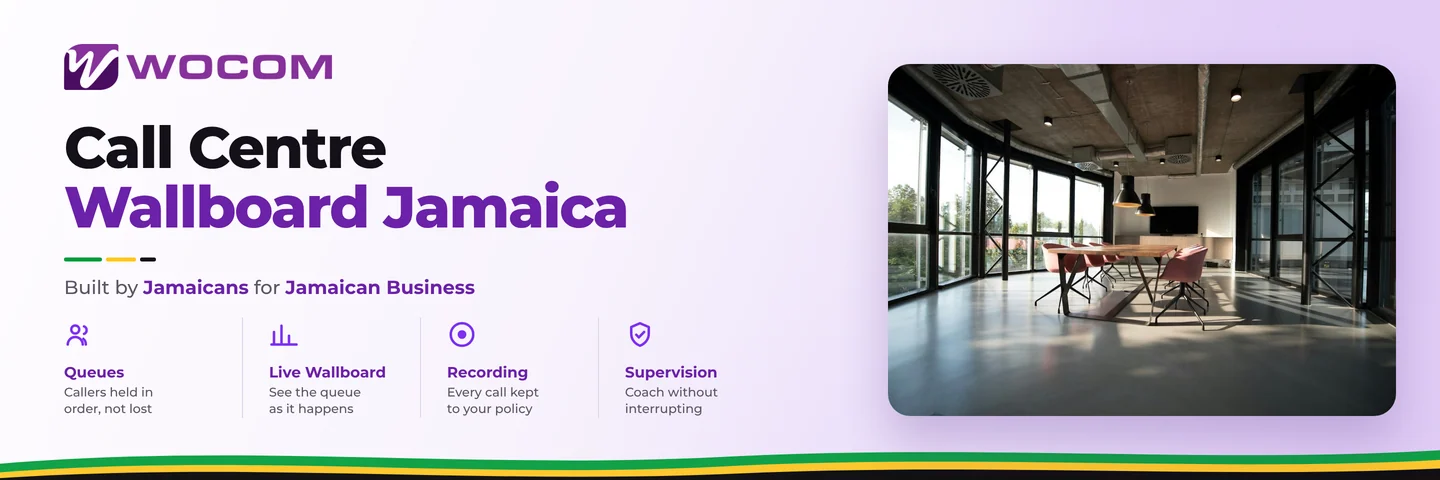
A wallboard sized for a wall: the three numbers that trigger action are large, the running totals sit underneath, and the hourly bars show where the crunch is.
1. Calls Waiting
What it is: how many callers are in the queue this second, not yet connected to anyone.
Why it matters: it is the only metric that is purely predictive. Every other number tells you about calls that already happened. Calls waiting tells you about damage that has not occurred yet.
Threshold: more than one waiting caller per available agent means you are falling behind. Two agents free and five waiting is not a busy moment — it is the start of an abandonment spike.
Action: pull someone into the ring group. In most Jamaican SMEs the reserve capacity is not extra staff — it is staff who are on the phone system but not in the queue: accounts, admin, a branch manager. Adding one extension to a ring group takes seconds.
2. Longest Wait
What it is: how long the caller who has been holding longest has been holding.
Why it matters: averages hide individuals. If nine callers wait ten seconds and one waits six minutes, your average looks excellent and one customer is drafting a review. Longest wait is the number that finds that person.
Threshold: set it against your own tolerance and publish it. Many Jamaican service teams use ninety seconds as the "somebody do something" line.
Action: answer that specific call. Longest wait is the one metric where the correct response is not a policy change but picking up the phone.
3. Agents Available
What it is: how many extensions are registered, logged in and genuinely able to take a call — as the phone system sees it, not as staff report it.
Why it matters: this is where the biggest gap between belief and reality usually sits. Managers routinely believe they have six agents on shift and discover the wallboard sees three, because two are on lunch and one never logged the mobile app back in after a site visit.
Threshold: any time available capacity drops below your rostered headcount, something is wrong that a roster cannot see.
Action: reconcile daily for two weeks. Almost every Jamaican business that does this finds a standing habit — a branch that never registers in the morning, a device that drops after an internet blip — that has been quietly costing calls for months.
4. Serviced vs Abandoned
What it is: a running count of calls handled versus calls where the caller gave up before anyone answered.
Why it matters: abandoned calls are the purest form of lost revenue in a phone business. Nobody complains about them, nobody logs them, and the customer simply goes to the next listing. A high abandoned count next to a healthy serviced count is the signature of a capacity problem at specific times, not a service quality problem.
Threshold: watch the ratio, not the raw number, and watch it by hour. Twenty abandoned calls spread across a day is a different problem from twenty between 12:00 and 1:00.
Action: if abandonment clusters in a window, fix the window — staggered lunch, a second ring group, or an AI receptionist covering overflow so the caller gets an answer instead of a ring tone.
5. Average Wait Time
What it is: mean time from call arrival to answer, usually shown to the second.
Why it matters: it is your headline service level, and the number worth reporting upward. It should be read alongside longest wait — average wait tells you whether the system is healthy, longest wait tells you whether anyone is being failed.
Threshold: a stable average that suddenly doubles is more meaningful than the absolute value. Trend beats target.
Action: when average wait rises while agents available holds steady, the problem is call handling time, not staffing — which points you at metric six.
6. Average Talk Time
What it is: mean duration of connected conversations.
Why it matters: it is the most commonly misused number on any wallboard. Short is not good. An agent averaging ninety seconds may be rushing customers off the line and generating callbacks — which show up later as extra volume nobody attributes to them.
Threshold: look for outliers in both directions and split by call type. Booking calls and complaint calls should not share a target.
Action: pair it with live listening. Talk time tells you which calls to listen to; only listening tells you why.
Reading the Numbers Together
Individually each metric can mislead. Together they form recognisable patterns:
| Pattern | Likely cause | First move |
|---|---|---|
| Calls waiting high, agents available low | Understaffed for the moment | Add extensions to the ring group now |
| Calls waiting high, agents available healthy | Calls not routing where you think | Check ring group membership and time conditions |
| Average wait fine, longest wait terrible | One call falling through a routing gap | Listen to that call; check failover path |
| Abandoned climbing at a fixed hour | Predictable capacity crunch | Stagger breaks or add overflow cover |
| Talk time falling, volume rising | Rushed calls generating callbacks | Live-listen the fastest agents |
Put the Board Where People Can See It
Two practical notes for Jamaican teams. First, a wallboard on a supervisor's laptop is a management tool; a wallboard on a screen the whole team can see is a culture tool — agents self-correct when they can see three people waiting. Second, agree the thresholds in writing before you mount the screen. A number without an agreed response is just a number.
WOCOM's live wallboard is part of Live Call Management on our Cloud PBX platform, alongside the live calls table, agent status board and listen/whisper/barge supervision. Ask for a walkthrough and we will set the thresholds with you.
Continue exploring
Ready to upgrade your communications?
Talk to our team about the right solution for your business.
Book a Demo Contact SalesEverett Kildare is WOCOM's voice and infrastructure specialist, with more than 25 years of experience designing and running carrier-grade voice, SIP and virtualization infrastructure. Holding a BSc in Information Technology, he has built, secured and migrated phone systems for businesses of every size. Everett writes WOCOM's technical coverage of SIP trunking, cloud PBX, contact centres, business continuity and migration.