Breaking a Business Phone Contract Mid-Term in Jamaica: Exit Clauses, Notice Periods and Number Porting
Why Jamaica Businesses End Phone Contracts Before Renewal
Signing a 24-month business phone contract feels straightforward at the time. By month 14, the picture can look very different. The service that worked for a five-person office in Kingston is straining under a team of twenty. The provider you chose has been slow to fix recurring call quality issues. A competing platform is offering meaningfully better capacity at a lower monthly rate.
Many business owners in Jamaica assume there is nothing to be done until the contract expires. That assumption costs them months of paying for a service that no longer fits, and sometimes costs them the motivation to investigate their options at all. The reality is more useful: most commercial telecommunications agreements include exit mechanisms that businesses rarely read until they are frustrated enough to act. Understanding those mechanisms before you approach your provider changes the conversation significantly.
What Your Contract Actually Says About Leaving
Before calling your current provider, locate your original agreement. If you do not have a copy, request one in writing — providers in Jamaica are required to furnish contract terms on request. When you have it, focus on three sections:
- Notice period. Most contracts require 30 to 90 days of written notice before termination. Miss this window and you may be billed for the following quarter automatically, regardless of whether you intended to renew.
- Early termination fee (ETF). This is typically either a flat charge or a percentage of the remaining contract value. Some agreements cap it at three months of service fees; others hold you to the full balance of the term. Know which applies to you before you open negotiations.
- Service-level provisions. Well-drafted contracts include clauses that allow termination without penalty when the provider fails to meet stated uptime or quality thresholds — usually consecutive failures or a defined number of incidents within a rolling period. This is the clause most businesses overlook entirely.
Read the whole document, not just the pricing schedule. The exit mechanism is usually buried in the terms and conditions, not the cover page.
Building Grounds for a Penalty-Free Exit
If your service has been poor, your contract may already give you the right to leave without paying an early termination fee. Before raising the matter formally, gather your evidence:
- Outage logs. Pull your call records and identify periods with no call activity — these may correspond to service outages. Cross-reference any support tickets you opened during those windows.
- Support ticket history. If you have logged recurring faults — dropped calls, one-way audio, SIP registration failures — and those faults were not resolved within the timeframe your agreement specifies, that is documented grounds for escalation.
- Written complaints. Verbal complaints rarely carry contractual weight. If you have not put complaints in writing, do so now by email or ticket, before you initiate a formal exit request. What you write today becomes part of the record.
Present this documentation in a formal letter to your provider's business support team. Request a written response. Many providers in Jamaica will waive the ETF rather than argue a well-documented service failure. The alternative — a formal dispute — is a reputational and administrative cost they prefer to avoid.
Negotiating When You Do Not Have Formal Grounds
If your service has been technically adequate but your business has outgrown it, or you have found a substantially better offer elsewhere, a penalty-free exit is harder to argue. That does not mean negotiation is closed.
These approaches are worth trying:
- Offer a compressed notice period in exchange for a reduced ETF. Providers prefer a quick, resolved closure over a drawn-out dispute. Proposing 30 days' notice plus a portion of the remaining ETF is often accepted — it removes them from the relationship cleanly.
- Explore an upgrade in lieu of exit. If the reason you are leaving is capacity — not enough channels, too few extensions, inadequate features — ask whether upgrading to a higher tier resets your contract on more favourable terms. This keeps you as a customer and may cost less than the termination fee.
- Ask about contract assignment. If your business is merging, relocating or restructuring, you may be able to assign the remaining contract to the acquiring entity rather than terminating it outright. Some providers will accept this with an administrative fee instead of an ETF.
Whatever is agreed, get it in writing before you act. A verbal commitment from a customer service representative is not a binding variation of your contract.
Number Porting: The Step Most Businesses Get Wrong
Your business phone number is a brand asset. If your number appears in print advertising, on vehicles, or has been in use for years across Montego Bay, Kingston or anywhere else in Jamaica, you cannot afford to lose it. This makes porting sequence the most critical operational decision in the whole process.
Never cancel your existing service before your number has been successfully ported.
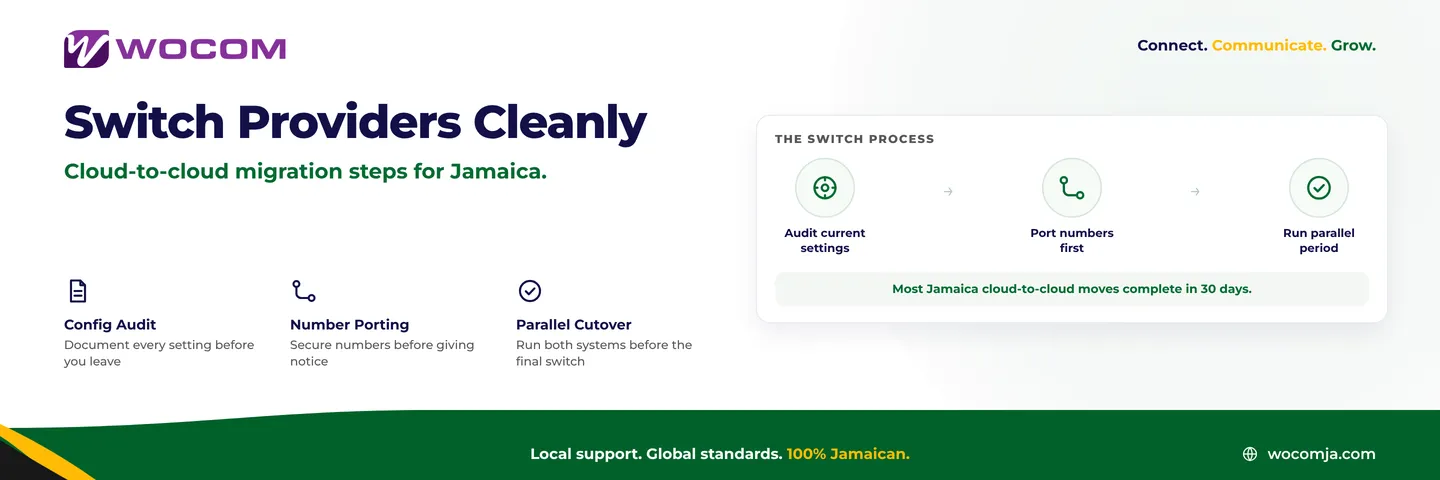
In Jamaica, number portability is managed through a carrier-coordinated process. Your new provider initiates the port — not you. The correct sequence is:
- Sign your agreement with the new provider and confirm they are ready to receive the port.
- Provide your new provider with the number to be ported, the account holder name as it appears on your current account, and your current carrier's account reference.
- Wait for porting confirmation before you do anything else. The process typically takes three to ten business days in Jamaica; large multi-number ports may take longer.
- Once the port is confirmed and calls are routing correctly to the new platform, submit your cancellation notice to the previous provider.
If you cancel first and your old provider deactivates the number before the port completes, that number is gone. Rebuilding brand recognition around a replacement number costs far more than any early termination fee.
Running Both Services in Parallel
For businesses with meaningful call volume, a parallel running period of 20 to 30 days reduces transition risk considerably. During this window, both your old and new systems remain active. Your team can learn the new platform, test call routing and confirm all integrations are working before the final cutover.
Practically, this means:
- Route new inbound calls to the new system while the old platform handles fallback during the transition.
- Test outbound caller ID on the new platform — confirm your business number presents correctly to mobile and landline recipients in Jamaica.
- Verify voicemail delivery, extension dialling and any integrations (CRM, ticketing software, your website's click-to-call button) on the new system before decommissioning the old one.
Yes, you will pay for both services briefly. That is the cost of a clean handover. It is almost always less expensive than a rushed cutover that disrupts customer calls on a Monday morning.
Switching to WOCOM: What the Process Looks Like
WOCOM manages number porting directly as part of the onboarding process. Our team coordinates with your current carrier, tracks the porting timeline and confirms successful routing before you cancel anything. For businesses with multiple numbers — a main line, department DIDs, toll-free numbers — we stage ports in batches to avoid simultaneous disruption across your entire operation.
We also support a parallel running period at no additional setup cost. Your WOCOM system can be live and tested while your existing service remains active, so your staff is familiar and confident before cutover day arrives.
If you are currently in a contract with another provider and want to understand your realistic options, speak with our business team. We will review what you have, explain the porting and exit timeline, and give you an honest picture of how the transition would work for your business — before you commit to anything.
Get in touch with WOCOM at wocomja.com. We work with businesses across Jamaica and handle the coordination so the switch does not fall on your desk.
Continue exploring
Ready to upgrade your communications?
Talk to our team about the right solution for your business.
Book a Demo Contact SalesEverett Kildare is WOCOM's voice and infrastructure specialist, with more than 25 years of experience designing and running carrier-grade voice, SIP and virtualization infrastructure. Holding a BSc in Information Technology, he has built, secured and migrated phone systems for businesses of every size. Everett writes WOCOM's technical coverage of SIP trunking, cloud PBX, contact centres, business continuity and migration.