AI Receptionist Scripts Jamaica: How to Write a Greeting That Converts Callers Into Customers
Your AI Receptionist's First Words Are Your Brand's First Impression
When a customer calls your Kingston or Montego Bay business, the first voice they hear sets the tone for everything that follows. If you've deployed WOCOM's Alex AI receptionist, you've already solved the problem of calls going unanswered. But there's a second problem most businesses overlook: the script Alex reads.
An AI receptionist running a generic, poorly written script sounds robotic and impersonal. One running a well-crafted, brand-aligned script sounds professional, welcoming, and — critically — moves callers toward the right outcome. This guide explains how to write scripts that work.
Why the Script Matters More Than the Technology
The technology behind Alex — natural language processing, intent recognition, intelligent routing — handles the mechanical part of the call. But the words in your script determine three things the technology alone cannot fix:
- Whether the caller stays or hangs up — a confusing or overly long greeting increases hang-up rates before a caller ever reaches anyone
- Whether they reach the right person or department — vague routing options create misdirected calls and frustrated customers
- Whether they perceive your business as competent and trustworthy — tone and phrasing shape that perception within the first ten seconds
In competitive Jamaican markets — medical clinics, legal firms, auto dealerships, freight forwarders — that first impression is the difference between a caller who books and one who calls your competitor instead.
The Anatomy of an Effective AI Receptionist Greeting
A well-structured greeting has four components, each with a specific job:
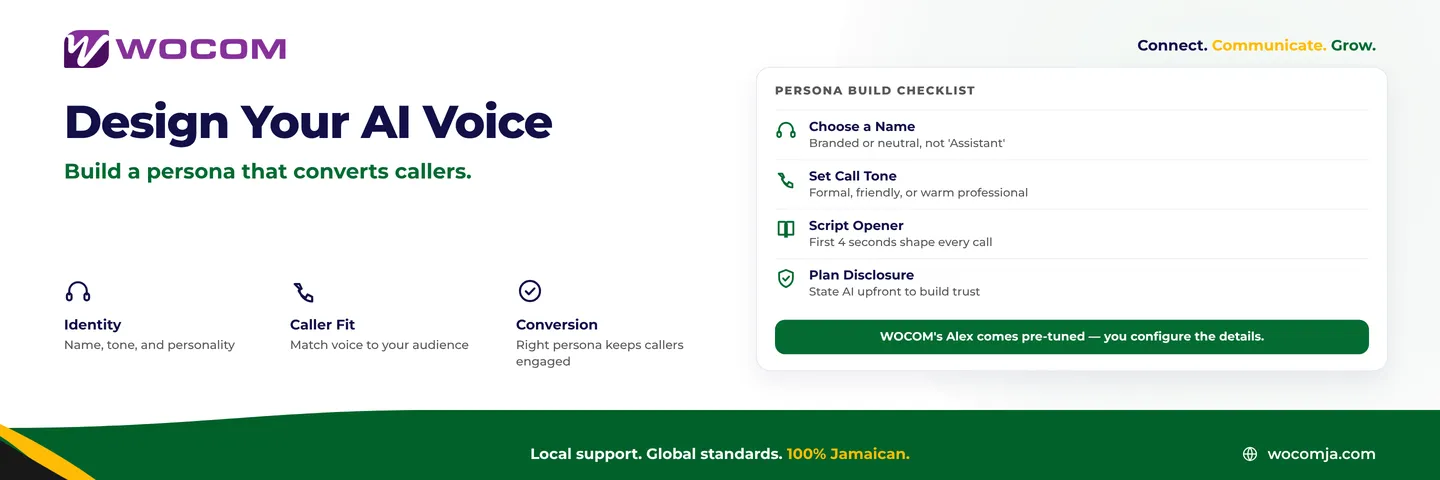
1. The Welcome. State the business name clearly and briefly. Callers already know they dialled you — they don't need a paragraph. Example: "Thank you for calling Riverside Medical Centre."
2. The Availability Signal. Tell the caller immediately that you are ready to help. This reduces anxiety and prevents early hang-ups. Example: "Our team is here to assist you." Avoid opening with "All our agents are currently busy" — you haven't offered help yet, so don't lead with a problem.
3. The Routing Options. Offer no more than four choices. Research consistently shows that menus with five or more options cause callers to forget the earlier ones and either guess incorrectly or abandon the call. Use plain outcome language — not department codes. Say "for appointments", not "for option two, the scheduling department."
4. The Fallback. Always include a way to reach a human or leave a message. This is your safety net for callers who don't fit neatly into your menu, and for customers calling about something unexpected.
Example greeting for a multi-location Jamaica business:
"Thank you for calling Caribbean Auto Parts. To check parts availability, press 1. For orders and delivery, press 2. To reach our Kingston branch directly, press 3. To speak with our team, press 0, or stay on the line and we'll connect you now."
Writing Routing Prompts That Prevent Caller Frustration
The routing menu is where most scripts break down. Businesses list internal department names — "Sales," "Administration," "Accounts" — that mean little to a caller who simply wants to know when their order arrives or whether you carry a specific part.
Write every option from the caller's perspective, not the company's. Ask yourself: what does this person want to accomplish right now? Then name the option after the outcome, not the department.
- Instead of "Press 2 for Accounts" → "Press 2 to make a payment or ask about your invoice"
- Instead of "Press 3 for Sales" → "Press 3 to get a quote or place a new order"
- Instead of "Press 4 for Technical Support" → "Press 4 if you're having a problem with your service"
This single change — caller-outcome language instead of internal-structure language — typically reduces misdirected calls significantly. When callers understand exactly where each option leads, they press the right one the first time.
After-Hours Messages That Do More Than Say "We're Closed"
Most businesses set an after-hours message that says "Our office is closed. Our hours are Monday to Friday, 8am to 5pm." This is a missed opportunity every time.
A caller reaching your business after hours is still a potential customer. Your message should:
- Acknowledge them warmly — they called for a reason, often an urgent one
- Tell them when they can expect a response, not just when you open
- Offer an alternative action: leave a voicemail, send a WhatsApp, visit your website
- If Alex handles after-hours calls autonomously, explain that clearly — "Alex, our AI assistant, can take your message now and our team will follow up first thing in the morning."
Better after-hours example:
"Thanks for calling Island Fresh Catering. We're not in the office right now, but we'd love to hear from you. Leave your name, number, and what you need, and our team will call you back by 9am tomorrow. For urgent event enquiries, WhatsApp us at 876-555-0192."
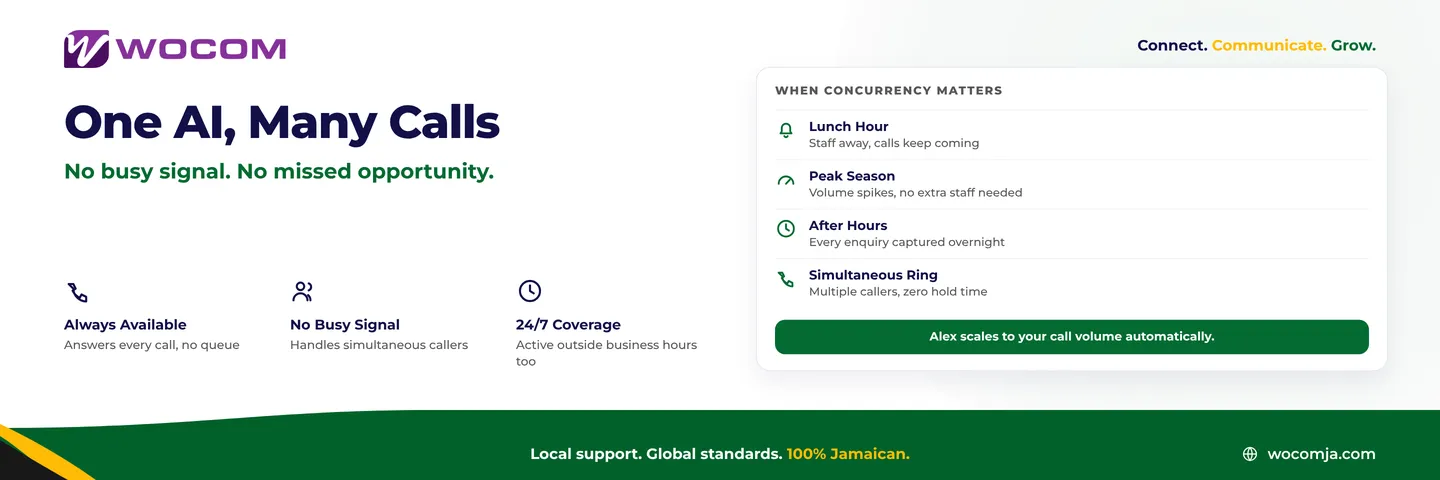
Businesses using Alex's autonomous after-hours handling go further — Alex can confirm an appointment slot, capture a quote request, or log a service enquiry without any human involvement. That means a caller gets a useful response at 11pm on a Sunday night instead of waiting until Monday morning wondering if anyone will call back.
Matching Your Script to Your Brand's Voice
A Kingston financial services firm and a Portmore food distribution company both need AI receptionist scripts — but they should sound nothing alike. Before writing a single word, settle three things:
- Formality level: Formal ("Good morning, thank you for contacting") vs conversational ("Hey, thanks for calling — we've got you")
- Pace: Fast-moving service businesses need short, direct prompts; professional services can afford a slightly warmer, more measured tone
- Personality signals: Use language your customers already associate with your brand. If your team consistently says "we'll sort it out for you," Alex can too
One important note for Jamaican businesses specifically: scripts that reflect local warmth and Caribbean communication norms consistently outperform stiff, corporate templates imported from a US playbook. Callers in Kingston and Montego Bay respond to language that feels genuine and local, not like it was written for a call centre in another country.
Test, Listen, and Revise Before You Move On
Writing the script is not the end of the process. After deploying Alex, do the following within the first two weeks:
- Call your own business number as a customer would — from a mobile, at different times of day, and after hours
- Listen to call recordings and note anywhere callers hesitate, ask "what?" or press the wrong option
- Check your call routing reports — if one menu option gets almost no presses, callers either don't need it or don't understand it
- Revise the script based on what you find, then test again
The businesses that get the most value from Alex are not the ones who set it up and walk away. They treat the script as a living document — updated when services change, when new departments are added, when peak seasons shift call patterns, or when customer feedback reveals a gap. A quarterly review is usually enough to keep it current.
Ready to Set Up Alex for Your Business?
WOCOM's Alex AI receptionist is included at no additional cost with every Cloud PBX plan — but getting the best results starts with a great script. Whether you're setting up Alex for the first time or want a second opinion on the script you already have, our team can walk you through it.
Call WOCOM at 876-926-3738, send us a WhatsApp, or visit wocomja.com to get started. Our team is available Monday to Friday — and Alex is available around the clock.
Continue exploring
Ready to upgrade your communications?
Talk to our team about the right solution for your business.
Book a Demo Contact SalesMichelle Goss is a data and AI analyst at WOCOM, where she studies how Jamaican businesses use voice, messaging and AI to win and keep customers. With a BSc in Data Science & Analytics, she turns call data, customer trends and AI receptionist performance into practical guidance owners can act on. Michelle writes WOCOM's coverage of AI call handling, call analytics, customer growth and industry trends.