AI Receptionist Jamaica: Preparing Your Business Team for Automated Call Handling
The Part Most Business Owners Skip
When Jamaica businesses decide to deploy an AI receptionist, the conversation almost always stays technical. Which calls does the AI handle? What is the routing logic? How does the system recognise business hours?
These are important questions. But they are the second conversation. The first one — the one that actually determines whether your rollout goes smoothly — happens inside your building, not inside any software dashboard.
Staff who do not understand what the AI does will either panic when a call transfers to them unexpectedly, or they will start manually intercepting calls the AI is designed to handle. Either way, the system you deployed stops working as intended. You end up with an AI licence you are paying for and a team that has quietly routed around it.
This guide is for managers and business owners who want to handle that first conversation properly — covering your team briefing, your workflow updates, your customer disclosure, and what to watch in the first two weeks after go-live.
Why Your Team's Reaction Matters as Much as the Technology
Front-line staff — your receptionist, your sales reps, your customer service team — often hear "AI answering the phone" and assume one of two things: their job is at risk, or the AI will make mistakes they will have to clean up.
Both reactions are understandable. Neither is entirely wrong. AI receptionists do change how calls arrive. They filter, qualify, and route. A call that once rang cold on a front desk now arrives at a specific extension with a name, a reason, and sometimes a short summary already captured.
What AI receptionists do not do is eliminate the need for your team. Every call that requires judgement, empathy, a specialist answer, or real account access still reaches a person. What changes is how the call arrives — usually better prepared, which means your team opens conversations from a stronger position.
The briefing your staff need is not a pitch for the technology. It is a clear explanation of what changes, what does not change, and what each person's role looks like the morning after go-live.
How to Run the Team Briefing
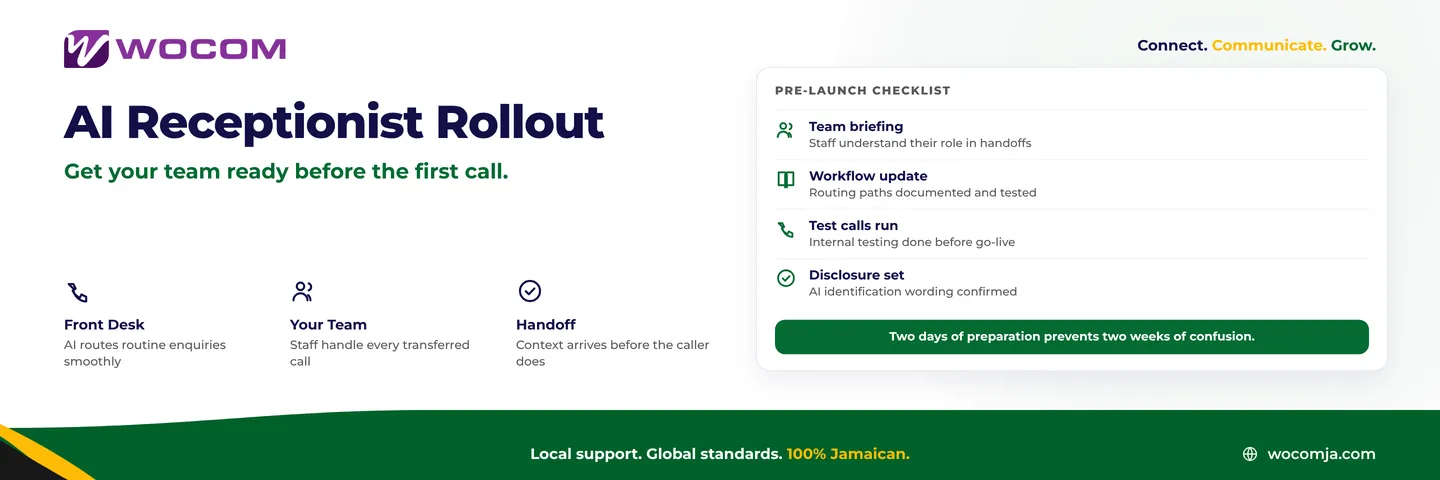
Schedule this meeting before the AI takes its first live call — not after the first complaint. Thirty minutes is enough. Here is the structure that works for most Jamaica businesses:
What the AI handles: Routine enquiries — business hours, directions, basic pricing questions, taking a message when no one is available. It answers the same questions your team answers dozens of times a week without thinking about them. It never tires, never sounds flustered at 8:05 am, and never puts a caller on hold to ask a colleague what the opening time is.
What the AI does not handle: Anything requiring account access, a complaint, a nuanced pricing negotiation, or a question outside its knowledge base. These come straight to staff — usually with a brief summary of why the call is being transferred.
What changes for your team: Calls will arrive with context. The AI will have gathered a name and a reason before transferring. Staff will receive a brief whisper announcement — "Caller is asking about a billing issue" or "New enquiry for fibre installation" — so they can open the conversation informed rather than cold.
What does not change: Responsibility for the customer relationship. Every call the AI passes on is still your team's call to handle well.
For reception staff specifically, address the job security question directly. Businesses that deploy an AI receptionist typically see more calls handled, not fewer staff needed. The AI extends coverage to hours when no one is at the desk — after 5 pm, on public holidays, during lunch when calls previously went unanswered. It does not replace the hours when your team is available and at their best.
Updating Your Internal Workflows for AI Hand-Offs
A briefing without updated procedures creates confusion after go-live. Before the AI takes its first live call, confirm these items are in order:
- Your contact directory is current. The AI routes by department and role. If your sales extension has been forwarding to a personal mobile for three months, fix that now. A bad transfer reflects on the whole experience.
- Staff know what a transferred call looks like. Walk your team through the whisper announcement they will hear. Practice the opening line of the conversation — something like "Good morning, I understand you have a question about your account" — so it sounds natural, not startled.
- You have a documented fallback path. If a transfer goes unanswered, where does the call go? Voicemail? Another extension? The AI returning to take a message? The answer should be set in your configuration and tested — not discovered mid-call by a frustrated customer in Portmore.
- The log review process is assigned. The AI captures names, call reasons, and messages. Who on your team reviews those logs? When? If a caller left a message at 9 pm on a Thursday, what is the expected response time by Friday morning?
What to Tell Your Customers
Jamaica businesses have tested both approaches — proactively announcing the AI and staying quiet. The consensus from businesses in Kingston, Montego Bay, and across the island is clear: transparency builds more trust than discovery.
WOCOM's AI receptionist is configured to identify itself as an AI assistant when a caller asks directly. But you do not need to wait for customers to ask. A simple line on your website or in your on-hold message is enough: "Our calls are initially handled by an AI assistant. Just ask to speak with a team member at any time."
Most callers adapt quickly. What they do not adapt to is feeling deceived. If a regular customer has been chatting warmly with "Michelle" for three months and only then discovers it was an AI, that is a relationship problem — even if every interaction was handled well.
If your business handles sensitive enquiries in areas such as financial services, legal advice, or healthcare, review your disclosure language against current Jamaica Data Protection Act guidance. The principle is consistent across sectors: callers should know they are speaking with an automated system before they share personal information.
Disclosure is not a weakness. In the Jamaican business environment, where trust is built on direct, honest communication, telling customers upfront that an AI will greet them is a stronger position than hoping they never notice.
The First Two Weeks After Go-Live
The calibration period is where good deployments separate from poor ones. Plan to review call recordings daily for the first two weeks. You are listening for:
- Calls that transferred when they should have been handled entirely by the AI — a sign that the knowledge base needs expanding
- Calls where the AI's captured information was incomplete, forcing staff to re-ask questions the caller already answered
- Any repeating question the AI is stumbling on — a prompt or knowledge base update resolves this quickly
- Staff feedback on how transfers are arriving and what additional context would help them open calls more confidently
This review is not micromanagement — it is the same process you would run if you had hired a new receptionist and wanted to confirm they were representing the business well. Most businesses find that the first two weeks surface two or three specific adjustments, after which the system runs stably without daily oversight.
The investment in those first fourteen days pays back in a system that handles calls consistently, frees your team for higher-value work, and gives your business coverage at hours your competitors are simply unavailable.
Get WOCOM AI Working for Your Business
WOCOM's AI receptionist is built for Jamaican businesses — trained on local language and business contexts, connected to your existing phone lines, and designed to hand off to your team with context rather than confusion.
Whether you are deploying AI for the first time or inheriting a system that was never set up with a proper team briefing, the WOCOM team handles the technical configuration and walks you through the go-live process.
Contact WOCOM at 1-888-GO-WOCOM or visit wocomja.com to schedule a consultation. Your team briefing, your workflow review, and your first test call can all happen in the same week.
Continue exploring
Ready to upgrade your communications?
Talk to our team about the right solution for your business.
Book a Demo Contact SalesMichelle Goss is a data and AI analyst at WOCOM, where she studies how Jamaican businesses use voice, messaging and AI to win and keep customers. With a BSc in Data Science & Analytics, she turns call data, customer trends and AI receptionist performance into practical guidance owners can act on. Michelle writes WOCOM's coverage of AI call handling, call analytics, customer growth and industry trends.