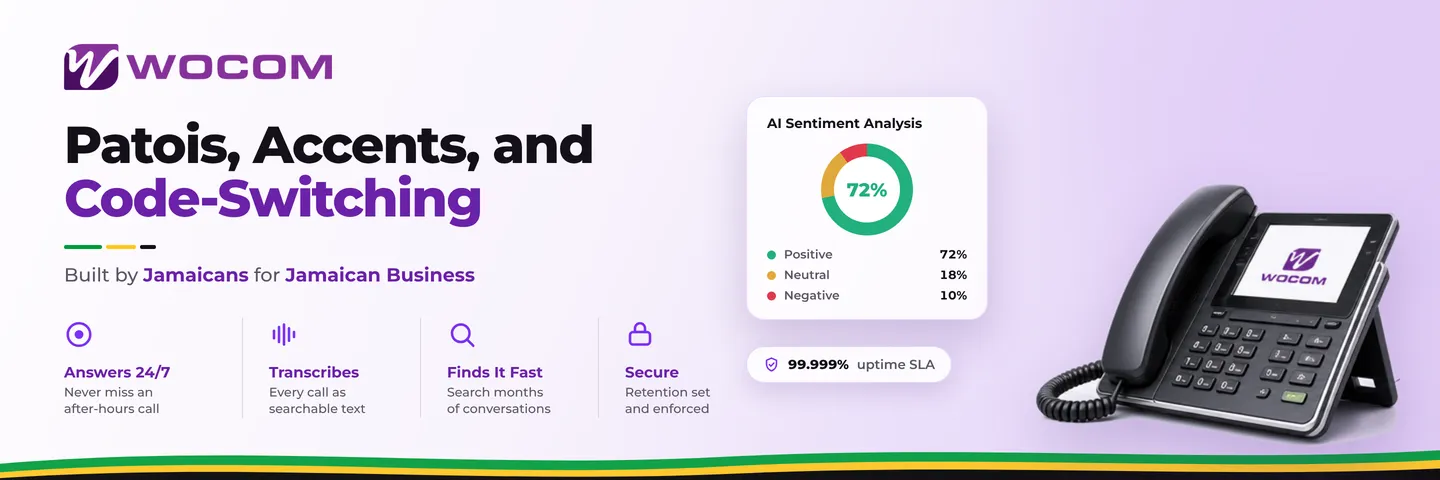
Patois, Accents, and Code-Switching: How AI Receptionists Handle Real Jamaican Callers
When a caller opens with "Mi just want to find out 'bout the plans" or switches between Standard English and Patois mid-sentence, what does your AI receptionist do? For most AI phone solutions built outside the Caribbean, the answer is: it stumbles. It mishears the intent, asks the caller to repeat themselves two or three times, then delivers a generic apology and stalls. That is a poor first impression for any Jamaica business.
Your callers are Jamaican. They speak the way Jamaicans speak — a fluid mix of Jamaican Standard English, Jamaican Patois, and everything in between, shaped by who they are, what they want, and how comfortable they feel. Your AI receptionist needs to meet them there, not force them to adjust to a system built for a different market.
The Reality of Jamaican Business Calls
Code-switching — moving naturally between two languages or registers in a single conversation — is not unusual in Jamaica. It is the norm. A caller might open your AI greeting in formal English, then relax into Patois as they describe their issue. A frustrated customer may drop into heavier dialect. Someone calling on a mobile from a busy street in Half-Way-Tree or New Kingston will clip their words, drop sentence structure, or speak quickly to get through the noise.
Standard AI voice systems designed for the US or UK market are trained on speech data that does not include Caribbean English. When they encounter:
- Dropped articles and simplified sentence structure ("Where the office at?")
- Patois phonology ("wi" for "we", "im" for "him", "fi" for "to")
- Jamaican Standard English vowel patterns and intonation
- Short confirmations like "yeah", "aright", or "true"
- Background noise from traffic, market environments, or a weak data connection
...the result is transcription errors, failed intent matching, or the dreaded repeat loop that drives callers to hang up before the conversation can progress. Each one of those dropped calls is a potential customer who chose not to call back.
How WOCOM's AI Was Designed for Jamaican Speech
WOCOM's AI receptionist — Alex — runs on a speech-to-text model that was benchmarked on real Jamaican caller audio before deployment. When WOCOM evaluated alternative speech recognition models, the testing was done on actual recordings from live calls, not synthetic test data or American-accented samples. The model in production today was chosen because it performs meaningfully better on Caribbean English than the generic alternatives — including systems from large international providers that hallucinate responses on short, clipped inputs common in Jamaican calls.
Beyond the recognition layer, Alex maps caller intent rather than matching literal phrasing. When a caller says "mi just want to know the price" or "how much it cost fi get set up", the system understands this as a pricing intent and responds with the right information. It does not require textbook phrasing to route a call correctly.
The system is also tuned to Jamaican telephone conventions that trip up generic AI systems, including:
- Short confirmations treated as agreement — "Yeah", "true", and "aright" are recognised as positive responses, not as unclear input requiring clarification
- The opening pause — Jamaican callers often wait after the AI greets them before stating their purpose; the system holds the floor rather than interpreting silence as a failed turn
- Informal address — callers who do not give their name immediately are not trapped in a name-collection loop at the top of every call
- Indirect questions — "So it possible to..." and "Mi was wondering if..." are handled as questions, not statements
What Happens When the AI Does Not Understand
No speech recognition system handles every call perfectly, particularly in difficult audio conditions — a poor mobile connection, a speakerphone from a noisy environment, or a caller with a very strong regional accent. What matters is what the AI does next.
When Alex cannot reliably interpret what a caller said, it follows a clear path rather than spiralling:
- One calm clarification request — phrased naturally, not as an error message: "Sorry, I missed that — could you say it one more time?"
- A second attempt using call context — if the caller has already said something earlier in the call, the system uses that context to make a better inference on the second try
- Graceful handoff or message-taking — if understanding still fails, the caller is routed to a human or offered to leave a message; they are never left without a next step
This matters specifically for Jamaican callers. Being asked to repeat yourself once is acceptable. Being trapped in a loop of three, four, or five requests signals that the technology does not respect the caller's speech or their time. That erodes trust in your business before a human has said a single word.
Configuring Your AI Receptionist for Jamaican Callers
Even a well-tuned speech model performs better when the AI is configured thoughtfully for local context. These are the settings and decisions that make the biggest difference for Jamaica businesses:
Keep your AI's questions short and conversational. When the AI asks for information — a name, a callback number, the reason for the call — shorter, plainer questions get more accurate answers. "What's your name, please?" works better than "Could I please take down your full name for our records?" The first phrasing matches how Jamaicans actually respond; the second creates a register mismatch that leads to awkward responses.
Write your knowledge base in plain business English, not formal document language. If your team explains pricing by saying "plans start from $3,500 a month", that phrasing should be in the knowledge base. The AI answers questions with the language it has been given; formal or unusual phrasing in the knowledge base produces unnatural-sounding answers that catch callers off guard.
Review your call transcripts for recurring clarification patterns. When you see the AI repeatedly asking for clarification on a specific term — a service name, a staff member's name, a local landmark used as a reference point — that is the signal to add that term explicitly to the AI's vocabulary. WOCOM's system learns from corrections, and transcript review is how you spot where those corrections are needed.
Test with real callers, not just the business owner. When the owner tests the AI, the scenario is best-case: you know the system, you phrase questions carefully, and you are probably calling from a quiet office. Ask a frontline team member who has not been briefed to call in and behave like a real customer. The gap between those two test calls will tell you exactly what needs refinement before you go live.
Jamaican Context Built Into Every Call
Speech and dialect are only part of what makes a Jamaican business call different. WOCOM's AI is also configured for several other local realities that generic systems miss:
- Seven-digit callback numbers — when a caller provides only seven digits, the AI knows to ask for the area code (876 or 658) rather than storing an incomplete number that your team cannot use
- Caller ID mismatch — in Jamaica, callers frequently ring from a different number than their actual contact number; the AI never assumes the calling number is the right callback number and always confirms
- Jamaica public holidays — the AI knows the Jamaican holiday calendar and will not tell a caller on Heroes Day or Boxing Day that the office is open and staff are available
- Local currency framing — J$ amounts in your knowledge base are handled naturally, without reverting to US dollar conventions that confuse local callers
Get an AI Receptionist That Was Built for Jamaica
Getting a generic international AI system to work reliably for Jamaican callers is a configuration project most businesses do not have the time or technical staff to take on. WOCOM's AI receptionist is calibrated from day one for the Jamaican business environment — the speech patterns, the telephony conventions, the local calendar, and the specific information your callers are looking for.
Contact WOCOM today to arrange a demonstration. You will hear exactly how Alex handles real Jamaican caller scenarios, and our team will walk you through how to configure the system for your business, your team structure, and the callers you serve. Visit wocomja.com or reach out through our contact page to get started.
Continue exploring
Ready to upgrade your communications?
Talk to our team about the right solution for your business.
Book a Demo Contact SalesMichelle Goss is a data and AI analyst at WOCOM, where she studies how Jamaican businesses use voice, messaging and AI to win and keep customers. With a BSc in Data Science & Analytics, she turns call data, customer trends and AI receptionist performance into practical guidance owners can act on. Michelle writes WOCOM's coverage of AI call handling, call analytics, customer growth and industry trends.