AI Receptionist Jamaica: What Your Business Discovers in the First 90 Days
The Activation Is Not the Finish Line
When a Jamaica business goes live with an AI receptionist, the instinct is to treat it as a completed project. The system is answering calls, staff are freed from the phone, and the problem feels solved. What actually happens in the weeks that follow is more nuanced — and far more valuable.
The first 90 days are when AI call handling earns its keep. Callers reveal what they actually want, business rules that looked fine on paper turn out to need adjustment, and the data starts painting a clear picture of where missed opportunities were hiding. Businesses that stay attentive during this window consistently report better outcomes than those that set it and forget it.
Here is what that journey looks like, phase by phase.
Days 1–30: The Calibration Phase
An AI receptionist arrives with a knowledge base built around your business — your hours, your services, your most common call reasons. What it has not yet encountered is the specific way your callers talk. Jamaica callers bring regional phrasing, patois expressions, and habits that vary even across parishes, and the first month surfaces all of them.
What businesses typically discover in this window:
- Call reasons that were never written down. A hardware supplier in Kingston might find that a quarter of early calls are about credit terms or delivery zones — topics that were never formalised as FAQs because staff just handled them from memory. Every gap that shows up in transcripts is an opportunity to close it permanently.
- Phrasing variations that matter. Callers do not say "I would like to report a service fault." They say "my line gone" or "the internet been off from morning." The AI adapts, but the first month reveals the most common local variants so you can confirm the system handles them cleanly rather than asking for clarification repeatedly.
- Routing mismatches. Calls that were expected to land in one department are better handled by another. A property management company in Portmore might discover that most calls labelled "maintenance" are actually billing disputes — and adjust the routing logic accordingly.
The right response to month one is observation and iteration. Review transcripts at least twice a week. Flag calls where the AI asked for clarification more than once, or where a caller ended the call without getting what they needed. Each one is a solvable problem, usually fixed in a single knowledge base update.
Days 31–60: Caller Acceptance and Business Rule Refinements
By the second month, most of your regular callers have met the AI at least once. This is when you get the clearest read on how your specific customer base responds — and it is usually more positive than business owners expect.
Jamaica callers, broadly, care about speed and accuracy far more than about whether the voice is human. What drives call abandonment is hesitation, repeated questions, or an inability to resolve a common need. If calibration in month one was thorough, month two should show steadily improving completion rates.
The business rule refinements that most commonly happen in this period:
- After-hours coverage expansion. Many businesses discover for the first time exactly how many calls arrive outside their operating hours. A medical supply company in Montego Bay receiving thirty after-hours calls a week about stock availability has thirty interactions it was previously losing entirely. The AI can capture a name, number, and query — converting a missed call into a qualified follow-up.
- Transfer threshold tightening. The AI should escalate to a human only when it genuinely cannot help, not as a default for anything moderately complex. Month two is when the escalation rules get refined: what the AI handles alone, what it hands off, and what it handles but flags for follow-up review.
- Schedule and exception updates. Jamaica's public holiday calendar — National Heroes Day, Christmas, Good Friday, and any business-specific closures — needs to be reflected accurately. Mid-operation is exactly when these gaps reveal themselves, and fixing them promptly prevents callers from being told the wrong thing about your availability.
Days 61–90: Measuring Real Impact
By the third month, the data is ready to tell a genuine story. This is when businesses move from qualitative observation to numbers — and where the return on investment stops being theoretical.
The metrics that matter most at this stage:
- Missed call rate. Compare the 90 days before activation with the 90 days after. The reduction in unanswered calls is typically the most dramatic figure — because the AI answers during lunch, between appointments, and after closing without any additional staffing cost.
- Caller resolution rate. What percentage of callers got a useful answer without needing a transfer or callback? A resolution rate above 70% is achievable for businesses with solid knowledge bases and indicates the AI is genuinely handling workload, not just shifting it.
- Lead capture from after-hours calls. This is often the single biggest surprise. Voicemail boxes across Jamaica go unlistened for hours or days. An AI that captures a name, contact number, and call reason in a structured way produces far more actionable leads from the same volume of after-hours enquiries.
- Transfer quality. For calls that do reach a live agent, are they arriving better prepared? Staff frequently report that callers who have spoken to the AI state their needs more clearly — because the AI gathered context before the handoff and the agent received a summary of the interaction.
Common Adjustments by Day 90
No Jamaica business ends up with exactly the configuration it started with, and that is entirely expected. The most common refinements made during the first 90 days include:
- Adding a service or product category that turned out to be a common call driver but was initially overlooked
- Adjusting the AI persona tone — some businesses shift toward warmer, more conversational phrasing; others tighten to something more brisk and efficient, depending on what their callers respond to best
- Changing escalation targets to be more specific — rather than routing all complex calls to a general line, routing technical issues to a technician and billing questions to the accounts team directly
- Expanding the AI's autonomous handling to include topics the business was initially cautious about — such as appointment confirmations, address validation, or queue position updates — once accuracy is confirmed through early transcripts
- Incorporating patois-aware phrasing for common call types, particularly for businesses whose customer base skews toward local residential callers
None of these adjustments represent a failure of initial setup. They represent exactly how a well-deployed AI call system should evolve — shaped by real caller behaviour rather than assumptions made before a single call was answered.
Setting Your Team Up for the Transition
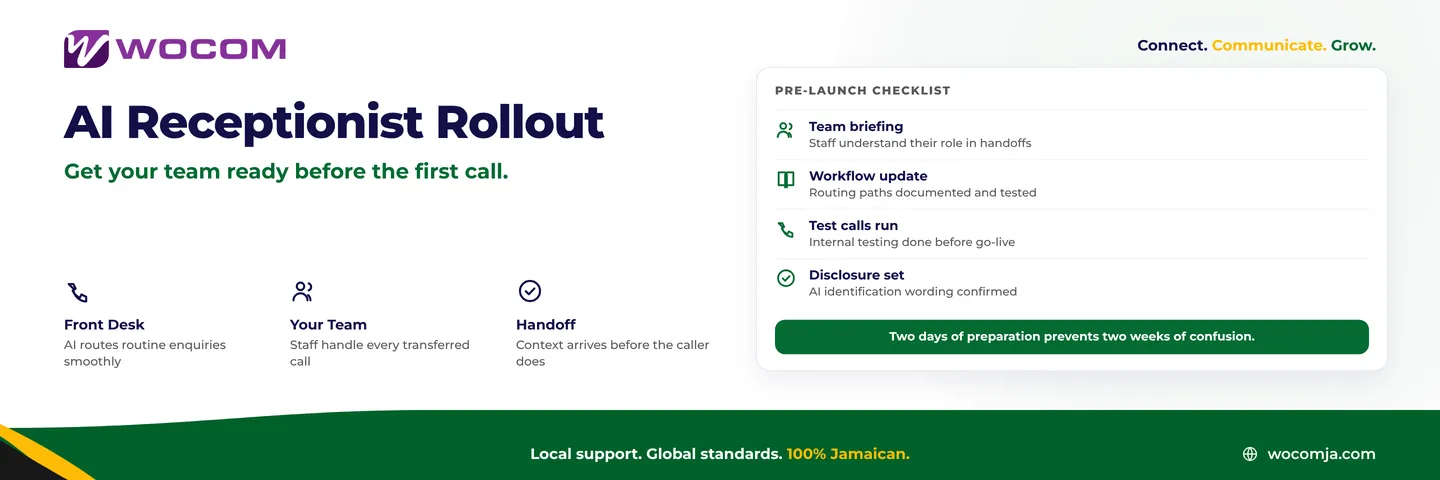
The 90-day adjustment is not only technical. For staff who previously handled every inbound call, the shift requires a recalibration of role and expectation. The businesses that navigate this most smoothly are clear about three things from the start.
First, the AI handles the first layer — not the whole job. Complex complaints, sensitive customer situations, and non-standard requests still flow to a person. That person needs to be ready, not caught off guard by a handover.
Second, call transcripts are a feedback tool for the whole team. Staff who review AI interactions alongside their own calls tend to spot training gaps and phrasing improvements that management would take weeks to identify from above. Treat the transcript log as a shared resource, not a performance monitoring instrument.
Third, the improvement curve does not stop at day 90. Most WOCOM clients see continued gains through months four and five as the AI's knowledge base deepens and the team's comfort with the system grows. The first three months establish the foundation; the real peak performance comes after.
Start Your 90-Day Journey With WOCOM
WOCOM's AI receptionist — Alex — is designed specifically for the Jamaica market. It understands local call patterns, integrates with your existing business phone system, and is supported by a local team that helps you tune and improve performance throughout the early weeks of deployment.
Whether you are evaluating an AI receptionist for the first time or you are already live and want to improve your configuration, our team can review your current call data, identify calibration opportunities, and map out a 90-day optimisation plan built around your business and your callers.
Talk to WOCOM today. Visit wocomja.com/contact or speak with a specialist who can walk you through what the first 90 days would look like for your business specifically.
Continue exploring
Ready to upgrade your communications?
Talk to our team about the right solution for your business.
Book a Demo Contact SalesMichelle Goss is a data and AI analyst at WOCOM, where she studies how Jamaican businesses use voice, messaging and AI to win and keep customers. With a BSc in Data Science & Analytics, she turns call data, customer trends and AI receptionist performance into practical guidance owners can act on. Michelle writes WOCOM's coverage of AI call handling, call analytics, customer growth and industry trends.