Difficult Callers and AI Receptionists: What Actually Happens on Jamaica Business Lines
Any Jamaica business that handles a high volume of inbound calls knows that not every caller arrives ready to cooperate. Angry customers, callers who refuse to give their name, heavy Patois, people who simply want to speak to a human — these are daily realities for front-line staff across Kingston, Montego Bay, and everywhere in between.
One of the most common questions business owners ask before adopting an AI receptionist is: what happens when the call gets difficult? The honest answer is more reassuring than most people expect.
The Angry Caller
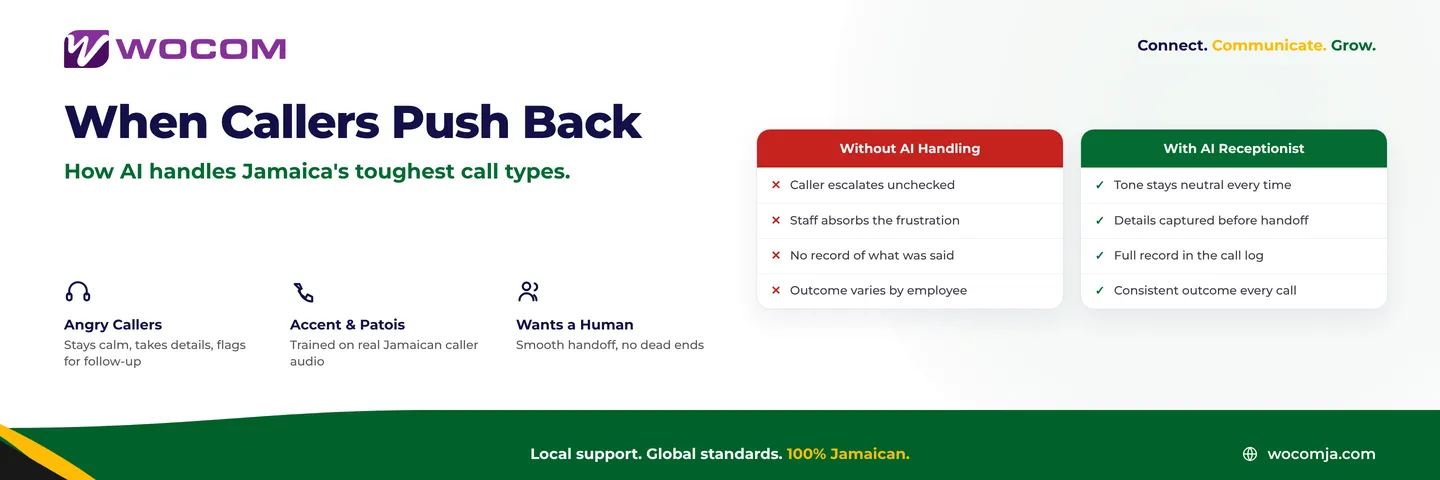
An upset customer calling about a billing dispute, a missed appointment, or a service failure is not going to be immediately soothed by a structured intake form. A human receptionist would match their energy — sometimes well, sometimes not. An AI receptionist does something different: it stays entirely neutral.
The WOCOM AI receptionist does not escalate, get defensive, or stumble when a caller raises their voice. It acknowledges the concern, continues capturing the information needed to get that caller to the right person, and if the business is configured for it, transfers the call immediately with context already noted.
The key design rule is never leave an angry caller in a dead end. A well-configured AI always offers a path forward — take a message, transfer to a live agent, or log a callback request. What it will not do is apologise vaguely and disconnect. The business holds the next step, not the caller.
The Caller Who Will Not Give Their Name
Some callers are cautious. Some are in a hurry. Some have given their name to a business before and had a poor experience with it. When a caller declines to identify themselves, the AI does not push repeatedly — it asks once, notes the outcome, and continues helping.
WOCOM's AI is configured with a strict one-ask maximum for name capture. If the caller does not want to provide their name, the system moves on. The call is still logged, the reason for calling is still recorded, and if a callback number is available from the caller's line, that is noted too. The business owner still gets actionable information; the caller does not feel interrogated.
This matters in Jamaica specifically, where personal privacy and trust are meaningful factors in how customers engage with businesses — particularly new ones. A system that harangues callers for their name before helping them damages the first impression the business is trying to make.
Callers Using Heavy Patois or Regional Speech
Jamaican Patois is not just an accent — it is a distinct language variety with its own phonology, vocabulary, and rhythm. A caller from rural St. Elizabeth sounds different from a caller in New Kingston, and both sound different from a member of the diaspora ringing in from the United Kingdom or Canada.
WOCOM's speech-to-text engine has been benchmarked against actual recordings from the platform and tuned specifically to reduce blank or garbled transcriptions on short, accented utterances. It handles the drawl, the clipped consonants, and the code-switching that characterises real Jamaican caller audio — not the broadcast-neutral English that off-the-shelf models train on.
Where the system is genuinely uncertain — speech that is low-quality, heavily overlapping, or extremely brief — it asks a single clarifying question rather than guessing. One ask, not three. If it still cannot resolve the utterance, it moves to a graceful fallback rather than looping the caller endlessly through the same prompt.
The Caller Who Demands to Speak to a Human
This is the most common difficult-caller scenario, and it is also the easiest to mishandle. A poor AI implementation meets this demand with one of two bad responses: ignoring the request and pressing on with the intake form, or simply disconnecting. Neither is acceptable.
WOCOM AI is configured to recognise the request for a live person at any point in the conversation and respond based on what the business has set up:
- If a live agent is available: the call transfers immediately, with the AI passing along whatever it has already captured — the caller's name, their reason for calling, and their number.
- If no one is available: the AI offers to take a message, provides the expected callback timeframe, and logs everything for an associate to action.
- Outside business hours: the AI says so clearly and does not imply that a transfer is coming when none is possible.
A standing rule across all WOCOM-powered lines: a caller is never sent to a phone number and told to call back themselves. The business reaches out to them. Every difficult call ends with someone on the business side holding the next action.
The Caller Who Is Testing the System
Some callers — particularly after a business has recently launched an AI receptionist — will deliberately try to trip it up. They ask off-topic questions. They claim to be someone they are not. They make leading or inappropriate statements to see how the system responds.
WOCOM AI operates entirely within business scope. It does not speculate, editorialize, or respond to prompts outside its defined purpose. A caller who asks a question unrelated to the business is told politely that the AI handles calls for that company and is redirected. A provocative statement receives a calm, neutral redirect. There is no reaction to bait.
This protects the business's reputation. Every interaction is logged, and business owners can review the transcript. The AI's response to an attempted manipulation is the same on the first call as on the hundredth — consistent in a way no human team member can be expected to match across hundreds of calls a week.
When the Call Cannot Be Resolved by AI Alone
Not every call should be handled end-to-end by an AI receptionist — and a good system knows this. WOCOM AI is designed as a first-response and triage layer, not a substitute for every human interaction. Complex complaints, technical faults requiring live diagnosis, and billing disputes that need account access all have defined escalation paths.
What the AI does in those cases: capture the essential details, confirm the caller's number, set a clear expectation for follow-up, and hand the complete record to the associate who will call back. The associate does not start from zero. The caller does not have to repeat everything. That efficiency — not re-explaining a problem to multiple people — is one of the most consistent pieces of positive feedback businesses receive from their customers after going live.
What This Means for Your Team
When your AI receptionist handles the difficult calls well, your human team benefits in three concrete ways:
- They receive pre-qualified, pre-logged enquiries rather than cold interruptions mid-task
- They are not the first emotional shock absorbers for every frustrated caller who contacts the business
- They spend their time on conversations where a human response genuinely adds value
Staff burnout is real in customer-facing roles across Jamaica. Structuring the inbound call experience so that your people handle the complex and meaningful conversations — rather than fielding every initial frustration — makes a measurable difference in both staff morale and the quality of service your customers receive.
The goal is not to replace human judgment. It is to make sure human judgment is applied where it matters most — not wasted on calls that a well-configured AI can handle with equal or greater consistency.
See How WOCOM AI Handles Your Calls
WOCOM AI is built for Jamaica's business environment — calibrated for local speech, configured for real caller behaviour, and designed to handle the full spectrum of inbound call types without breaking down at the edges. If you are evaluating an AI receptionist for your business, the WOCOM team is happy to walk you through how the system responds to your specific call scenarios before you commit to anything.
Visit wocomja.com/contact to get in touch, or explore the full AI receptionist offering at wocomja.com. A demonstration uses your actual call types — not a generic script.
Continue exploring
Ready to upgrade your communications?
Talk to our team about the right solution for your business.
Book a Demo Contact SalesMichelle Goss is a data and AI analyst at WOCOM, where she studies how Jamaican businesses use voice, messaging and AI to win and keep customers. With a BSc in Data Science & Analytics, she turns call data, customer trends and AI receptionist performance into practical guidance owners can act on. Michelle writes WOCOM's coverage of AI call handling, call analytics, customer growth and industry trends.